Why Every Executive Needs a Go Bag
Executive protection means planning for contingencies most people never consider. With recent global events including the Iran conflict, increasing cyberattacks on infrastructure, extreme weather, and geopolitical instability, personal emergency preparedness matters for everyone, even outside active conflict zones.
If you have to evacuate quickly or shelter in place without normal services, a pre-packed "go bag" holds everything you need to survive and function for 72 hours. Also called a bug-out bag or 72-hour kit, it draws on a military and emergency management concept that we've adapted specifically for executives, UHNW families, and business travelers.
Organized relief or evacuation support typically takes 72 hours to reach you during a major emergency, which makes that window critical. You can face that same gap during a natural disaster, an infrastructure attack, or an escalation in regional conflict.
The AMERINE Go Bag Framework: Five Pillars
We organize go bag contents into five categories. Each serves a clear purpose: keeping you safe, informed, and mobile.
Pillar 1: Documents & Identity
Your identity documents are irreplaceable and often impossible to obtain quickly during an evacuation:
Physical Documents (in waterproof pouch):
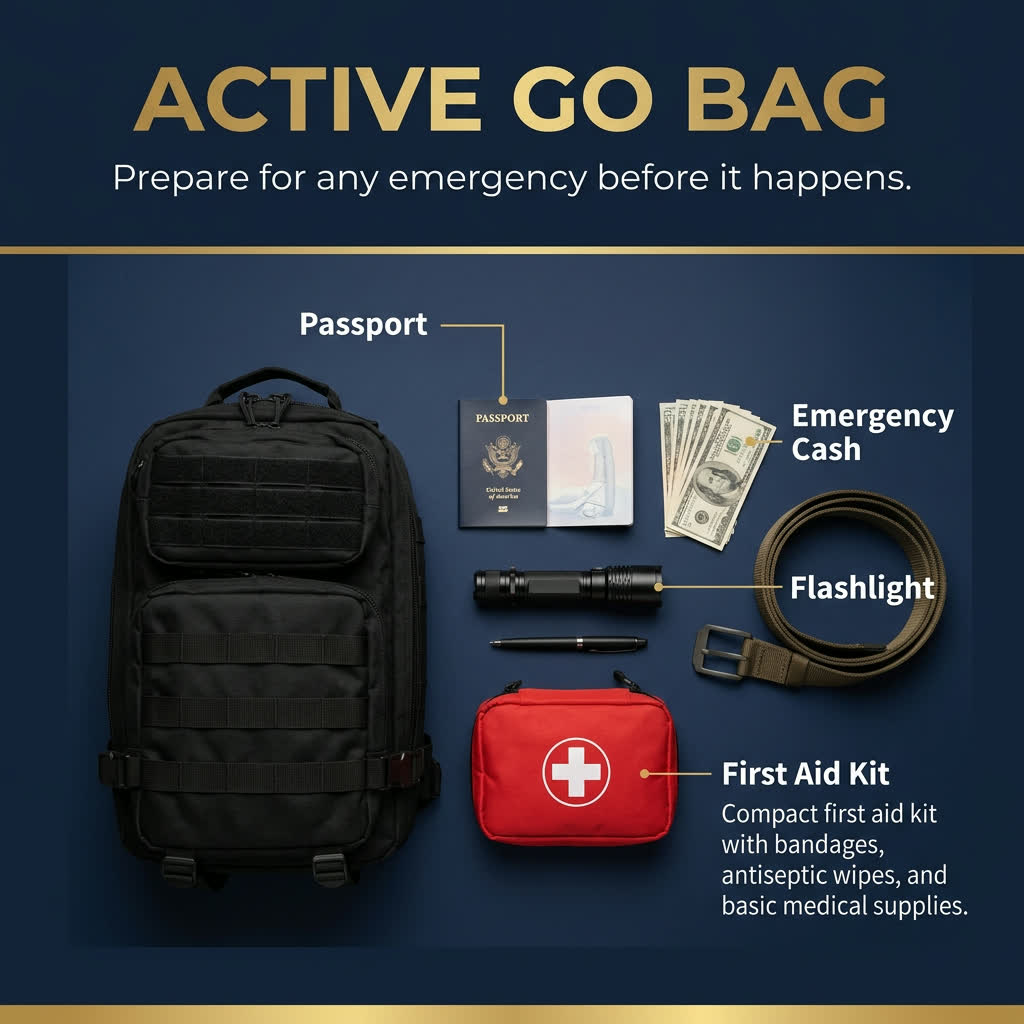
- Passport (and a photocopy stored separately)
- Driver's license
- Printed copies of travel insurance policies
- Emergency contact card with phone numbers, addresses, and account details
- Medical information card: blood type, allergies, medications, doctor contact
- $500-1,000 in cash (mix of USD and local currency if traveling internationally)
- Credit and debit cards from at least two different banks
- Copies of prescriptions for all medications
For digital backups, keep scanned copies of all documents on an encrypted USB drive. Write your password manager credentials on a sealed card and store it separately from your devices. Maintain a cloud backup you can access from any device, and memorize your master login.
Our protection teams recommend photographing the front and back of all documents and emailing the images to a trusted family member or attorney. That leaves someone holding your paperwork if everything else is lost.
Pillar 2: Communication & Power
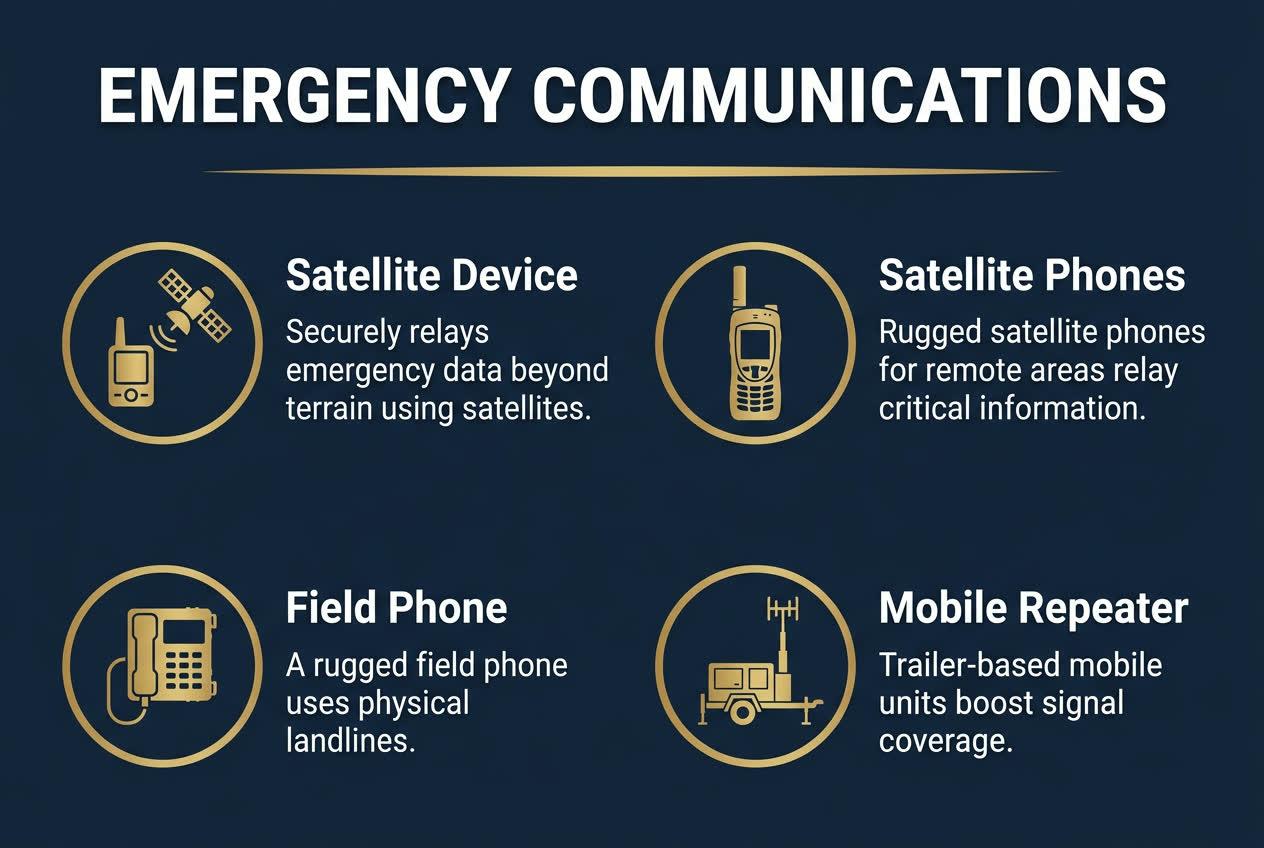
If normal communication infrastructure fails, your options depend on being able to call for help or coordinate with family. Our companion article on emergency communication plans covers the subject in depth.
For essential communications, pack a satellite messenger; we recommend the Garmin inReach Mini 2, which works anywhere on Earth. Include a fully charged portable power bank with a minimum 20,000mAh capacity, enough to charge a phone 4-5 times, plus a secondary power bank with a 10,000mAh minimum. Add a multi-device charging cable for USB-C, Lightning, and Micro-USB, along with a hand-crank or solar emergency radio that receives AM/FM/NOAA Weather. Pack a small Surefire or Streamlight flashlight with extra batteries and a headlamp to keep your hands free, an invaluable feature at night. Include an emergency whistle that's audible up to 1 mile.
For international or conflict zone travel, add an Iridium or Thuraya satellite phone and a foldable portable solar panel rated at 21W minimum. Include a Faraday bag for device protection, plus local SIM cards purchased in advance for your destination country.
Pillar 3: Medical & Health
Your go bag's medical kit needs to cover trauma, minor illness, and ongoing care for chronic conditions. Injuries rarely happen at a convenient time.
Start your first aid supplies with a compact kit; we recommend Adventure Medical Kits Ultralight. Pack personal prescription medications with a minimum 7-day supply, ideally 14, and over-the-counter ibuprofen, acetaminophen, anti-diarrheal, antihistamine, and antacid medications. Include electrolyte packets, with 6-10 packets on hand. For trauma supplies, pack a tourniquet, preferably CAT or SOF-T, and learn how to apply it beforehand; add an Israeli bandage for emergency compression and QuikClot hemostatic gauze. Include nitrile gloves, 4-6 pairs, plus medical tape, adhesive bandages, tweezers, small scissors, and safety pins. Round out the kit with hand sanitizer, antiseptic wipes, insect repellent with DEET, sunscreen rated SPF 50+, and N95 masks, 4-6.
If you take daily medications, keep a dedicated emergency reserve separate from your everyday supply. Bring a signed letter from your physician that details your conditions and active prescriptions; it's especially useful at border checkpoints. Make your medical alert details visible, and wear a medical ID bracelet if you have severe allergies or hidden conditions.
Pillar 4: Water, Food & Survival
You can survive weeks without food, but only days without water. Prioritize hydration:
For water, pack collapsible bottles with 1-2 liters capacity, plus Aquatabs or Katadyn Micropur purification tablets to treat 25+ liters. Include a portable filter such as a LifeStraw or Sawyer Mini. If you're sheltering in place, store at least 1 gallon per person per day for 3 days.
Choose lightweight, high-calorie, non-perishable food: KIND, Clif, or similar energy bars, 6-8 bars; peanut butter packets; and trail mix or nuts, which are calorie-dense and have a long shelf life. Add Mountain House or similar freeze-dried meals, 3-4 meals, and hard candy or glucose tablets for fast energy. Set a recurring calendar alert to rotate food every 6 months.
For survival tools, pack a multi-tool, with Leatherman our recommendation, and Mylar space blankets, 2 minimum. Include 25-50 feet of paracord and a fire-starting kit with waterproof matches, a lighter, and a ferrocerium rod. Save room by wrapping a length of duct tape around a pencil. Add assorted sizes of zip ties, which are endlessly useful, and a compact rain poncho.
Pillar 5: Clothing & Shelter
Pack versatile, durable layers suited to your operating environment:
Pack a complete change of weather-appropriate clothing in a compression sack, plus sturdy walking shoes or boots if you aren't already wearing them. Include a warm mid-layer of packable down or fleece, a rain shell jacket, a hat, and sunglasses. Add extra socks and underwear, 2 pairs each, along with leather work gloves.
If shelter supplies apply to your situation, pack a compact emergency bivy or lightweight tarp and a small pack towel. Include heavy-duty contractor trash bags, which are useful as field-expedient rain gear, ground insulation, or water collection.
Go Bag Selection: Choosing the Right Pack
The bag itself matters. Choose one that:
- Doesn't attract attention: avoid tactical or military-looking bags in urban settings
- Is comfortable for walking: prioritize padded shoulder straps and a waist belt
- Fits airline carry-on requirements: necessary for executive travelers
- Is durable and water-resistant
For urban and business use, we recommend the GoRuck GR1 (26L) or 5.11 Covrt18 2.0. For travel and international use, our picks are the Osprey Farpoint 40 or Mystery Ranch 2-Day Assault. If you need an ultra-compact option, we recommend the Patagonia Black Hole 25L.
The Home Preparedness Extension
A go bag gets you out the door. If you are staying put, your supplies need to stretch further:
At home, stock 1 gallon of water per person per day × 7 days minimum, along with 7-14 days of non-perishable food your family actually eats. Keep a full stock of AA, AAA, C, D, and 9V batteries, plus LED lanterns (2-3), candles, and matches for lighting. For cooking, have a camp stove with fuel or a charcoal grill with extra charcoal. Store garbage bags, toilet paper, and hygiene supplies for 2 weeks, along with food and medications for pets. ATMs and card readers fail when the power drops, so keep $500-1,000 at home. Store copies of all vital documents in a fireproof safe or waterproof container.
Maintenance Schedule
A go bag is only useful if it's current and ready:
| Task | Frequency |
|---|---|
| Check expiration dates on food and medications | Every 6 months |
| Test all electronic devices and replace batteries | Every 3 months |
| Update documents and emergency contacts | Every 6 months |
| Verify cash supply (bills in good condition) | Every 6 months |
| Rotate seasonal clothing | Every season change |
| Full inventory check | Annually |
| Practice grab-and-go drill with family | Every 6 months |
What Most People Forget
After years of preparing executive clients for contingencies, here are the items people most commonly overlook:
- Prescription glasses/contacts, a spare pair is essential
- Feminine hygiene products, for any women in your group
- Children's comfort items, one small toy or stuffed animal reduces stress enormously
- Pet supplies, food, leash, vaccination records
- Local maps, printed, not digital. GPS requires power and satellite access
- Cash in small denominations, making change is impossible in emergencies
- Photocopies of keys, house, car, office (yes, you can copy most keys from a photo)
- Entertainment, a deck of cards or small book. Waiting is the hardest part of any emergency
- Morale items, photos of family, a letter, something that keeps your mindset positive
The Executive Difference
The gear itself rarely distinguishes an executive go bag from a standard emergency kit. The difference is how you plan around that gear.
- Your executive assistant should know where your go bag is stored and what is inside.
- Your family should have matching go bags at home, pre-packed and maintained.
- Your protection team (if you have one) should coordinate their kits with yours to avoid redundancy.
- Your travel go bag should be a smaller subset that stays in your carry-on luggage.
- Your vehicle should contain a secondary kit that remains in the trunk year-round.
Being prepared means knowing you're ready for anything, rather than expecting the worst. The executives we protect understand that spending 30 minutes preparing today can make the difference between a manageable inconvenience and a genuine crisis.
AMERINE Executive Logistics offers tailored security assessments for executives and UHNW families looking to develop a comprehensive personal security and preparedness plan. Those assessments include emergency preparedness planning, go bag consultation, and family communication protocols.
Schedule a confidential consultation with our team.