The Current Threat Picture: Why Mexico Is Different Now
Mexico’s security situation has changed dramatically. The Sinaloa Cartel, Jalisco New Generation Cartel (CJNG), Gulf Cartel, and other drug cartels have moved beyond fighting each other for territory: they now directly target American citizens for kidnapping-for-ransom, express kidnapping, carjacking, and violent robbery. Recent headlines reveal a clear pattern of cartel operatives specifically identifying Americans at border crossings, airports, resorts, and business districts.
Multiple Mexican states currently carry U.S. State Department Level 4 "Do Not Travel" advisories, including Tamaulipas, Sinaloa, Colima, Guerrero, Michoacán, and Zacatecas. Significant security incidents involving foreign nationals have also occurred in states under Level 2 or Level 3 advisories, including Quintana Roo (Cancún), Jalisco (Guadalajara), and Baja California.
Key risk factors for Americans in Mexico:
- Targeted kidnapping operations focused on perceived wealthy foreigners
- Express kidnappings at ATMs, ride-share pickups, and hotel exits
- Cartel checkpoints on highways between major cities
- Corruption within local law enforcement, leading to unreliable emergency response
- Fentanyl trade disputes spilling into tourist and commercial corridors
- Criminal organizations monitoring social media to track travel posts in real time
Before You Go: Pre-Trip Security Planning
When business, family obligations, or personal matters require you to travel to Mexico, your security starts with planning. Travelers’ single biggest mistake is skipping that work.
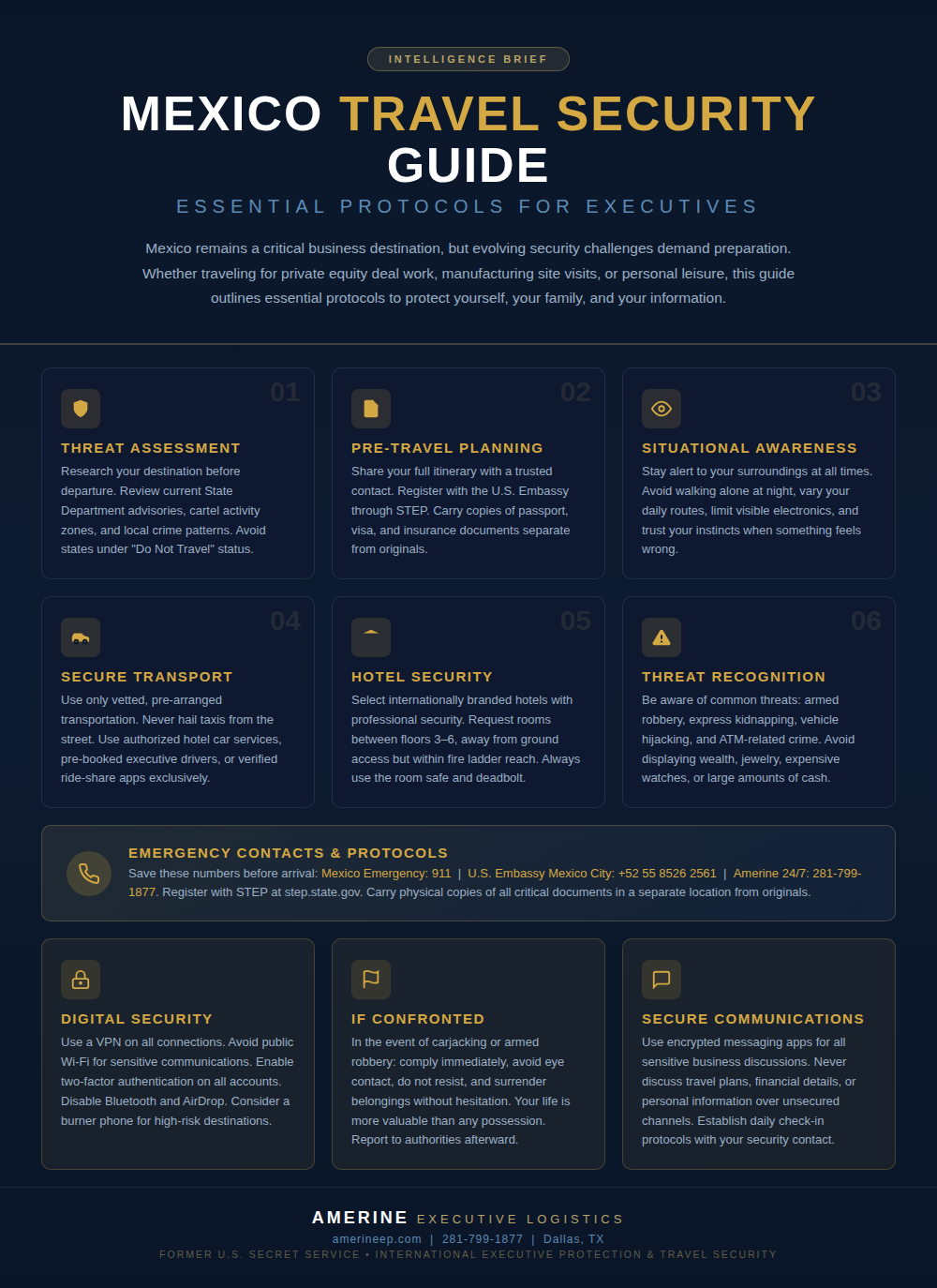
Conduct a Threat Assessment
Research your specific destination before you book flights. Mérida and Culiacán have vastly different conditions. Check the U.S. State Department's country-specific information, read OSAC (Overseas Security Advisory Council) reports, and consult a professional security firm with on-the-ground intelligence in Mexico.
Register with STEP
Through the U.S. Embassy, enroll in the Smart Traveler Enrollment Program (STEP). Enrollment ensures you get real-time security alerts and helps the U.S. government find you during an emergency.
Establish a Communication Protocol
- Share your complete itinerary with a trusted contact stateside.
- Establish check-in times (for example, every 4 hours during waking hours).
- Agree on a duress code: a specific word or phrase that signals you are in danger.
- Download encrypted communication apps (Signal, WhatsApp) and verify they work on your device.
- Store emergency contacts, including the U.S. Embassy in Mexico City (+52 55 5080 2000) and the nearest consulate.
Secure Your Digital Footprint
- Do NOT post travel plans or real-time location updates on social media.
- Use a VPN on all devices.
- Consider traveling with a burner phone and leaving your primary device at home.
- Disable location services on social media apps.
- Remove any visible indicators of wealth from your online profiles before travel.
Arrange Secure Transportation in Advance
Arrange all ground transportation with vetted providers before you land; never leave it to figure out on arrival. At AMERINE, we coordinate secure transportation throughout Mexico with protective drivers who handle route intelligence, advance work, and real-time monitoring. Treat this as a baseline security measure rather than an optional convenience.
While You're There: In-Country Security Protocols
Ground Transportation Safety
Most security incidents happen on the road. The operating rules are simple:
- Never hail taxis off the street. Use only pre-arranged, vetted transportation.
- Avoid ride-share apps in high-risk areas; cartel members have been known to pose as drivers.
- Do not drive between cities after dark under any circumstances.
- If you must drive, stick to toll roads (cuotas) rather than free highways (libres).
- Keep windows up and doors locked at all times.
- Keep the gas tank full, and never let it drop below half.
Hotel and Accommodation Security
- Book rooms at internationally recognized hotel chains with dedicated, professional security setups.
- Request a room between the 3rd and 6th floors: high enough to deter ground-level entry, but within reach of local fire equipment.
- Locate all emergency exit routes as soon as you check in.
- Lock your passport, cash, and backup devices in the room safe.
- Never open the door to unexpected visitors without verifying their identity through the front desk first.
- Turn down ground-floor rooms with accessible windows or street-facing balconies.
Situational Awareness
Basic awareness costs nothing, but it remains your most reliable defense:
- Stay alert in transitional spaces, including parking garages, hotel lobbies, elevators, and the sidewalks beside your vehicle.
- Notice who is watching you. Trust your instincts when something feels wrong.
- Leave expensive watches, jewelry, and prominent electronics out of sight.
- Dress to blend into the local environment, avoiding clothes that mark you as an obvious American tourist.
- Learn essential Spanish phrases for emergencies.
- Know the exact location of the nearest hospital, police station, and U.S. Consulate at all times.
- Steer clear of political demonstrations, large crowds, and nightlife corridors in high-risk zones.
If You Encounter a Cartel Checkpoint
Illegal checkpoints operated by cartel members are a documented reality on many Mexican highways. If stopped:
- Remain calm and comply with instructions.
- Do not attempt to flee or turn around; doing so can trigger a violent response.
- Keep both hands visible at all times.
- Answer questions directly and briefly without offering unsolicited details.
- Never fight back if they take your possessions. Valuables are replaceable, your life is not.
- Report the encounter to your security team and the U.S. Consulate as soon as you are safely clear.
Your Options If You Must Travel
Option 1: Executive Protection Detail
A trained executive protection team offers the highest degree of safety if you’re a high-net-worth individual, a corporate executive, or anyone traveling to a high-risk area. Here’s what a typical detail includes:
- Advance work and route planning
- Armed or unarmed close protection agents, depending on the legal framework
- Secure vehicle with a trained protective driver
- Operations center monitoring your movement
- Emergency extraction capability
Our Mexico teams at AMERINE include vetted professionals whose backgrounds span the military, law enforcement, and intelligence. They have a firsthand understanding of local cartel operations.
Option 2: Secure Transportation Only
If a full protective detail is not feasible, arrange secure transportation with a vetted provider at minimum. This covers:
- Background-checked, professionally trained drivers
- Vehicles equipped with communication and tracking systems
- Pre-planned primary and alternate routes
- Real-time monitoring by an operations center
Option 3: Virtual Security Support
For lower-risk regions, virtual security support provides remote oversight:
- Pre-trip intelligence briefings on your destination
- Real-time monitoring of your location via a tracking app
- Check-in protocols managed by an operations center
- Emergency response coordination if an incident occurs
- Evacuation planning and medical coordination
Option 4: Postpone or Cancel
Postpone your Mexico trip if it isn’t essential. Your life is worth more than any business meeting, vacation, or event. Keep monitoring the situation and reassessing regularly, since security conditions can change dramatically within weeks.
What to Do in an Emergency
If You Are Being Followed
- Do not return to your hotel or residence.
- Drive directly to the nearest police station, military checkpoint, or well-lit public area with active security.
- Call your security team or the U.S. Embassy immediately.
- If possible, note the vehicle description and the number of occupants.
If You Are Kidnapped
- Remain calm. The first minutes are the most dangerous.
- Do not resist physically unless your life is in immediate danger.
- Memorize details: voices, sounds, elapsed time, and direction of travel.
- Comply with instructions while watching for safe opportunities to communicate.
- Your pre-established duress code and check-in protocol will trigger your emergency contacts.
Medical Emergencies
- Carry a card listing your blood type, allergies, and emergency contacts in both English and Spanish.
- Know the location of the nearest private hospital, as public facilities may be overwhelmed.
- Consider medical evacuation insurance. Companies like Global Rescue or International SOS can coordinate air evacuation to U.S. facilities.
The Bottom Line
For millions of Americans, Mexico means extraordinary culture, vital commerce, and deep personal connections. Its security conditions still require more preparation than most travelers are accustomed to.
Planning, awareness, and professional support can’t wait until you need them. Having them in place beforehand is what separates a safe trip from a catastrophic one.
Planning a Mexico trip and want to discuss your specific situation? AMERINE offers confidential threat assessments, secure transportation, executive protection, and monitoring for individuals and corporate groups operating throughout Mexico and Latin America. Don’t leave safety to chance.