Why Student Security Abroad Matters More Than Ever
A study abroad program can be among a young person's most valuable experiences, exposing them to cultures, languages, and perspectives that shape their career and worldview. It also puts young adults in unfamiliar settings with unfamiliar risks, often while they're living independently for the first time.
Each year, the U.S. State Department reports dozens of serious incidents involving American students abroad, from petty theft to kidnapping. Universities have a legal duty of care, yet their resources are often stretched thin. If you're a parent thousands of miles away, you have limited visibility into your child's daily safety.
Use this guidance if your family is considering or preparing for study abroad programs, or if your university is looking to strengthen its student safety frameworks.
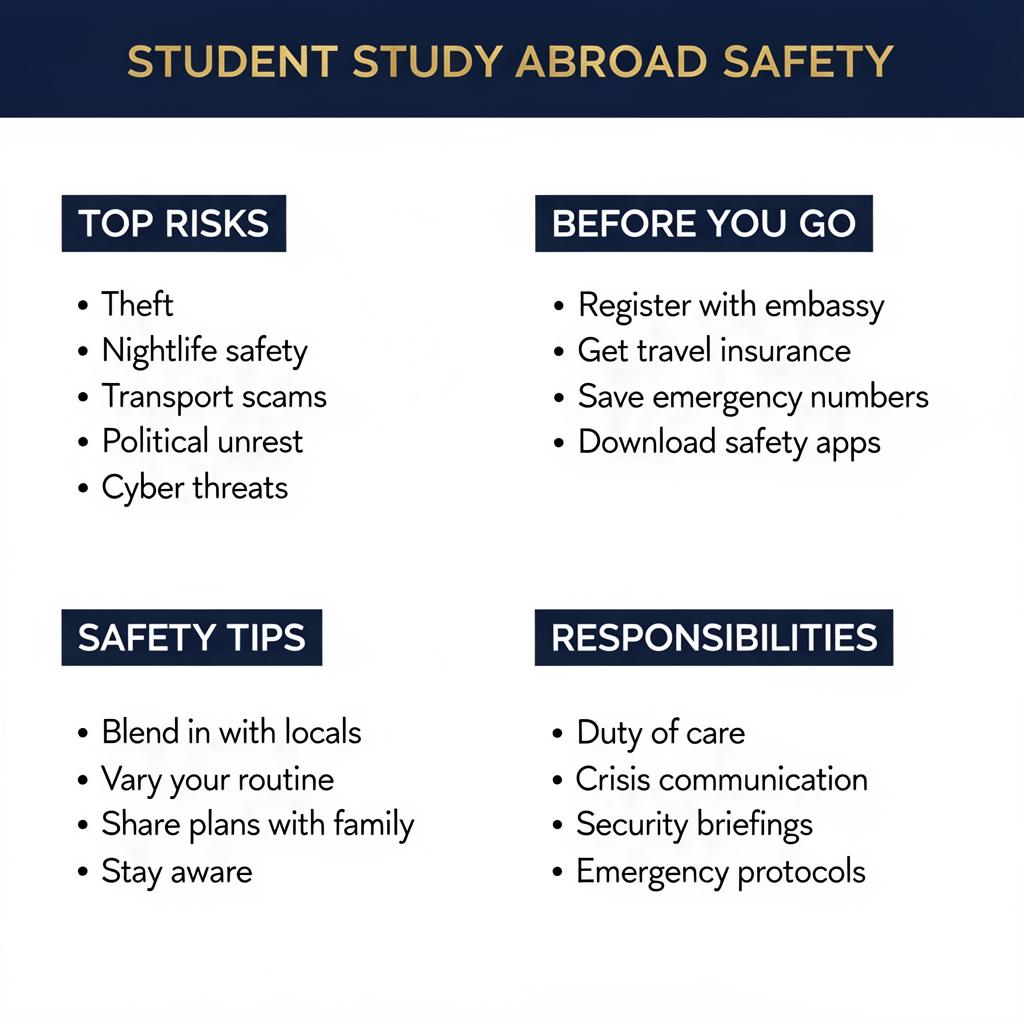
The Top Security Risks for Students Abroad
1. Petty Theft and Pickpocketing
Students overseas face this security problem more often than any other. Rome, Barcelona, Paris, and Buenos Aires are among the major destination cities that are global hotspots for pickpocketing. Students make easy targets because they:
- Carry expensive electronics, such as phones, laptops, and cameras
- Look visibly foreign and are frequently distracted
- Frequent tourist corridors and crowded transit hubs
- Often carry all their identity documents in one bag
2. Nightlife and Social Safety
Students abroad often encounter social environments far more permissive than what they know back home. Notable risks include:
- Drink spiking and drug-facilitated assault
- Unfamiliar alcohol laws and local drinking cultures
- Walking alone at night through unfamiliar neighborhoods
- Meeting strangers from dating apps without knowing the local area
3. Transportation Risks
Moving around an unfamiliar country brings specific hazards:
- Unlicensed taxi drivers and fare scams
- Motorbike accidents, a leading cause of injury overseas
- Unfamiliar road conditions and local driving customs
- Public transit safety issues in specific cities
4. Political Unrest and Civil Disturbance
Students can easily stumble into complex local conflicts:
- Demonstrations and rallies that turn violent
- Transit disruptions caused by labor strikes
- Political hostility directed at foreigners
- Rapidly deteriorating security conditions
5. Cyber Threats
Personal digital security is routinely ignored on the road:
- Unsecured public Wi-Fi networks that expose personal data
- Social media updates that broadcast locations and daily routines
- Phone theft and SIM swapping that lead directly to identity theft
- Electronic surveillance in certain countries
6. Health and Medical Emergencies
Local healthcare capabilities and standards vary widely from one country to the next:
- Language barriers during emergency care
- Difficulties securing specific prescription medications
- Mental health crises occurring far from family and friends
- Exposure to illnesses uncommon in the U.S.
Before Departure: The Safety Preparation Checklist
For Students
- Register with the U.S. State Department's Smart Traveler Enrollment Program (STEP)
- Save the address and emergency number for the nearest U.S. Embassy or Consulate
- Make copies of your passport, visa, insurance cards, and prescriptions. Store them both digitally and physically
- Download offline maps and translation apps for your destination
- Look up local emergency numbers for police, ambulance, and fire
- Install a VPN on all devices before departure
- Locate the nearest hospital and pharmacy to your housing
- Learn basic phrases in the local language: "help," "police," "hospital," "embassy"
For Parents
- Establish a regular check-in schedule, like a daily text or weekly call
- Set up phone location sharing with your student's consent
- Research the destination's current security situation
- Confirm comprehensive travel insurance coverage, including medical evacuation
- Keep the university's emergency protocols and 24/7 contact numbers on hand
- Put together a family emergency communication plan with designated contacts
- Keep accessible copies of all travel documents
For Universities
- Run pre-departure safety orientations with scenario-based training
- Provide destination-specific security briefings
- Maintain an emergency hotline staffed by trained responders
- Vet all housing, transportation, and excursion providers
- Establish clear incident response protocols
- Build relationships with local security and medical providers
- Carry appropriate insurance and review liability exposure
On-the-Ground Safety Practices
Daily Security Habits
- Vary your daily routine. Don't take the same route at the same time every day.
- Keep a low profile: avoid wearing university logos, expensive jewelry, or American flag apparel.
- Carry only what you need for the day. Leave passport copies in secure housing.
- Stay aware of your surroundings, especially in crowded areas.
- Trust your instincts. If something feels wrong, leave immediately.
- Always have a charged phone with emergency numbers saved.
Housing Security
- Verify that your housing has functioning locks on doors and windows.
- Don't share your address on social media.
- Know your neighbors and establish trusted contacts.
- Keep valuables in a portable safe or hidden location.
- Ensure you have a clear exit route in case of emergency.
Social Safety
- Go out in groups, especially at night.
- Designate a sober companion for social events.
- Never leave drinks unattended.
- Share your plans with roommates or friends before going out.
- Use only licensed, verified transportation to get home.
- Avoid sharing personal details with strangers.
Digital Security
- Use a VPN on all devices, especially on public Wi-Fi.
- Enable two-factor authentication on all accounts.
- Be cautious about what you post on social media, and avoid real-time location sharing.
- Back up important documents to secure cloud storage.
- Be wary of public charging stations: use your own cable and adapter.
What to Do in an Emergency
Immediate Steps
- Get to a safe location: your housing, a public building, or a police station.
- Contact local emergency services. Know these numbers before you need them.
- Call your university's 24/7 emergency line.
- Reach out to the nearest U.S. Embassy or Consulate.
- Contact your family through your predetermined communication plan.
- Document everything: photos, notes, and police report numbers.
If You're a Victim of Crime
- Report to local police immediately and get a written report.
- Contact your program coordinator and university.
- Notify the U.S. Embassy. Staff can assist with passport replacement, legal referrals, and victim assistance.
- Seek medical attention if needed, even if injuries seem minor.
- Contact your insurance provider.
- Preserve evidence and document all details while your memory is fresh.
During Civil Unrest or Political Crisis
- Stay indoors and away from windows.
- Avoid protest areas and government buildings.
- Monitor local news and embassy alerts.
- Follow university evacuation instructions if issued.
- Keep your passport and emergency documents accessible.
- Be prepared to shelter in place for extended periods.
The Parent's Role: Support Without Helicopter Parenting
Balancing safety with independence takes discipline. Students need autonomy to grow, but parents can still provide a safety net:
- Agree on communication expectations before departure: establish what counts as a routine check-in versus an emergency.
- Resist the urge to track every movement; trust the preparation you did together.
- Learn about the destination so your concerns are proportional to actual risks.
- Know when to escalate: if you cannot reach your student for 24+ hours, contact the program.
- Connect with other parents in the program for mutual support and information sharing.
University Duty of Care
Universities sponsoring study abroad programs carry significant legal obligations:
- They must provide reasonable safety measures proportional to known risks
- Pre-departure training should cover practical safety skills alongside cultural orientation
- On-site staff should be trained in crisis response and emergency management
- Housing and excursion providers must be vetted for safety standards
- Incident response plans should be tested annually with tabletop exercises
- Communication systems must reach all students within minutes during a crisis
How Professional Security Services Help
A student's profile, the destination's threat level, or specific intelligence can put a family at elevated risk. For families facing those risks, professional security services provide:
- Pre-departure security briefings tailored to the specific destination and program
- Secure airport transfers and coordinated ground transportation
- Low-profile protective accompaniment for high-risk destinations
- Monitoring and rapid response capabilities
- Crisis extraction planning and evacuation coordination
- Regular security situation updates throughout the program
When to Consider Professional Security
- Your student is traveling to a Tier 3 or 4 risk destination
- Your family has a public profile that could attract attention
- The program includes independent travel or remote excursions
- You have specific threat information or concerns
- Your student has medical conditions requiring specialized emergency planning
Making Study Abroad Safe and Transformative
With proper preparation, study abroad will be what it should be: one of the best experiences of a young person's life. Eliminating all risk isn't possible, and doing so would defeat the purpose of going. Sound planning instead brings foreseeable risks down to acceptable levels and ensures everyone knows what to do when things don't go as expected.
For a confidential consultation about student security services, Contact AMERINE. We work with families and universities to set up practical safety frameworks that protect students and preserve the transformative nature of international education.