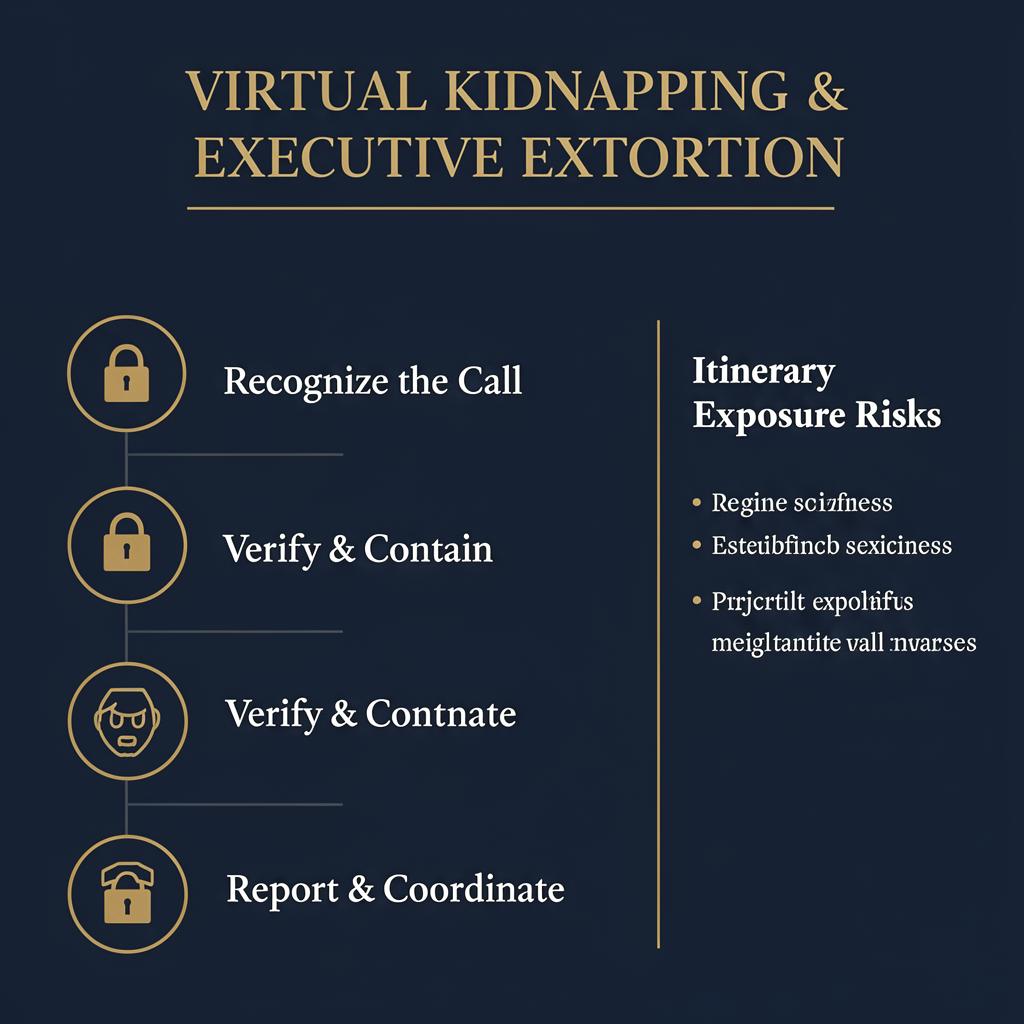
A Call That Is Designed to Disorient
An urgent voice on a short call claims to be holding an executive or a family member. Screaming plays in the background. The caller demands an immediate wire transfer and keeps the family on the line to prevent anyone from checking the story. The wire has already cleared by the time anyone thinks to call the principal directly.
Known as virtual kidnapping, this tactic has been one of the most consistent extortion playbooks of the last decade. Recurring warnings from the U.S. State Department, FBI, and OSAC have focused particularly on Mexico-related travel. Generative AI makes the attempts even more convincing. A brief sample of the principal's voice from a podcast, an interview, or a social-media clip is enough to clone a believable voice in distress.
Families and corporate security teams should put this practical framework in place before a call comes in. Leaving no time to figure things out in the moment is precisely what makes the scheme work.
1. Recognize the Call
Virtual kidnapping calls share consistent patterns:
- Inbound call from an unknown number, often international or spoofed.
- Immediate urgency: "we have your son, do not hang up."
- Background audio engineered to disorient: screaming, crying, or what sounds like a struggle.
- A specific monetary demand, typically wire-transferable, often in a precise odd amount designed to feel improvised.
- Instructions to stay on the line and avoid calling anyone else.
- Sometimes, a voice that sounds like the principal. Increasingly, callers use an AI-cloned voice trained on publicly available audio.
The demand that you stay on the line is the single most important sign to recognize. Actual law-enforcement calls don't make that demand, and real ransom communications, when they occur, follow an entirely different pattern.
2. Verify and Contain
The single most effective defense is a verification protocol agreed on in advance. Before any incident, families should sit down together and agree on:
- A named family contact other than the principal who can be reached on a separate line.
- A safe word or verification phrase that the principal would use in any real distress communication.
- An understanding that any urgent request for money will be verified through a second channel before taking action.
- A written contact list for the principal's office, executive assistant, and protective team.
When the call happens, follow the protocol:
- Stay calm. The caller is reading from a script and is not in control of the principal.
- Buy time. Ask questions. Ask the caller to put the principal on, then ask for the safe word.
- Have someone else in the household, or the executive assistant, call the principal directly on a separate device.
- Do not wire money before independent verification.
In every documented case where families reached the principal directly within minutes, the call resolved without loss.
3. Report and Coordinate
Once the principal is verified safe:
- Report to the FBI through ic3.gov and, where appropriate, to local law enforcement.
- For travel-related calls, report to the U.S. Embassy or Consulate in the destination country and to OSAC.
- Notify the corporate security lead and protective intelligence team so the pattern is logged.
- Preserve call records, voicemails, and any other evidence.
Even if the family wasn't victimized, reporting still matters. Patterns are tracked, and credible reports help law enforcement track the operations behind them.
4. Itinerary Exposure: The Quiet Enabler
To sound credible, virtual kidnapping operations depend on a single ingredient: enough knowledge about the principal and the family. Public sources almost always supply that information.
The most common itinerary-exposure vectors:
- Social media in real time: Geotagged photos, check-ins, and story posts from family members, especially adult children.
- Public flight-tracking: Tail-number aggregation for private aircraft, visible to anyone online.
- LinkedIn and professional posts: "Headed to CDMX for the week, looking forward to..."
- Resort and venue tagging: Photos from named properties with clear timestamps.
- Vendor leakage: Travel agencies, drivers, household staff, and event vendors sharing schedules through unsecured channels.
The defense here is behavioral, not technological:
- Family-wide agreement: no real-time travel posts. Share photos only after returning, and keep them on private channels.
- Adult-children briefing, repeated annually. For most families, this remains the single largest point of exposure.
- Vendor discipline: travel itineraries go through named-recipient channels only.
- Periodic OSINT sweeps of the family footprint to see what an outsider can piece together.
5. AI-Cloned Voices and Deepfakes
Generative AI is behind the recent shift in this category: convincing distress audio can be produced from a 15- to 30-second sample of someone's voice. Public-facing executives leave plenty of source material publicly available through interviews, podcasts, conference talks, and earnings calls.
This raises the bar on verification:
- A voice that sounds like the principal is no longer sufficient evidence.
- The safe word and the out-of-band callback are the verification, not the voice itself.
- Families should explicitly brief on AI voice cloning so the "but it sounded just like him" reaction is anticipated in advance.
Specific FBI guidance addresses AI-enabled impersonation. The protective recommendation remains consistent: agree on verification, confirm through a separate channel, and treat urgent demands made through the same channel with direct skepticism.
6. When to Engage Protective Counsel
For most families, the work centers on a briefing and a protocol rather than coverage. Our virtual-kidnapping and extortion-risk preparation takes three forms:
- One-time family briefing: 60- to 90-minute session for the principal, spouse, and adult children, with a written protocol document.
- Corporate program integration: Built into a corporate EP program as a recurring family-side component.
- Active incident: Engagement during or immediately after an extortion attempt to support verification, reporting, and posture review.
Contact us or call (281) 799-1877 to schedule a private family briefing.
---
This article is general guidance on extortion-scam and travel-itinerary risk. It is not legal, law-enforcement, or insurance advice. Anyone receiving a credible threat or extortion demand should immediately contact local law enforcement and, where applicable, the FBI.