The Year Cyber Stopped Staying Online
For two decades, corporate security operated as if there were a clean line between cyber and physical. Information security owned the network. Corporate security owned the building, the executive, and the travel. The two teams compared notes at the quarterly risk committee and otherwise stayed in their lanes.
That line is gone. In the first half of 2026, AMERINE and peer firms have tracked an unprecedented surge in inbound corporate executive protection requests — anchored around a roughly 340% year-over-year jump in new corporate EP engagements across the industry — and the driver is not a single high-profile incident. It is a structural shift in how threats reach principals.
The pattern is consistent: a digital event — a doxxing post, a leaked dataset, a deepfake extortion email, a credible online threat tied to a layoff, an earnings miss, or a controversial product decision — escalates within hours into a physical-protection question. Where does the principal sleep tonight. Who is at the residence. What does the school run look like tomorrow. Who answers the door.
This article lays out why the surge is happening, what the cyber-to-physical pathway actually looks like, and a concrete risk checklist for founders, C-suite executives, and UHNW family principals to use right now.
What "Cyber Threats Turning Physical" Actually Means
The phrase gets used loosely. For our purposes it covers five recurring patterns:
- Doxxing-driven escalation — a hostile actor publishes a principal's home address, family members, school, vehicle, or routine, and a second wave of actors acts on it.
- Deepfake extortion — AI-generated audio or video of the principal is sent to the company, the spouse, or the board with a payment demand and an implicit physical threat if it goes public.
- AI voice-clone vendor and family fraud — a cloned voice on the controller line or the spouse's phone, designed either to move money or to lure the family into a confrontation.
- Targeted intrusion plus stalking — breach of a personal account or smart-home system used to monitor routine, then leveraged in person.
- Grievance amplification — a single hostile post about a layoff, lawsuit, or public controversy is amplified by bots or coordinated actors until a small percentage of recipients moves toward real-world action.
In each case the first incident is digital. The protective response is physical. That is the bridge corporate security teams were never staffed to walk across, and it is the bridge the EP industry is now being pulled across at speed.
Why Demand Jumped in 2026
Several forces compounded at once:
- Generative AI matured into an operational tool for adversaries. Serviceable voice clones from thirty seconds of podcast audio. Convincing deepfake video. The FBI's repeated public warnings about AI-enabled impersonation are no longer theoretical — they are the daily caseload.
- The 2024–2025 high-profile incidents reset board risk appetite. Targeted attacks on public-company executives moved CEO and director protection from a discretionary line item to a fiduciary expectation. Boards now ask, in writing, what the protection program is.
- Insurance and D&O carriers added pressure. Several carriers now ask explicit questions about executive protection programs at renewal. A documented program lowers the conversation. The absence of one raises it.
- The personal-data exposure surface widened. Continued breaches of data brokers, real-estate platforms, and people-search aggregators mean that the cost to assemble a target package on a named executive has collapsed.
- The World Cup, election cycle, and high-profile sporting and corporate events layered short-term spikes on top of the structural trend.
The result is the demand surge. It is not a fad. It is a re-baselining.
The Cyber-to-Physical Pathway, Step by Step
Understanding the pathway is what lets you intervene early — before a digital incident becomes a residential one.
- Reconnaissance. The actor assembles the target package from public sources, breached data, and social media. Home address, spouse and children's names, school, vehicle, gym, frequent travel. With modern tooling this takes hours, not weeks.
- Trigger event. A layoff, an earnings miss, a litigation filing, a controversial public statement, a deal close, or a regulatory action. Triggers concentrate hostile attention.
- Digital first contact. A doxxing post, a hostile DM, a deepfake email to the board, a cloned-voice call to the controller, a fake account impersonating the principal.
- Escalation testing. The actor watches for response. Silence reads as opportunity. Visible overreaction reads as effectiveness and invites repetition.
- Real-world action or attempt. Showing up at the residence, the office, the school, an event. The minority of digital incidents that reach this stage are the ones the protective program exists to absorb.
The leverage point is between steps 2 and 3. Programs that watch trigger events tighten posture automatically, before the first hostile contact lands. Programs that wait for a doxxing post to surface are already a step behind.
The Founder and UHNW Risk Checklist
Use this as a self-assessment. Each item is either in place, partially in place, or absent. Anything below "in place" is a documented gap.
Digital Exposure
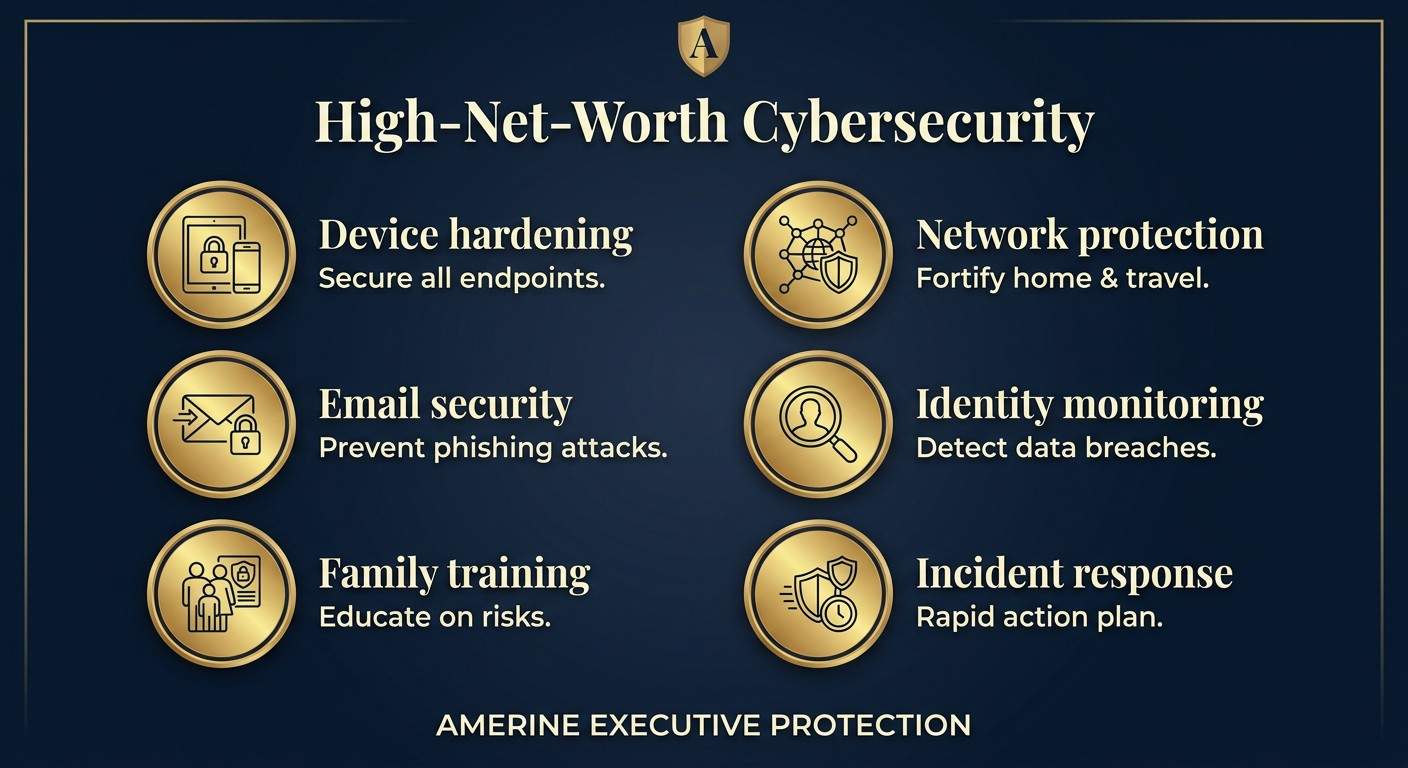
- [ ] Principal, spouse, and adult children scrubbed from major data-broker and people-search sites, with ongoing re-scrub on a quarterly cadence.
- [ ] Residences titled through an LLC or trust where state law permits, so principal names do not appear in county tax records.
- [ ] Social media of principal and family audited for geotags, school logos, vehicle plates, and routine-revealing content.
- [ ] Personal email and primary phone segregated from any account ever used for public-facing business.
- [ ] Smart-home, camera, vehicle telematics, and connected-device accounts on unique credentials with hardware-backed MFA.
Impersonation and Deepfake Defense
- [ ] Pre-agreed verbal challenge phrase between principal, spouse, controller, chief of staff, and key direct reports. No wire, no movement, no public statement without it.
- [ ] Family briefed on the "your son has been in an accident" and "your husband has been arrested abroad" call patterns and the response script.
- [ ] Working relationships or playbook with platform trust-and-safety teams for rapid takedown of impersonation accounts.
- [ ] Board, communications, and legal aligned on a 30-minute notification standard for any deepfake or impersonation content with potential to go public.
Protective Intelligence
- [ ] Continuous monitoring across surface, deep, and dark web for principal, family, residences, aliases, and key business identifiers.
- [ ] Documented list of trigger events that automatically tighten monitoring and physical posture — earnings, litigation, layoffs, public statements, deal close, travel.
- [ ] A named owner — internal or external — who receives intelligence alerts 24/7 and has authority to escalate to the protective detail.
- [ ] See protective intelligence cycle for the operating framework AMERINE uses.
Physical Protection Baseline
- [ ] Residential posture documented: who responds at 3 a.m., what the access plan is, where the safe room is, where the family meets if evacuated.
- [ ] Travel posture documented: who books, who advances, what the airport plan is, what the in-country contact list looks like.
- [ ] Vehicle and driver standards documented. See secure transportation and security driver standards.
- [ ] Event posture documented for predictable high-exposure events — earnings, shareholder meetings, public appearances, family weddings, charity galas.
Incident Response
- [ ] Written 72-hour response framework for credible threats. See Executive Protection After a Credible Threat.
- [ ] Pre-identified outside counsel, communications, protective intelligence, and EP provider — by name, by mobile number, tested annually.
- [ ] Evidence-preservation discipline: original artifacts, full headers, timestamps, chain of custody captured before any takedown request.
- [ ] Decision authority defined: who decides on visible vs. low-profile posture, who decides on law enforcement engagement, who decides on public statement.
Family Office Specifics
- [ ] Out-of-band confirmation required on all wire transfers above a defined threshold, regardless of who appears to be calling.
- [ ] Documented cybersecurity strategy with a named owner — Deloitte's family office research has repeatedly shown that roughly 31% of family offices operate without one, and 43% have experienced a cyberattack in the prior 12–24 months.
- [ ] Household-staff vetting refreshed annually. See vendor and household vetting.
- [ ] Principal-and-family briefing at least twice a year on current scam, deepfake, and stalking patterns.
If more than three boxes are unchecked, the program is below 2026 baseline for a corporate principal or UHNW family of comparable profile.
What "Visible" vs. "Invisible" Looks Like
A frequent founder question: do I need agents standing at the lobby? Almost never.
The mature 2026 response to the cyber-to-physical surge is low-profile, intelligence-led, and posture-shifted rather than visibly hardened. Doormen, residences, and routines stay the same. What changes is who is paying attention, what the verification standards are, what the response time is, and what the posture can flex to in 30 minutes if intelligence shifts.
Visible security is occasionally the right answer — generally in stalking patterns where the actor is known and deterrence is the goal, or in immediate post-incident windows where the principal needs the reassurance and the message to a threat actor is intentional. Outside those cases, visibility usually creates more problems than it solves.
How AMERINE Engages on the Cyber-to-Physical Surge
For new corporate, founder, and family-office engagements in 2026, our intake walks through:
- A 60-minute confidential principal and family-office briefing — no obligation, no sales pitch.
- A documented baseline of digital exposure, monitoring posture, physical posture, and incident-response readiness against the checklist above.
- A written program proposal with named owners, defined response times, and integration points between digital monitoring and the protective detail.
- A phased build that prioritizes the gaps with the highest probability of being exploited in the next 90 days.
We do not sell software. We do not sell ad-hoc bodyguards. We build and run protection programs for principals, founders, and UHNW families, and we coordinate the digital perimeter with the physical detail so the two move together.
Bottom Line
The 2026 executive protection demand surge is real, the driver is structural, and the cyber-to-physical pathway is the single most common reason new principals come through our door. The defense is not exotic. It is sequenced, written down, rehearsed, quiet — and built before the first hostile post lands.
If you are a founder, C-suite executive, board director, or family-office principal and the checklist above surfaced more than three open items, that is the conversation. Request a confidential briefing or call (281) 799-1877. Scott personally takes every first call.
Related reading: Digital Executive Protection, Executive Protection After a Credible Threat, Tech CEO Security, UHNW Family Security, Protective Intelligence Cycle, and the Executive Protection Services hub.
Frequently Asked Questions
Did corporate executive protection demand really jump ~340% in 2026?
Inbound corporate EP request volume across AMERINE and peer firms is tracking roughly 340% above the same period in 2025, anchored on cyber-to-physical incidents — doxxing, deepfake extortion, AI-enabled impersonation, and grievance-driven targeting. The number is a directional industry signal, not a single audited statistic, and individual firms see variance, but the surge is real and consistent across reputable providers.
What is the single most common cyber-to-physical pattern you see?
A doxxing post — usually triggered by a layoff, lawsuit, earnings event, or controversial public statement — followed within 24 to 72 hours by either a credible online threat or an attempted approach at the residence or office.
Do founders without a public profile need executive protection?
Often, yes. Funding announcements, acquisitions, regulatory filings, and product launches create discoverable wealth and visibility events even for founders who avoid press. The 2026 risk is rarely about fame — it is about findability plus a trigger.
Is a personal cybersecurity team enough?
No. A digital-only program catches the first contact but cannot answer the residential, travel, and event questions that follow. The 2026 baseline integrates digital monitoring with a physical protective posture under one accountable program owner.
How fast can a real program be stood up?
A documented baseline, residential posture, monitoring setup, and family briefing can be in place inside 30 days. A fully matured program with rehearsed incident response, vetted travel posture, and integrated digital perimeter is a 90-to-180-day build.
How is a program scoped?
Programs are scoped to principal profile, family composition, residential footprint, travel pattern, and threat picture. Initial briefings are confidential. Scope and terms are confirmed in writing.
---
This article is general planning guidance for executive protection and is not legal, cybersecurity, law enforcement, or insurance advice. Specific incidents should be reviewed with qualified counsel and, where appropriate, federal law enforcement. AMERINE Executive Logistics is licensed by the Texas Department of Public Safety, License No. C31012001.