When the Call Comes In
It usually starts with a weekend call, prompted by an email, a social post, a voicemail, or a letter at the office. The threat may name a specific date or location, or it may be vague but still read as serious. The general counsel calls the CEO, who calls the head of security. Then the head of security calls us.
How you handle the first 72 hours determines whether your response is measured and effective or visible, chaotic, and damaging in its own right. AMERINE uses this framework to guide boards and C-suite leaders after a credible threat surfaces against an executive, family member, or high-profile employee.
The Trap of Overreaction
After a threat, the reflex is to make security visible: put two-officer details in the lobby, station SUVs at the residence, and issue a public statement. In most cases, that's exactly the wrong response.
To the threat actor, visible security signals that the threat worked. It also draws press coverage the principal rarely wants and rattles employees, family, and neighbors. Obvious protection is known to escalate behavior rather than deter it in certain profiles, particularly stalking and grievance-driven cases.
Over the last decade, ASIS and the broader protective intelligence community have pushed the industry toward threat-assessment-driven programs and away from blanket protection. A credible threat rarely calls for simply "more guards." The response needs the right measure of protection at the right time, based on what the threat actually is.
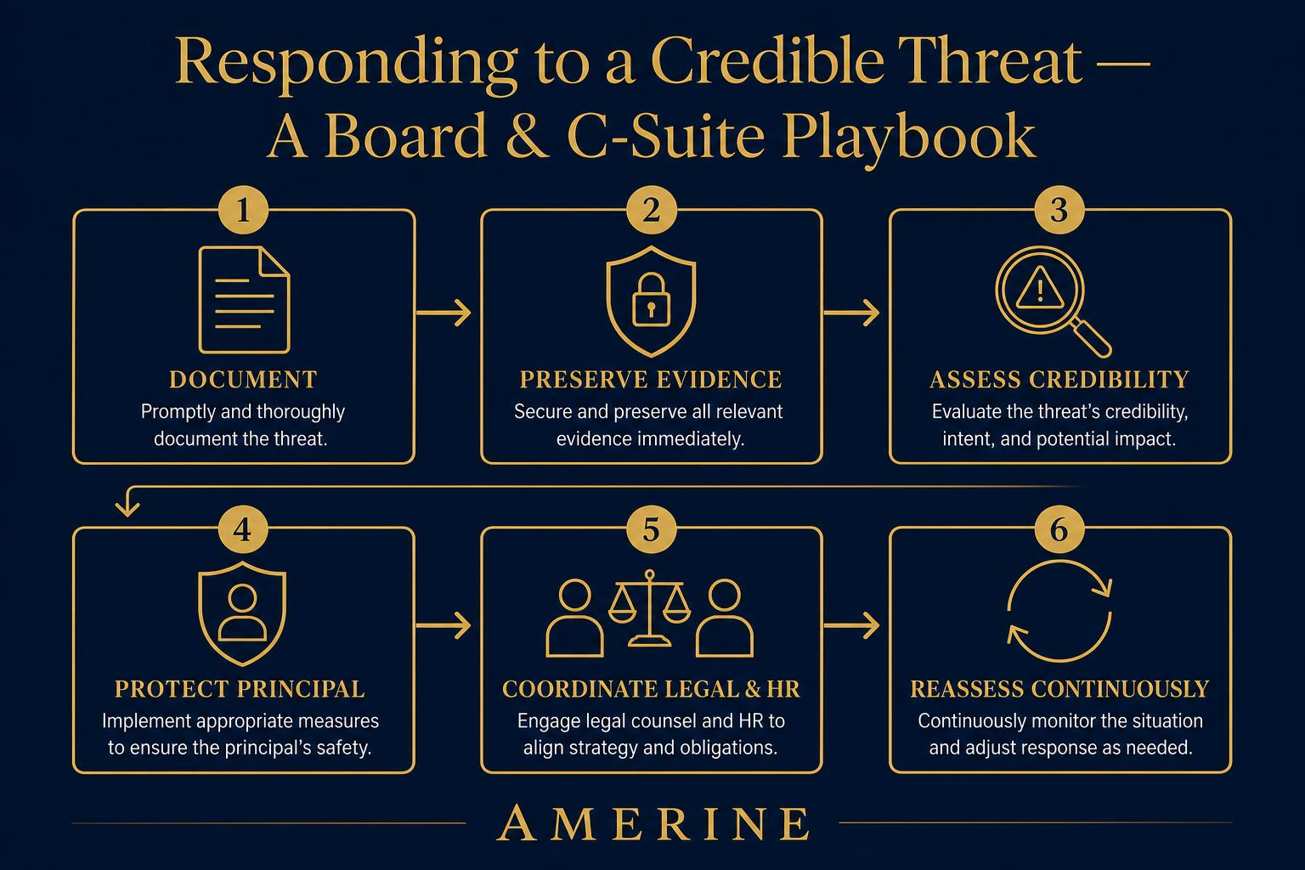
Step 1: Document the Threat
Before any protective measure is taken, document the threat cleanly.
- Preserve the original artifact: an email with full headers, a voicemail as an audio file, a letter along with its envelope, or a social post captured as a screenshot showing the URL and timestamp.
- Note the chain of custody: who received it, when, on what device, and who has handled it since.
- Capture the principal's reaction and any context they offer: prior contact with the actor, recent business decisions, public appearances, ongoing litigation.
This documentation becomes the foundation if law enforcement gets involved later. Unless it's preserved properly in the first hour, it can't be reconstructed.
Step 2: Preserve Evidence and Avoid Engagement
Don't respond to the threat actor. Don't have legal send a cease and desist without input from protective intelligence. On social media, don't delete, repost, or quote-reply. Each of these actions changes the threat actor's behavior in ways that are hard to predict and often counterproductive.
The only exception is platform-level reporting (Meta, X, YouTube) of content that violates terms of service. Even that decision belongs with the protective team; don't make it unilaterally.
Step 3: Assess Credibility
A threat isn't necessarily credible, and a credible threat isn't necessarily imminent. Protective intelligence never asks "is this scary?" The question is simpler: what can this actor actually do, given their capability and proximity?
The framework we use:
- Specificity: Does the threat name a person, place, date, or method? Vague threats are statistically less actionable than specific ones, but escalating detail across a campaign is a clear warning sign.
- Capability: Does the actor have the means? Consider any history of violence, access to weapons, physical distance from the principal, and technical capability for digital harm.
- Motivation: Grievance-driven actors with a personal connection to the principal (terminated employees, plaintiffs, former partners) score differently than ideological or random actors.
- Trajectory: Is the language escalating over time? Is the actor narrowing focus on the principal instead of spraying hostility across multiple targets?
Threats usually fall along a spectrum, not neatly into a "credible" or "not credible" bucket. Your job is to match the security posture to the assessed level and reassess as new information arrives.
Step 4: Evaluate the Digital Footprint
A credible threat usually triggers an immediate digital exposure review.
- What can the actor already find? Home address, family names, school names, daily routine, vehicle, frequent locations.
- Where has the principal been recently photographed in public? What is the next public appearance?
- What does the principal's family's social media look like in the 30 days following the threat?
Publicly available information that the principal didn't know was public accounts for most of the residential and travel risk an actor exploits. Reviewing that exposure runs alongside the protective posture decision, rather than as a separate workstream. The full digital perimeter framework is available in Digital Executive Protection.
Step 5: Set the Protective Posture
Based on the credibility assessment, a protective posture is set across four environments:
- Residence: Hardened entry, secure communications, low-profile presence on the property during high-risk windows, neighborhood awareness, and where warranted, a residential protective agent.
- Travel: Vetted secure transportation, advance work for meetings and public appearances, route variation, and reduced predictability in daily patterns.
- Events: Threat-informed advance work, credentialed entry, controlled access to greenrooms and reception areas, and a clear extraction plan.
- Family: Posture decisions for spouse and children, briefings on what to share and what not to, school and routine adjustments where indicated.
Stage the posture to match the threat: light-touch measures for a low-credibility threat, and a full protective detail for a high-credibility, imminent threat, with armed coverage where lawful and appropriate. As the assessment evolves, the posture can move up or down.
Step 6: Brief the Principal
This step is routinely overlooked. The principal needs to understand:
- What the threat actually says, in plain language, without melodrama.
- What the credibility assessment concluded and why.
- What the protective posture is, what the principal will see and feel, and what remains invisible.
- What the principal needs to do differently, and what they explicitly do not need to do differently.
When executives aren't surprised by their own security detail, they manage threats better. Keep the briefing direct and concise, and repeat it as the situation evolves.
Step 7: Coordinate Legal, HR, and Communications
A credible threat almost always brings parallel legal, HR, and communications demands.
- Legal: Deciding whether to pursue protective orders, whether to engage law enforcement, and what disclosure obligations exist to the board, insurers, or regulators.
- HR: If the actor is or was an employee, the HR file and termination procedures become protective intelligence material. That information must be handled with care.
- Communications: Holding statements prepared in case the threat goes public, media monitoring activated, and social channels watched.
A single incident lead, usually the general counsel or chief security officer, should coordinate these workstreams as they run alongside the protective response. The protective team serves as the operational arm.
Step 8: Reassess Continuously
The first 72 hours set the posture. The next 30 days refine it.
- New communications from the actor reset the assessment immediately.
- An actor going silent does not mean the threat has receded. Sometimes it signals the opposite.
- Changes to the principal's schedule, public appearances, earnings calls, and travel each trigger a fresh posture review.
- At a defined point, typically 60 to 90 days post-incident, the protective program is either institutionalized, scaled down to a baseline, or wound down entirely based on the threat trajectory.
What This Is Not
This is not legal advice. This is not law enforcement advice. The right counsel from a qualified attorney and the right law enforcement engagement, at the federal, state, or local level, are often essential. Those decisions are made by the principal and general counsel, not by a security vendor.
This operational framework turns the response to a credible threat into a managed program instead of a chaotic reaction.
How AMERINE Engages
We've built post-threat protective programs for public-company executives, private principals, family offices, and high-profile public figures. We typically start engagements with a 24- to 72-hour assessment and surge posture, then move into a sustained program matched to the assessed threat. Our role is to work alongside in-house security teams, general counsel, and law enforcement, not replace them.
If you've received a credible threat or think one may be developing, you can contact us or call (281) 799-1877. Every first call goes personally to Scott.
---
This article is general guidance on protective response and is not legal, law enforcement, or psychological assessment advice. Specific incidents should be reviewed with qualified legal counsel, behavioral [threat assessment](/threat-assessment-services) professionals, and where appropriate, federal or local law enforcement.