The Buyer Has the Hardest Job
For a Dallas-based executive, family office, or general counsel seeking executive protection, the search begins with a few Google queries, a few referrals, and a few introductory calls. Within a week, you've spoken with firms that seem much alike: the photos show the same gear, the websites use the same words, and the voices on the phone sound equally confident.
The differences between firms are substantial and consequential. You won't see them from the outside unless you know what to ask. We recommend that Dallas buyers use this vetting framework, which focuses on what actually matters.
Texas Licensing Is the Floor, Not the Ceiling
The Texas Department of Public Safety regulates the private security profession under the Private Security Act. Any firm providing executive protection in Texas must hold an active Class B license (security services). Individual protective agents working in the state must hold a Personal Protection Officer (PPO) certification, a separate credential beyond a standard security officer license.
This is the floor. A firm that cannot produce a current Texas Class B license number on request is not in compliance. It is not a close call. AMERINE operates under Texas Private Security License No. C31012001.
What the license does not tell you is whether the firm has actually run executive protection at the level you need. That is what the rest of the vetting is for.
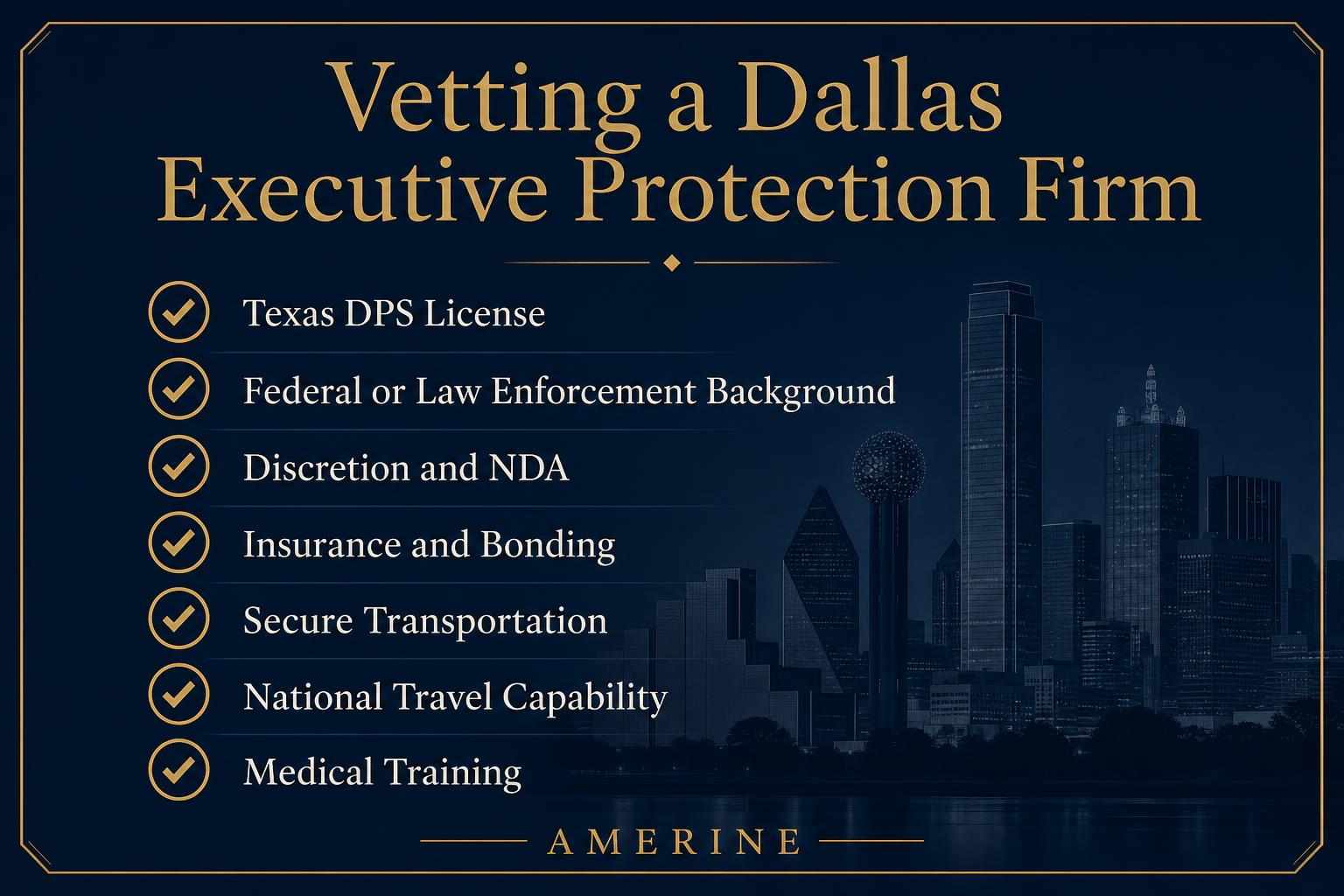
The Vetting Checklist
If you're vetting AMERINE, we welcome and expect sophisticated buyers to ask every one of these questions. If we're advising you on other firms, we give you this exact list.
1. Licensing and Compliance
- Current Texas Class B license number. Verify it directly on the TDPS website.
- PPO certifications for every agent assigned to the principal, covering field personnel as well as the firm's owner.
- Insurance: general liability, professional liability (E&O), and a current certificate of insurance available on request.
- For armed coverage, confirmation of each agent's License to Carry status and the firm's authorization for armed services in Texas.
2. Background and Experience
- Where do the agents actually come from? Federal law enforcement (USSS, FBI, HSI, DSS), military special operations, state and major-city law enforcement, and credible private-sector EP backgrounds form the spine of a serious firm.
- How long has the firm's leadership operated in this space? Years matter. So does the reputation of the principals: protective work is a small community, and references are easy to verify off-list.
- What is the assigned agent's specific experience? Look past the sales deck to the individual person who will be standing next to your principal.
3. Discretion and Confidentiality
- Mutual NDA at the start of any substantive conversation. A firm that resists a standard NDA is the wrong firm.
- No name-dropping. Reputable firms do not discuss past clients, and they never parade identifiable case studies. If a firm pitches you by dropping client names, walk away.
- Social media discipline among agents. The firm's policy must be explicit: no posts featuring clients, vehicles, routes, or locations.
4. Operational Capability
- Secure transportation: vetted drivers, vehicle staging, route planning, and the capacity to coordinate ground movement at the level the principal requires.
- Advance work: an operative walks the venue, the route, and the hotel before the principal arrives.
- Protective intelligence: monitoring, threat assessment, and the ability to feed updates back to the protective detail in real time.
- Medical training: at minimum, individual agents hold TECC or TCCC certifications and carry an appropriate trauma kit.
5. Travel Capability
If the principal travels, and most do, the firm needs national and international capability.
- Coverage outside of Texas: can the firm run a detail in New York, Los Angeles, Miami, London, Dubai, or the next host city on the calendar?
- Vetted operator network: in foreign jurisdictions where direct staffing is impractical, the firm should maintain established relationships with vetted partners, never improvised local arrangements.
- Logistics: visas, equipment transport, secure communications in-country, and consulate awareness where it matters.
AMERINE supports clients in 45+ countries through a vetted operator network coordinated from our McKinney office.
6. Fit With the Principal
Buyers overlook this variable more than any other: even a firm that looks right on paper fails if its assigned agent clashes with the principal's routine.
- Does the agent present at the level the principal moves in? Boardroom-quality presentation is mandatory for corporate assignments.
- Communication style: terse and operational versus warm and conversational. Both styles work, but the match must be deliberate.
- Family fit: agents working around a spouse and children must be vetted with direct input from the family as well as the corporate office.
7. References and Reputation
- Ask for two or three references that match your profile. Reputable firms produce them within a week, often faster.
- Run off-list reference checks. Call the head of security at a peer company. Call the general counsel of a comparable family office. The protective community is small, and reputation travels quickly.
What to Avoid
A few patterns almost always signal the wrong firm:
- Tactical-style marketing imagery (kit, weapons, "operator" language) on the website. The buyer the firm should want, and the principal the firm should serve, are the opposite of that aesthetic.
- A pitch that emphasizes the firm's gear or its owner's biography rather than the assigned agent and the operational plan.
- Pressure to commit before a clear scope, threat assessment, and written agreement are in place.
- Protective work presented without context for scope, posture, and risk.
What AMERINE Looks Like
For full transparency, when AMERINE is the firm being vetted, the answers to the questions above:
- Texas Private Security License No. C31012001 (verify at TDPS).
- Founder Scott Jones is a former U.S. Secret Service Special Agent (1998–2015) with federal protective experience at the highest levels.
- Agents drawn from federal law enforcement, special operations, and credible private-sector EP backgrounds. Every agent assigned to a principal is named in the engagement.
- Texas headquartered in McKinney, with active operations across Dallas, Houston, Austin, and San Antonio, and travel coverage across the U.S. and 45+ countries.
- Discreet by default. No client name-dropping. NDAs standard at the outset.
How to Start
On the first call, we spend 20- to 30-minute conversation time discussing the principal, the situation, and what a good outcome would look like. There's no pitch or pressure. We may be the right fit, or we may not. Either way, you'll leave with a clearer view of what to look for.
Contact us or call (281) 799-1877. Scott personally takes every first call.
---
This article is general guidance on selecting a private security provider in Texas and is not legal, licensing, or insurance advice. Buyers should independently verify all licensing and insurance representations made by any firm under consideration through the Texas Department of Public Safety and qualified counsel.