The Seat Belt Test
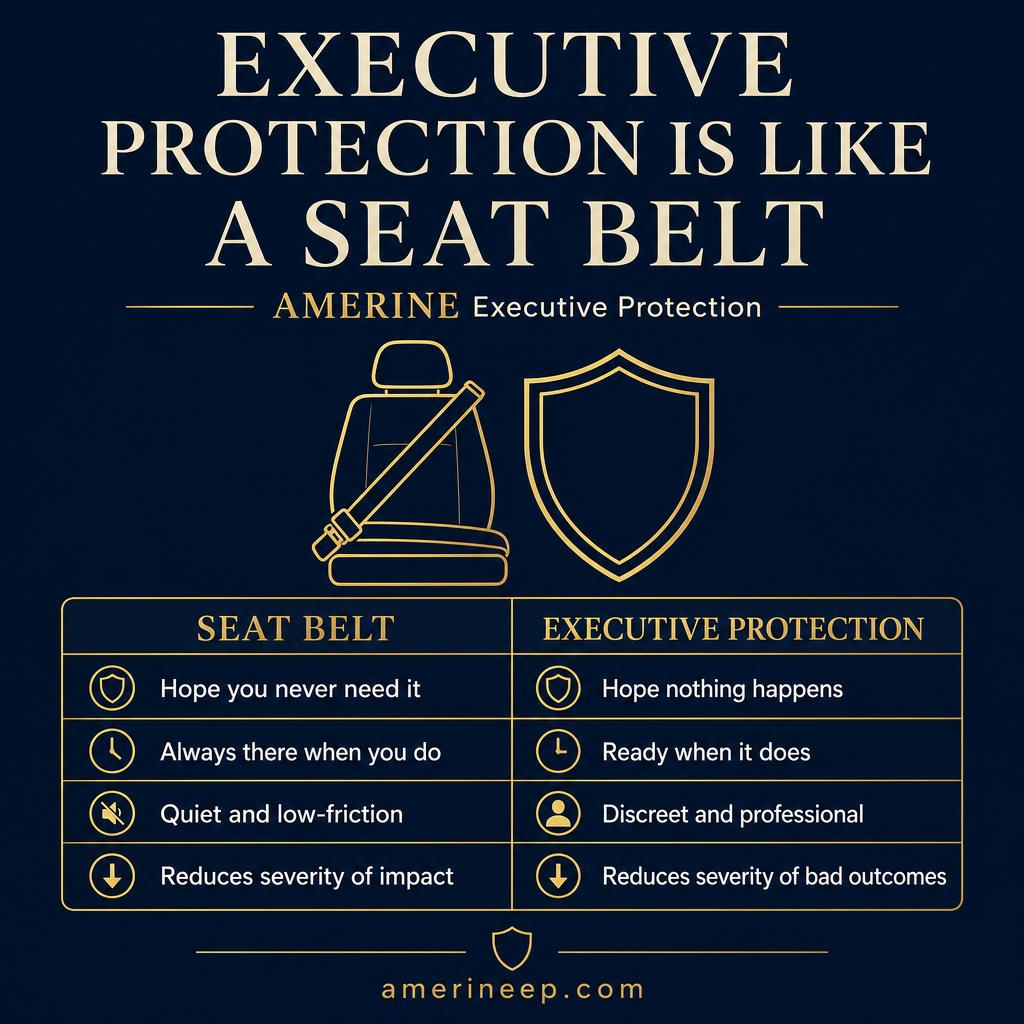
Nobody puts on a seat belt expecting a crash. They put it on because the small inconvenience of clicking it in is nothing compared to the consequence of not wearing it the one time it matters. The math is obvious. The behavior is automatic. We don't debate it anymore.
Executive protection should be thought about the same way.
Quiet, Always-On, Low-Friction
A good seat belt does its job by staying out of your way. You feel it for a second when you sit down, then you forget it is there. It does not slow you down, lecture you, or make a scene. It is simply present — engineered, tested, ready.
Executive protection at its best is the same.
- A driver who knows the route, the alternates, and where the nearest hospital is.
- An advance who has already walked the venue, met the manager, and identified the exits.
- An agent positioned where you almost don't notice them, but who notices everything.
- A plan you never have to invoke — until the one moment you do.
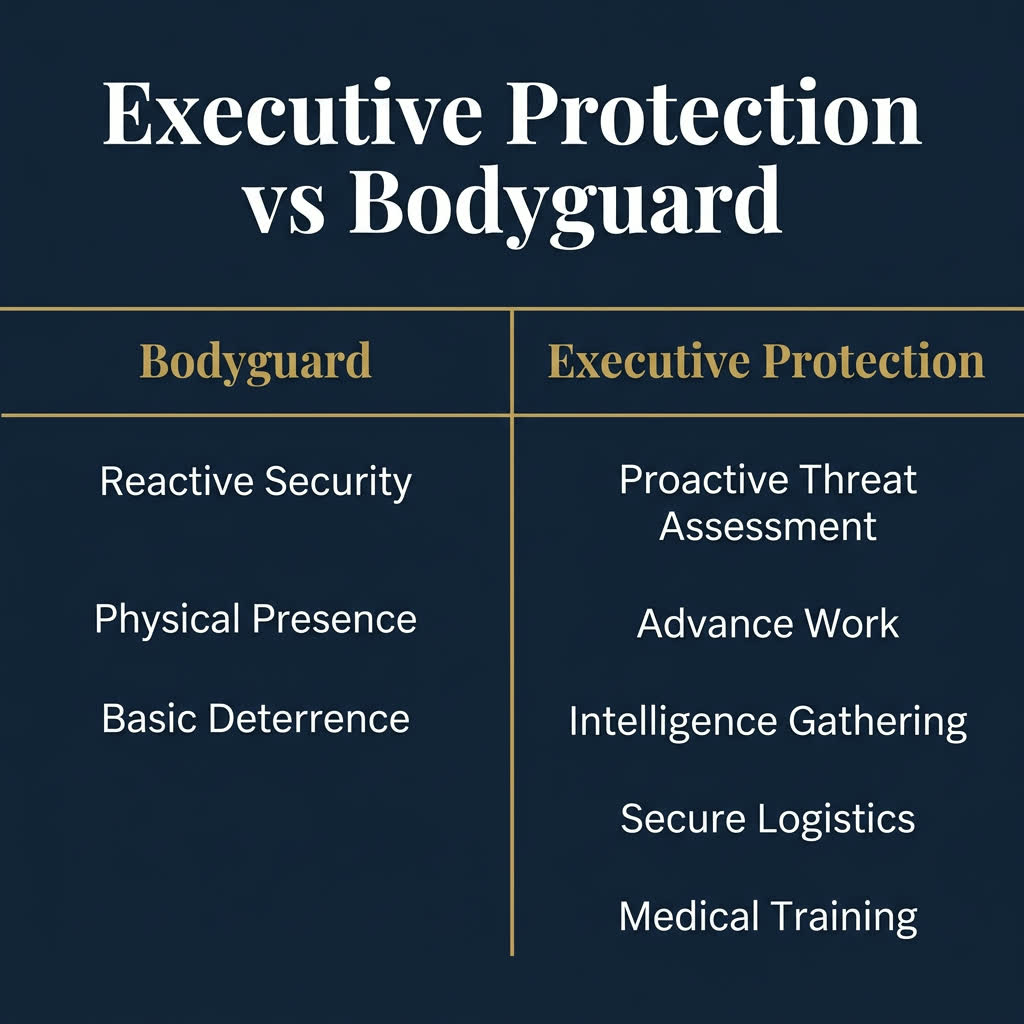
> Executive protection is not bodyguards standing in the photo. It is the silent infrastructure that keeps the photo possible in the first place.
What Seat Belts Actually Do
Seat belts do not prevent collisions. They reduce the severity of what happens during one. They keep you in the seat. They keep you upright. They keep you in a position where the rest of the safety system — airbags, crumple zones, the structure of the car — can actually do its job.
Executive protection works the same way. We do not pretend to eliminate every risk in the world. What we do is reduce the severity and likelihood of bad outcomes:
- A confrontation that becomes a quiet exit instead of a viral video.
- A medical event that gets to the right hospital faster.
- A travel disruption that becomes a rebooked itinerary instead of a stranded family.
- An aggressive approach that gets intercepted before it touches the principal.
- A moment of confusion that becomes a clean, rehearsed movement.
Most of our work, like most of a seat belt's work, is invisible. That is the point.
Who Wears the Belt
Seat belts are universal — but the need scales with exposure. A short trip down a quiet road carries less risk than a long-haul night drive in heavy weather. Yet we wear the belt either way, because the cost of not wearing it is asymmetric.
Executive protection scales similarly with exposure. The need is not equal for everyone, but it grows with:
- Public visibility — media coverage, social platforms, conferences, philanthropy.
- Wealth and ownership — recognizable assets, recognizable family, recognizable name.
- Travel footprint — international meetings, multiple residences, frequent transitions.
- Business posture — controversial decisions, layoffs, M&A, regulatory exposure.
- Family structure — children, ex-spouses, custody situations, vulnerable members.
For people whose lives carry more of those factors, going without protection is the equivalent of unbuckling on the highway. Statistically you might be fine. The day you aren't, you really aren't.
The Cost of Not Buckling
The cost of a seat belt is measured in time, comfort, and that brief second of friction. Most people pay it without thinking, because they have internalized the asymmetry: small known cost vs. large unknown cost.
The same logic applies here. The cost of being wrong about your exposure — a single incident, a single lawsuit, a single news cycle, a single hospital visit handled the wrong way — is not bounded or predictable.
How to Think About It
If you are wondering whether executive protection is right for you or your family, do not start with the question, "How likely is something to happen?" That is the wrong frame. Drivers do not buckle up because crashes are likely. They buckle up because crashes are consequential.
Better questions:
- If something happened tonight, who would be responsible for moving my family safely?
- If I were approached aggressively in public tomorrow, what is my plan?
- If a medical event occurred at the hotel, who is calling whom, and in what order?
- If a story broke about me at 9pm Friday, who is positioned at my home by 10pm?
If those answers are vague, the seat belt isn't on yet.
What a Good Program Looks Like
A well-designed executive protection program is engineered like an automotive safety system: layered, tested, and designed to be unobtrusive until it is needed.
- [Threat assessment](/threat-assessment-services) — what is your actual exposure, in plain language.
- Plan — routes, residences, travel, family, special events.
- Detail design — armed or unarmed, single agent or team, full-time or trip-based.
- Advance work — venues, hospitals, hotels, drivers, alternates.
- Communications — how everyone reaches each other when networks fail.
- Review — every quarter, every trip, every change in your life.
Then it disappears into the background of your day. You go to dinner. You take the kids to school. You close the deal. You attend the gala. The system is there. You don't have to think about it.
That is the seat belt. That is the standard.
The AMERINE Standard
We design protection programs the way safety engineers design cars: quietly, methodically, and around the principal. The goal is never to make your life feel smaller. The goal is to make it feel exactly as large as it should — without the risk that scale carries.
Contact AMERINE for a confidential conversation. Scott personally takes every first call.