When you look for personal security services, you'll see "bodyguard" and "executive protection agent" used almost interchangeably. Both roles aim to keep people safe, but they have little else in common. The distinction between the two comes down to reacting to a crisis versus preventing one from happening at all.
The Traditional Bodyguard Model
Bodyguards go back centuries. Traditionally, the role has centered on a physically imposing individual whose main job is to deter threats by being visibly present.
- Reactive posture: The bodyguard responds to threats as they materialize.
- Physical deterrence: Size, strength, and visible presence are the primary tools.
- Limited scope: Protection is typically confined to the immediate physical space around the principal.
- Minimal advance work: Little or no pre-event intelligence gathering or route planning.
- Basic training: Often limited to physical security, basic firearms, and conflict de-escalation.
For nightclub security, event crowd control, or short-term personal escorts in low-threat settings, that setup works. But it's dangerously inadequate for executives, UHNW families, and high-profile individuals who face sophisticated threats.
The Executive Protection Model
Executive protection (EP) treats personal security as an integrated, intelligence-led system rather than a single physical presence.
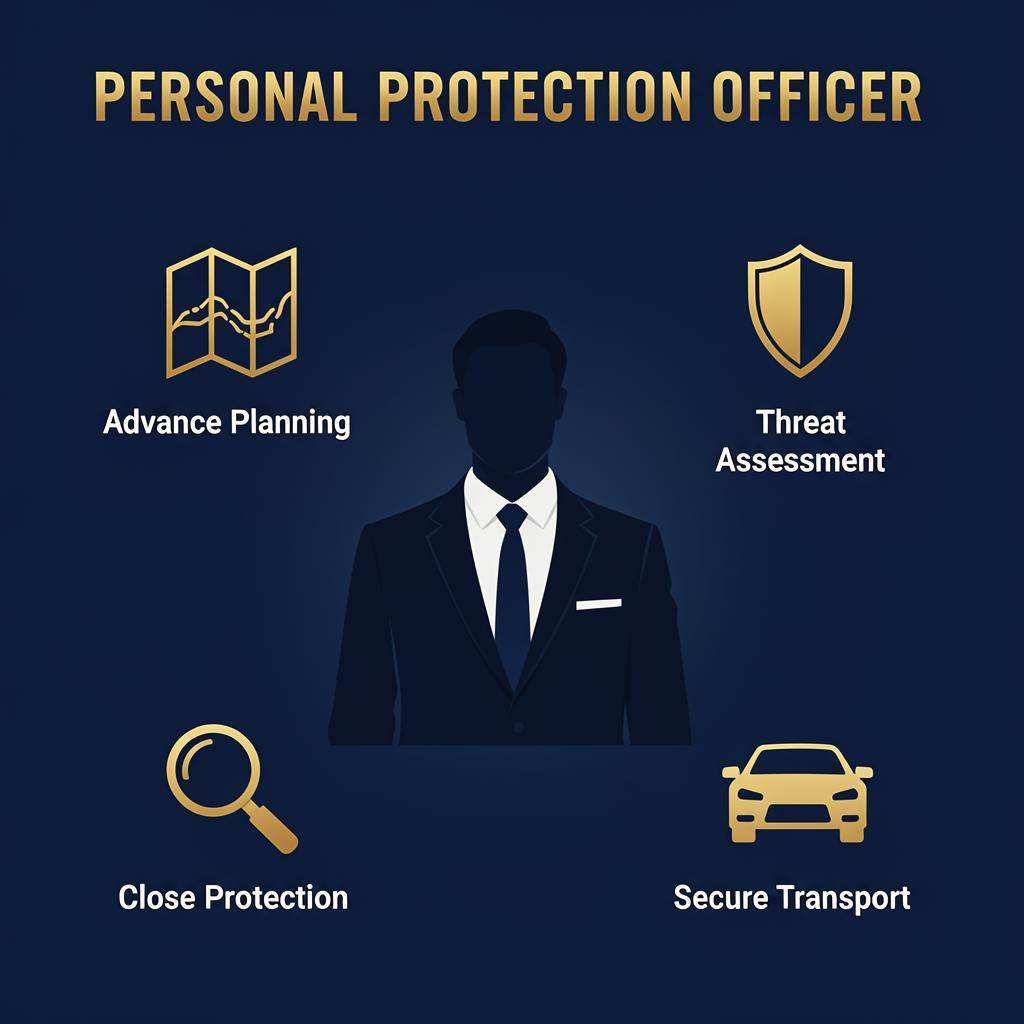
Proactive Threat Assessment
EP begins long before an agent ever stands next to the principal. The work starts with:
- Formal threat and vulnerability assessments
- Continuous monitoring of open-source intelligence (OSINT) for emerging risks
- Dark-web surveillance for leaked personal information, travel plans, or targeting discussions
- Social media analysis to identify potential stalkers, disgruntled individuals, or protest activity
Advance Work
Before the principal arrives anywhere, agents run thorough advance operations:
- Physical inspection of venues, hotels, restaurants, and meeting spaces
- Identification of entry and exit routes, safe rooms, and rally points
- Coordination with local law enforcement and venue security teams
- Medical facility mapping: locating the nearest trauma center, rather than a standard local clinic
- Counter-surveillance detection to identify anyone conducting pre-operational reconnaissance
Secure Logistics
Protection covers every part of a principal's movement:
- Route planning with primary, secondary, and emergency alternatives
- Secure transportation with trained protective drivers
- Airport and aviation security coordination
- Coordination with residential security systems and personnel
Intelligence Integration
Modern EP teams operate as intelligence units alongside their physical security duties:
- Daily intelligence briefings tailored to the principal's schedule and locations
- Real-time threat monitoring during travel and events
- Coordination with corporate security, cyber teams, and family office advisors
- After-action reporting and continuous improvement
Medical and Emergency Response
EP agents typically hold advanced medical certifications:
- Tactical Combat Casualty Care (TCCC) or Tactical Emergency Casualty Care (TECC)
- CPR/AED and advanced first aid
- Emergency evacuation planning and execution
- Coordination with medical concierge services for principals with specific health requirements
Side-by-Side Comparison
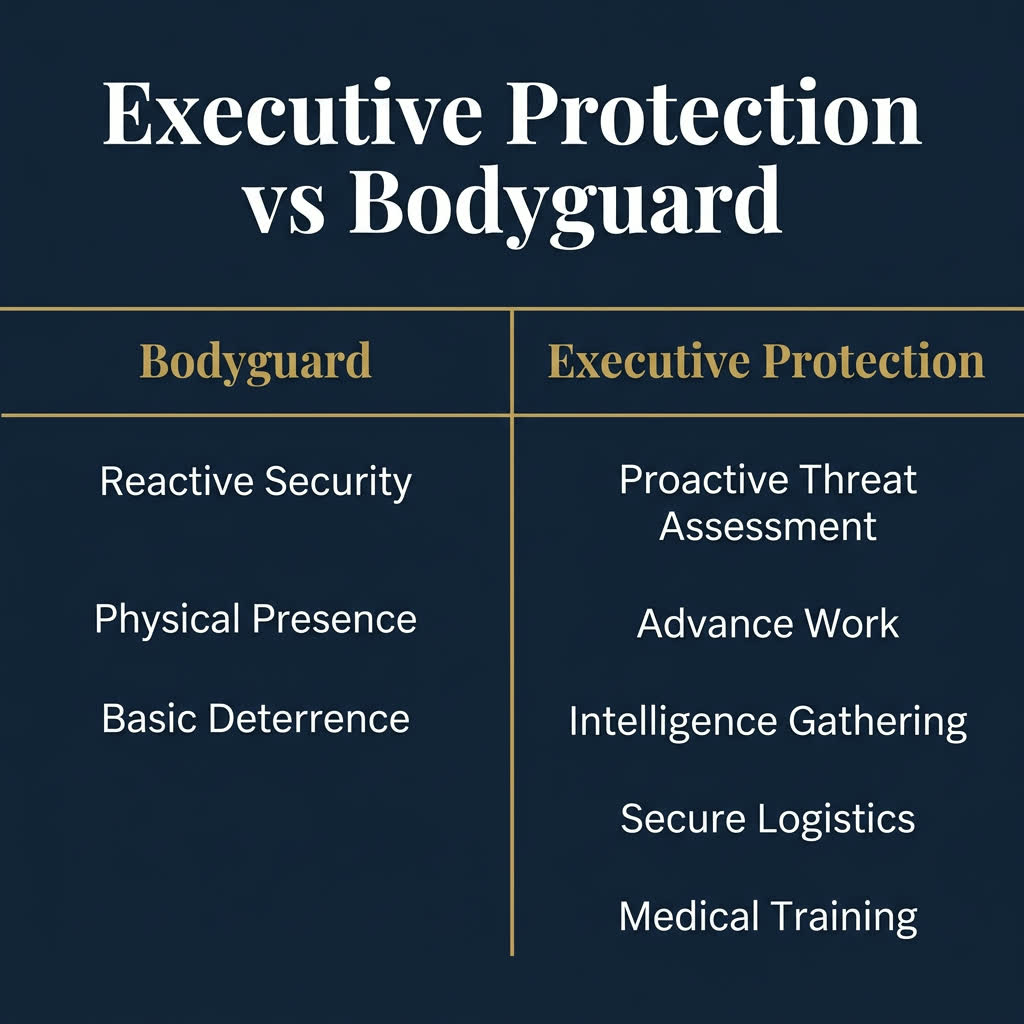
A bodyguard's training covers basic security licensing, firearms, and physical fitness. An EP agent brings a federal law enforcement or military SOF background, along with protective intelligence, emergency medicine, secure driving, and surveillance detection.
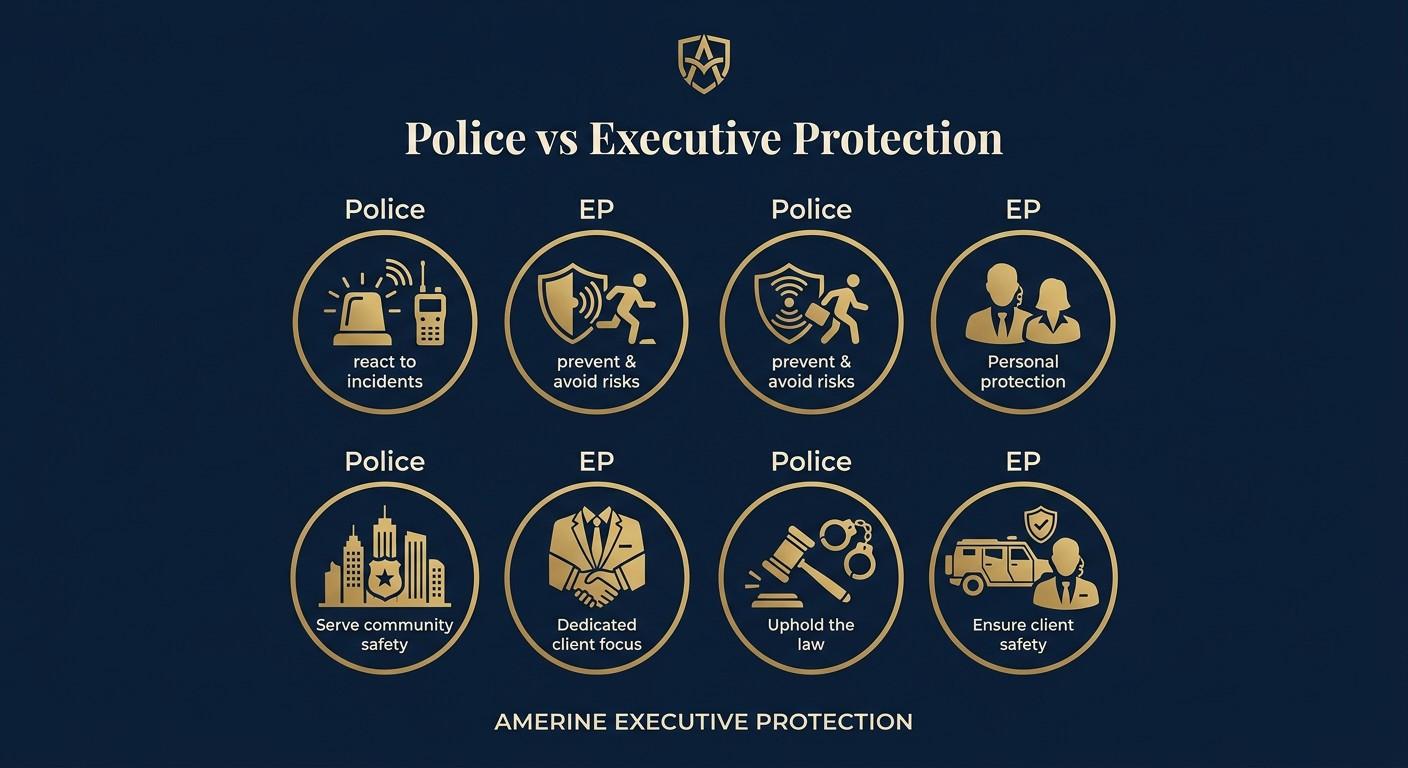
A bodyguard takes a reactive approach, responding when a threat appears. An EP agent works proactively to prevent threats from ever reaching the principal.
Bodyguards use minimal intelligence, relying only on situational awareness in the moment. EP agents take a comprehensive approach to intelligence through continuous OSINT, dark-web monitoring, social media analysis, and advance reconnaissance.
A bodyguard's scope centers on physical presence around the principal. An EP agent works within an integrated system that covers physical security, cyber-physical convergence, secure logistics, medical response, and family protection.
Bodyguards are often highly visible to deter threats. EP agents keep a low profile, blending into the principal's environment without drawing attention.
- EP Agent: Higher investment reflecting comprehensive training, intelligence capabilities, and operational depth
When Each Model Is Appropriate
A traditional bodyguard may be enough when the threat level is low, the environment is controlled, the engagement is short-term, such as a single event or evening, and the main need is visible deterrence rather than comprehensive protection.
You need executive protection when the principal faces credible, ongoing threats such as stalking, extortion, or kidnapping risk; when travel involves elevated-risk international regions; or when the principal's public profile creates inherent vulnerability. It's also essential when family members, especially children, need protection, corporate duty-of-care obligations apply, or the principal's routine calls for discreet, unobtrusive security integration.
The Cost of Getting It Wrong
If you need executive protection and hire a bodyguard instead, you're leaving risk unaddressed, not simply accepting lower quality. Sophisticated threat actors watch their targets, exploit predictable patterns, and find security gaps. A security model focused on physical presence and reaction can't detect or counter those methods.
Giving someone confidence without the competence to back it up is the most dangerous security failure. A principal may feel safe with a visible bodyguard nearby even as vulnerabilities remain completely unaddressed.
The Amerine Approach
Everyone on the Amerine protective team has a background in elite federal law enforcement or military special operations. What we provide is integrated executive protection grounded in intelligence, advance work, and operational excellence. We don't offer "bodyguard services."
We serve UHNW families, Fortune 500 executives, and high-profile individuals who need protection that remains rigorously effective behind the scenes while staying invisible to the outside world.
If you are evaluating your personal security posture, contact us for a confidential threat assessment and consultation.