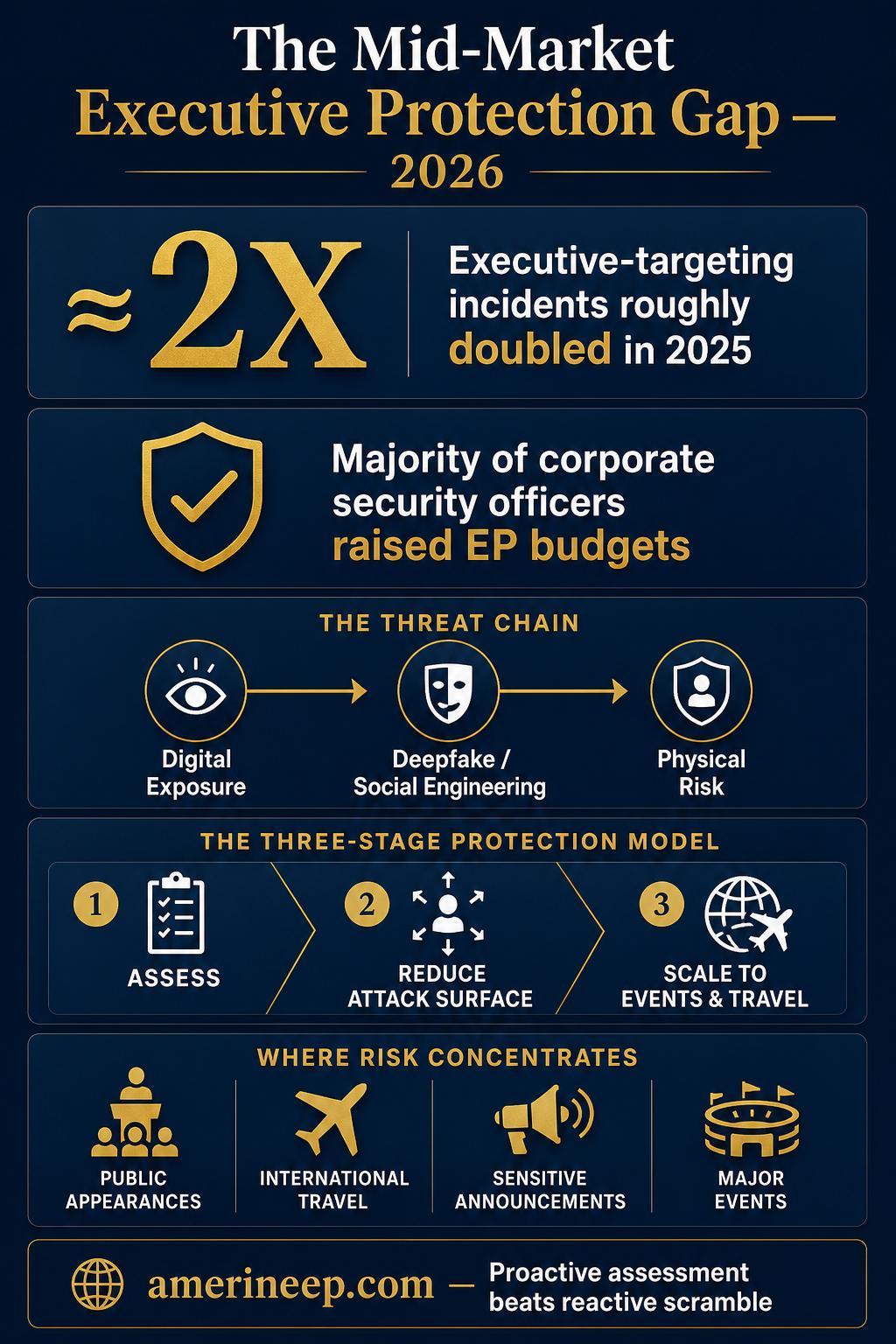
For years, executive protection was treated as something for CEOs of Fortune 100 household-name corporations and nobody else. That assumption is now outdated. The most recent industry threat reporting logged a sharp rise in executive-targeting incidents through 2025, roughly double the prior year's count. Deepfake-enabled impersonation and fraud, once a novelty, have become a routine part of the threat picture.
If your company sits in the $20M–$500M revenue range, this trend matters more than you might think. Mid-market leaders are increasingly visible, increasingly targeted, and almost never prepared. This article explains why the threat curve moved, what's actually driving it, and the practical steps a company can take before an incident — not after.
What's Actually Behind the Increase
Several forces are compounding at once. First, public exposure of leadership has never been higher. Executive bios, travel schedules, home-purchase records, and family details are aggregated and resold by data brokers, then amplified across social platforms. A motivated individual can assemble a usable profile in an afternoon.
Second, the line between physical and digital threats has blurred. Deepfake audio and video now power social-engineering schemes that start as fraud and escalate into physical risk — a fake "urgent" call from a CEO, a spoofed assistant, a coordinated approach at an event. Threat actors no longer need to choose between cyber and physical; they chain them.
Third, sentiment-driven targeting is up. Layoffs, contentious public statements, and high-profile disputes can each generate a wave of hostility directed at named individuals. The trigger is often unpredictable, which is exactly why a reactive posture fails.
The Mid-Market Blind Spot
Large enterprises typically have a dedicated corporate security function. Mid-market companies usually do not. The result is a familiar pattern: a concerning email arrives, a follow-at-an-event happens, or a credible online threat surfaces — and leadership scrambles to find help with no plan, no vetted vendor, and no baseline assessment.
Arranging protection in a panic is ineffective. Engaged under duress, vendor diligence gets skipped, and coverage is improvised. Engaged proactively, protection becomes a thoughtful, intelligence-led program with vetted protectors, rehearsed plans, and a partner who already knows your principals, properties, and travel patterns.
A Practical, Staged Approach
You do not need a full-time detail to be meaningfully more secure. Most mid-market companies should think in stages.
Stage 1 — Assess the Baseline
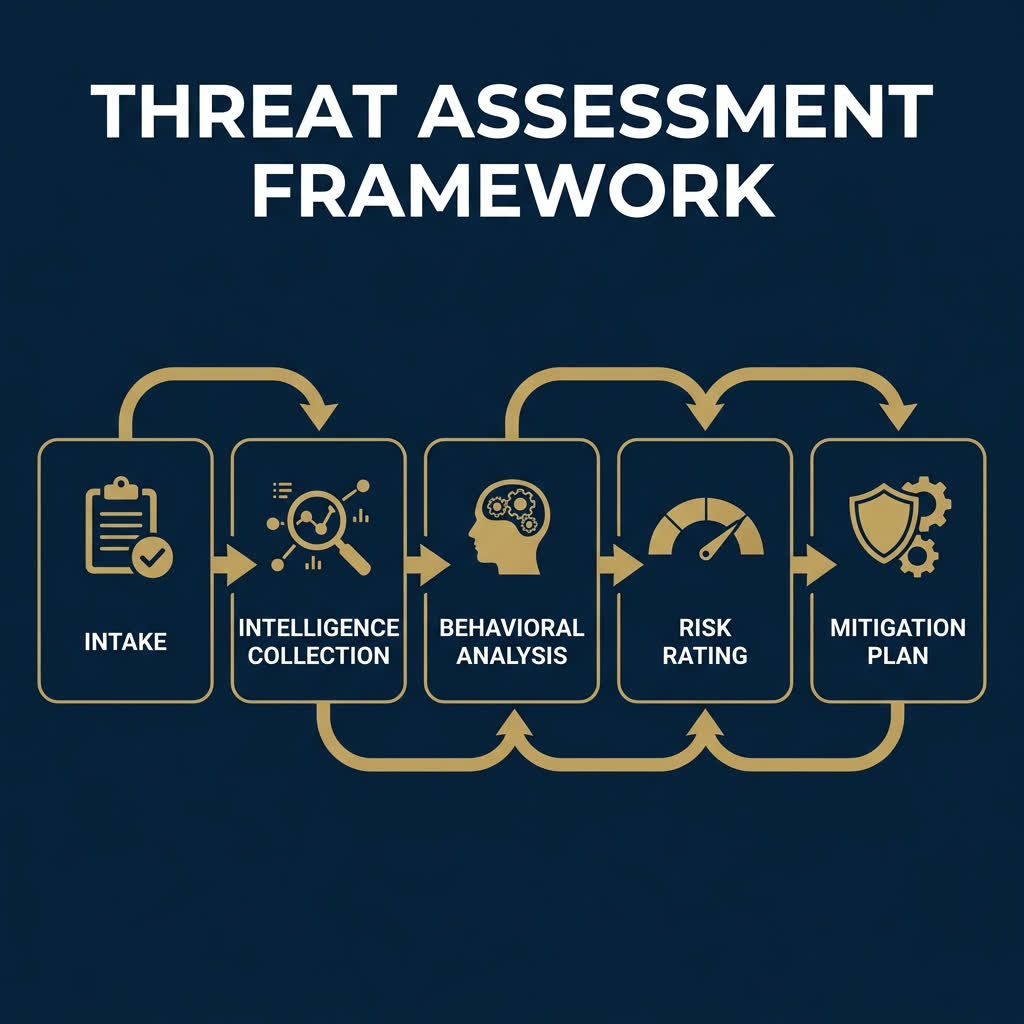
Start with a protective intelligence assessment: what's publicly exposed about key leaders, what the realistic threat vectors are, and where the gaps sit (travel, residence, events, digital footprint). This tells you whether you need more. A proper baseline includes open-source exposure mapping, data-broker presence, social-graph analysis, residence and routine review, and a candid conversation about which family members and assistants share the executive's risk surface.
Stage 2 — Reduce the Attack Surface
Much of the exposure is removable. Data-broker opt-outs, tightened privacy settings, travel-pattern discipline, and clear protocols for verifying executive requests — call-back numbers, code words, dual-channel confirmation — cut risk without a standing detail. These are the controls that make a deepfake voice-clone of the CEO useless to a fraudster.
Stage 3 — Scale Coverage to Events and Travel
When risk concentrates — a public appearance, international travel, a sensitive announcement, a major event — that's when event security and secure transportation earn their keep. An intelligence-led provider scales coverage up and down with the actual threat picture. Scope and terms are confirmed in writing. The principle: protection where the risk is, not where it isn't.
The Bottom Line
The doubling of executive-targeting incidents is not a headline to file away; it's a signal that the threshold for "companies that need a plan" has dropped well into the mid-market. The companies that fare best are the ones that assessed their exposure before anything happened and had a vetted partner on speed-dial.
If your organization has never run a baseline assessment, that's the place to start. Contact AMERINE about a protective intelligence review scoped to your leadership and your risk profile.
Sources & Further Reading
The figures and trends referenced above are drawn from publicly available industry threat reporting and corporate-security benchmarks. Readers conducting their own due diligence should consult the primary sources directly:
- Ontic — 2025 State of Protective Intelligence Report. Annual benchmark covering executive-targeting incidents, threat volume, and corporate-security program maturity. ontic.co/resources
- Allied Universal — World Security Report (in partnership with The Center for Audit Quality / FT Longitude). Surveys Chief Security Officers at large enterprises on threat trends. aus.com/world-security-report
- Global Guardian — Annual Threat Forecast. Geopolitical and executive-targeting threat outlook for corporate travelers and leadership teams. globalguardian.com/insights
- FBI Internet Crime Complaint Center (IC3) — Annual Report. Primary U.S. government source for deepfake, business email compromise, and impersonation-fraud trend data. ic3.gov/AnnualReport
- U.S. Department of Homeland Security — Homeland [Threat Assessment](/threat-assessment-services). Annual assessment covering domestic violent extremism, targeted violence, and threats to public figures. dhs.gov/publication/homeland-threat-assessment
- ASIS International — Enterprise Security Risk Management resources. Industry guidance on protective-program design. asisonline.org
Figures cited as "roughly doubled" reflect directional trends across the reports above as of the most recent reporting cycle; exact percentages vary by methodology and survey population. Where this article uses approximate language ("roughly"), readers should verify the latest published numbers before citing them in their own materials.
---
General security-planning commentary. Not legal advice. Threat data references industry reporting on 2025 executive-targeting trends; readers should verify against current primary sources listed above.