Building a Comprehensive Family Office Security Program
Family offices are responsible for protecting assets and the people behind them. A comprehensive security program brings multiple protective disciplines into a coordinated strategy that adapts to the family's lifestyle and risk profile.
The Challenge of Fragmented Security
For many UHNW families, security is fragmented across vendors: one handles residential security, another handles transportation, and a third handles travel protection. That split creates dangerous gaps.
- Communication Breakdowns: Information doesn't flow between security elements
- Inconsistent Standards: Quality varies wildly between providers
- No Single Point of Accountability: When issues arise, nobody owns the problem
- Fiduciary Exposure: Incomplete documentation creates liability
Components of a Comprehensive Security Program
A well-designed family office security program addresses multiple dimensions:
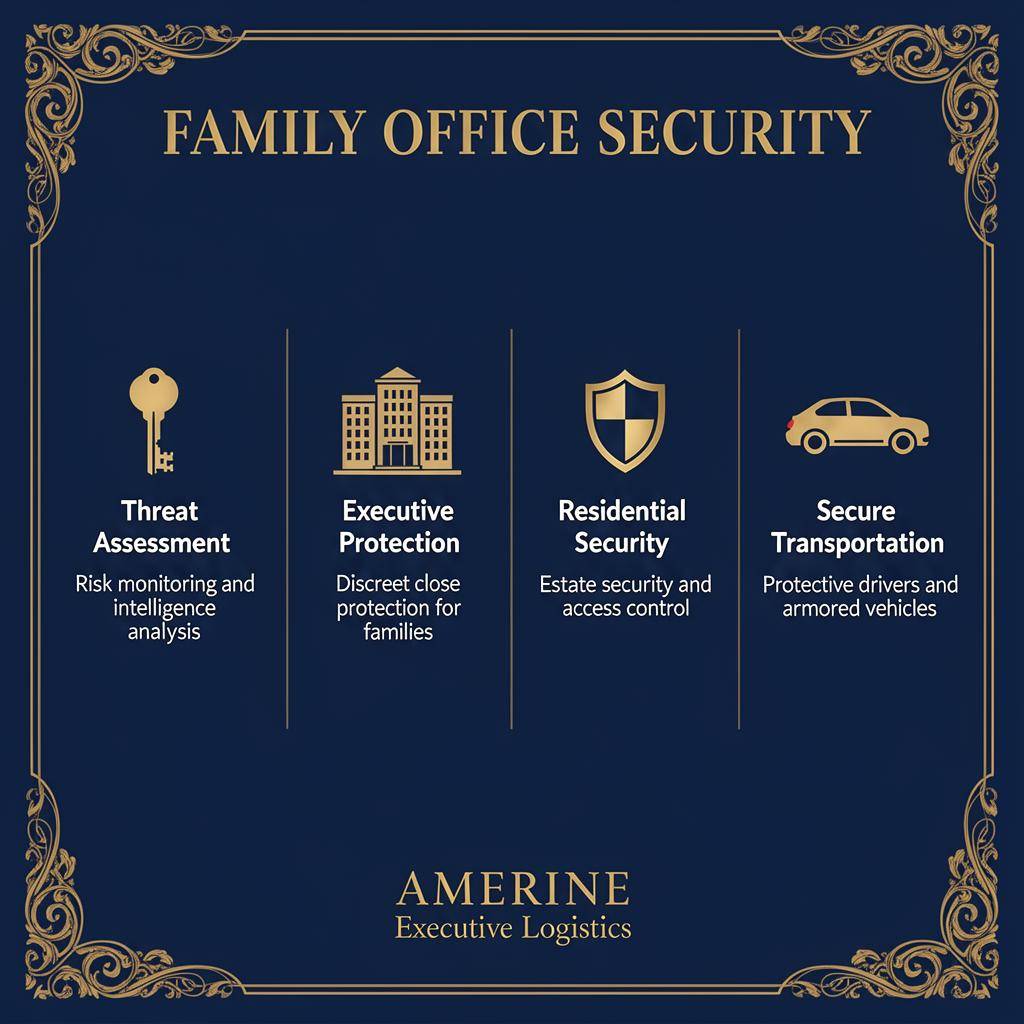
1. [Threat Assessment](/threat-assessment-services) & Intelligence
To build an effective security program, you first need to understand the threats. That means analyzing the family's visibility and public profile, assessing geographic risks at residences and frequent destinations, monitoring social media and open-source intelligence, and mapping relationships to identify potential threat actors.
2. [Executive Protection](/executive-protection-services)
Close protection services fit the family's lifestyle through discreet operators who blend with household dynamics and coverage that scales with travel, events, and threat levels. These services integrate with residential and transportation security and use family-friendly approaches that don't alarm children.
3. Residential Security
Comprehensive estate protection combines guard coverage by vetted professionals with technical systems such as cameras, alarms, and access control. It also includes emergency response protocols, safe room procedures, and security awareness training for staff.
4. [Secure Transportation](/services/executive-transportation)
Protecting all family members while they're on the move involves vetted protective drivers with advanced training, route planning, and real-time monitoring. Secure vehicle programs and coordination of airport and travel logistics are also part of that protection.
5. Travel Security
Protection for domestic and international travel includes coordinating advance teams and providing destination threat briefings. It also covers security assessments of hotels and venues, along with emergency evacuation planning.
Reporting & Governance
Family offices need documentation that satisfies fiduciary requirements:
- Quarterly Security Reports: Comprehensive overview of security posture, incidents, and recommendations
- Threat Assessment Updates: Regular analysis of evolving risks
- Program Metrics: Quantifiable measures of security program effectiveness
- Board-Ready Summaries: Executive-level briefings for family governance
Building Your Program
Creating a comprehensive security program requires:
- Assessment Phase: Understand current security gaps and family requirements
- Design Phase: Develop integrated program architecture
- Implementation Phase: Deploy personnel, technology, and procedures
- Optimization Phase: Continuous improvement based on experience and evolving threats
The Single Provider Advantage
Working with a single security partner offers significant benefits:
- One point of contact for all security matters
- Integrated information sharing across all security elements
- Consistent quality standards and vetting
- Simplified vendor management
- Single source of accountability
Next Steps
If your family office is evaluating security programs, you're invited to schedule a confidential assessment. Our team will assess your current security measures and recommend ways to build a comprehensive protection program.