Why Every UHNW Family Needs a Security Program
As your family's net worth grows, wealth brings both opportunity and exposure to a wider range of threats, from targeted burglary and kidnapping to social engineering, cyber fraud, and reputational attacks. Most high-net-worth families still handle security reactively, putting measures in place only after an incident.
A family security program brings protection for your family, assets, and privacy into a proactive, integrated framework that covers every part of daily life. Rather than a single product or service, it's a comprehensive system built around your family's particular lifestyle, travel patterns, and risk profile.
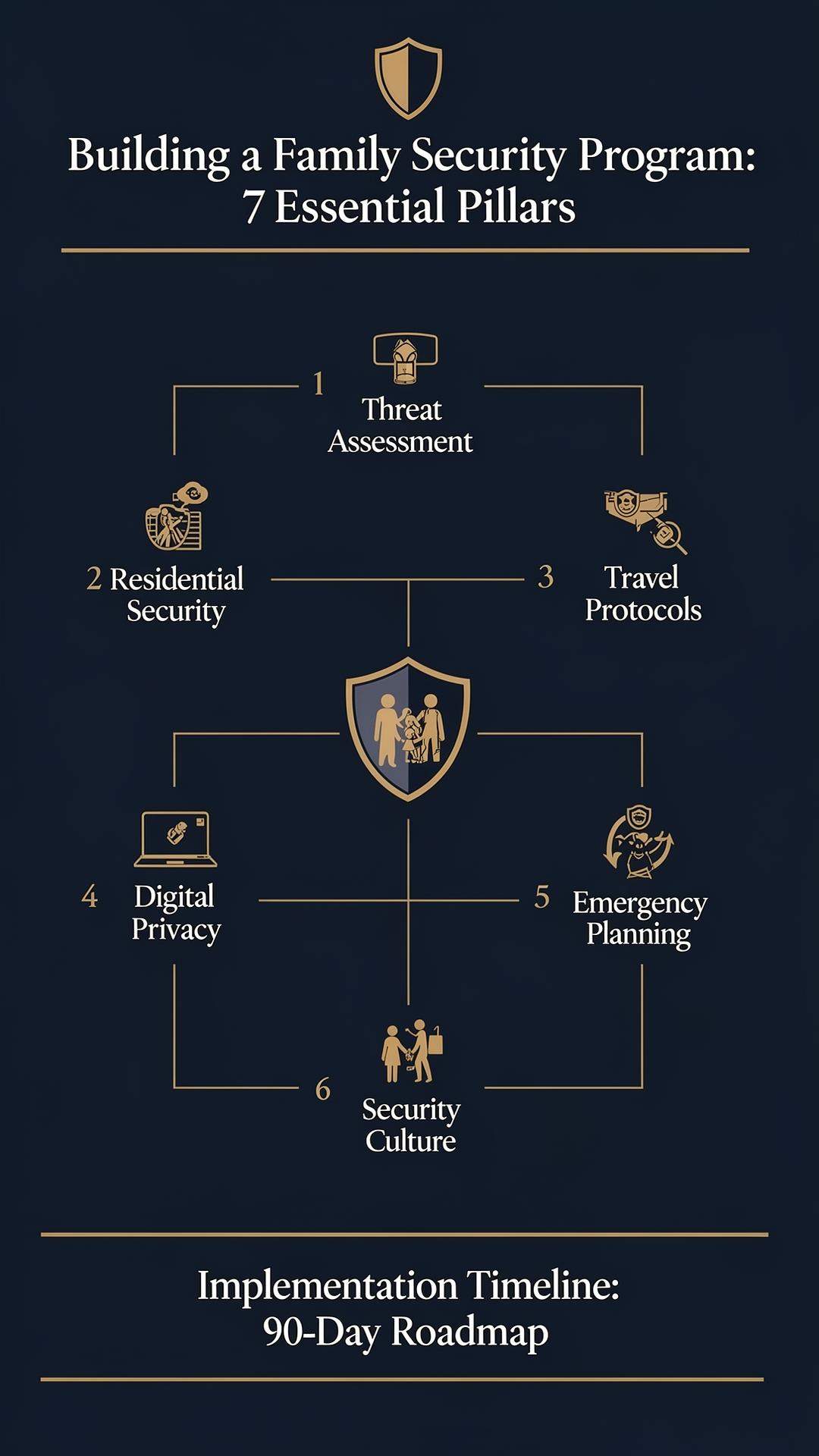
!Building a Family Security Program: 7 Essential Pillars
The 7 Pillars of a Family Security Program
Pillar 1: Comprehensive Threat Assessment
Every effective security program begins with understanding what you are protecting against. A professional threat assessment evaluates:
Your Personal Threat Profile covers public visibility and media exposure, along with risks specific to your industry, such as finance, technology, or energy. It also accounts for geographic risks at your residences and frequent destinations, your social media footprint and digital exposure, and any known adversaries, legal disputes, or contentious business dealings.
A Family Vulnerability Analysis examines your children's school and activity schedules, your spouse/partner's professional and social activities, and extended family members' exposure levels. It also looks at domestic staff access and background verification, plus routines that make your family's movements predictable.
A professional assessment establishes your Baseline Risk Rating, which guides every security decision that follows. Threat assessments aren't a one-time exercise: update them annually or whenever circumstances change significantly, such as new business ventures, divorce proceedings, or public controversy.
Pillar 2: Residential Security
Your home should be your most secure environment. Residential security encompasses:
Your Physical Security Infrastructure includes perimeter protection through fencing, gates, barriers, and access control, plus surveillance cameras, motion detection, and monitoring. It also includes alarm systems connected to 24/7 monitoring centers, safe rooms or hardened spaces for shelter-in-place scenarios, and lighting designed to eliminate blind spots.
Access Management covers controlled entry points with visitor verification protocols and staff credentials that grant permissions by zone. It also includes screening procedures for deliveries and service providers, along with vehicle access management for family, staff, and visitors.
Security Personnel include residential security officers, armed or unarmed depending on the assessment, and estate managers trained in security. Clear protocols cover shift changes, incident reporting, and emergency response.
The Key Principle: Layer residential security with multiple overlapping measures to create depth of defense. Don't let any single system become a single point of failure.
Pillar 3: Travel Security Protocols
Travel is the highest-risk activity for most UHNW families. Travel protocols should include:
Pre-Travel Planning covers a destination threat assessment for every trip, primary and alternate routes, and secure transportation arrangements with vetted drivers and armored vehicles when warranted. It also includes evaluating accommodation security, identifying medical facilities, and planning for emergency evacuation.
In-Transit Security includes executive protection agents for high-risk destinations and communication protocols with scheduled check-ins. Measures also cover luggage and document security, plus procedures for airport and ground transportation security.
Aviation Security covers private aviation security screening and evaluation of FBO (Fixed-Base Operator) security. It also includes international arrival and departure protocols, along with crew vetting for charter flights.
For Family Travel Standards, set minimum security standards according to destination risk level and create a "no-go" list of destinations requiring enhanced measures. Develop age-appropriate security awareness for children who travel.
Pillar 4: Digital Privacy and Cybersecurity
Digital threats are the fastest-growing risk category for UHNW families:
Personal Device Security combines encrypted communications, such as Signal and encrypted email, with device management and secure configuration. It also includes multi-factor authentication on all accounts and regular security audits of personal devices.
Managing your Social Media and Digital Footprint includes a social media policy for all family members, an audit and reduction of your digital footprint, and monitoring for unauthorized exposure of information. Protocols also cover photography and location sharing.
Cyber Threat Protection includes phishing awareness training for family and staff, plus dark web monitoring for compromised credentials. Identity theft protection and monitoring services, along with secure home network architecture, are also part of that protection.
Financial Account Security includes wire transfer verification protocols with callback confirmation and account alerts configured for unusual activity. It also calls for separating personal and business digital infrastructure and regularly rotating financial account credentials.
Pillar 5: Executive Protection
For families with elevated threat profiles, dedicated executive protection provides:
Protective Operations cover close protection agents for daily activities and advance work for events, meetings, and travel. They also include counter-surveillance to detect and deter threats, along with secure transportation provided by trained drivers.
Scalable Protection
- Baseline protection level for normal conditions
- Enhanced protection protocols for elevated threat periods
- Surge capacity for specific events or situations
- Coordination with local law enforcement when appropriate
Selection Criteria for EP Providers include a government protection background, such as the Secret Service or Diplomatic Security, extensive international experience, and a discreet, professional demeanor suited to UHNW environments. Medical training with EMT/paramedic certification and cultural competency for international assignments are also selection criteria.
Pillar 6: Emergency Planning and Crisis Response
Emergency Action Plans include response protocols specific to each scenario, such as a home invasion, medical emergency, natural disaster, or active threat. They also cover rally points and evacuation routes from all residences, a communication tree with emergency contacts and backup channels, and go-bag preparation for a rapid departure.
Crisis Communication includes a spokesperson designated in advance to handle media inquiries, along with social media response protocols. It also covers procedures for notifying legal counsel and protocols for contacting the insurance company.
Business Continuity covers succession planning considerations and backups of critical documents and information. It also includes alternative procedures for communication and decision-making, plus financial access during a crisis.
Pillar 7: Security Culture
The most sophisticated security program fails without buy-in from everyone in the family ecosystem:
Family Education includes age-appropriate security awareness for children and regular family briefings on current threats and protocols. Scenario-based exercises cover what to do if someone approaches or follows you, among other situations. Keep the framing positive: security enables freedom rather than restriction.
Staff Training covers security awareness for all household staff, background verification, and periodic re-screening. It also includes clear protocols for reporting suspicious activity, along with confidentiality agreements and their enforcement.
Vendor and Service Provider Management covers vetting protocols for all service providers who have home access, escort requirements for contractors and repair personnel, and regular reviews of vendor access and credentials. It also includes compartmentalizing information so staff know only what they need.
The 90-Day Implementation Roadmap
Days 1–30: Assessment and Foundation
- Conduct comprehensive threat assessment
- Audit current residential security measures
- Review existing insurance coverage (including K&R)
- Assess digital footprint and cybersecurity posture
- Identify highest-priority gaps
Days 31–60: Critical Infrastructure
- Implement priority residential security upgrades
- Establish secure communication protocols
- Deploy personal device security measures
- Create emergency action plans for primary residence
- Begin executive protection evaluation (if warranted)
Days 61–90: Integration and Training
- Conduct family security briefing
- Train household staff on security protocols
- Test emergency response procedures
- Establish ongoing monitoring and review schedule
- Document all protocols in a Family Security Manual
Family Security Program Scope
Investment varies dramatically based on the family's risk profile and lifestyle:
- Assessment and planning: Initial comprehensive assessment
- Residential security upgrades: Depending on property and measures required
- Executive protection: Full-time protection
Why Work with AMERINE
At AMERINE Executive Logistics, building comprehensive family security programs for UHNW families and family offices is our specialty. We take a distinctive approach:
- [Former Secret Service](/former-secret-service-protection) methodology applied to private-sector family protection
- Whole-program design covering all seven pillars instead of one dimension
- White-glove service that fits quietly into your family's lifestyle
- Global capability with operations in 45+ countries
- Discretion as a core value — your security is never a spectacle
We begin every engagement with a confidential consultation to understand your family's unique circumstances, concerns, and objectives.
Contact AMERINE to schedule a confidential family security consultation, or call (281) 799-1877.