Most people don't think about personal security until something goes wrong. By systematically checking your digital footprint, physical environment, and daily habits for vulnerabilities, a personal security audit prevents you from becoming a statistic.
At AMERINE, we audit security for UHNW families, corporate executives, and high-profile individuals with a methodology developed during careers in the U.S. Secret Service. A simplified version of that framework lets you start assessing your own security today.
What Is a Personal Security Audit?
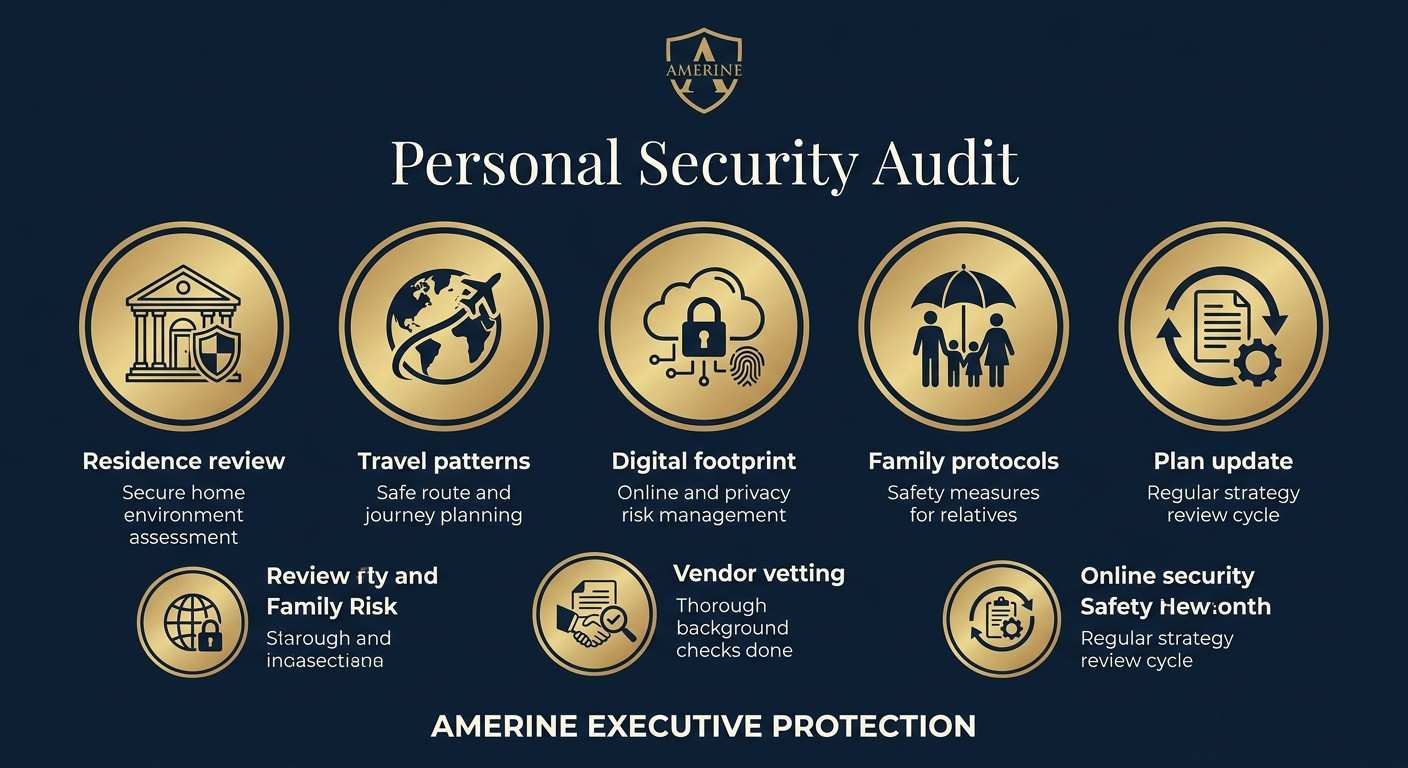
A personal security audit is a structured self-assessment that identifies vulnerabilities across several areas:
- Digital life (online accounts, social media, data exposure)
- Physical environment (home, office, vehicle, travel routes)
- Travel patterns (domestic and international)
- Personal habits and routines
- Emergency preparedness
- Family and household security
You're looking to identify realistic risks and put practical countermeasures in place, not create paranoia. The aim is to protect you and your family without disrupting your quality of life.
Step 1: Digital Security Audit
Your digital footprint is often your biggest vulnerability. Start here:
Password and Account Security
- Are you using unique, complex passwords for every account? If not, this is your #1 vulnerability.
- Is two-factor authentication (2FA) enabled on all critical accounts, especially email, banking, and social media?
- When was the last time you changed passwords on sensitive accounts?
- Are you using a reputable password manager like 1Password or Bitwarden?
- Have any of your accounts appeared in known data breaches? Check at haveibeenpwned.com.
- Do you have a recovery plan if your primary email is compromised?
Social Media Exposure
- Are your personal accounts set to private, or is your information visible to anyone?
- Do your posts reveal your real-time location, daily routines, travel plans, or home address?
- Have you searched your own name to see what is publicly available about you?
- Are family members, especially children, visible on social media with identifying information?
- Do you accept connection requests from people you do not personally know?
- Have you audited third-party app permissions on your social accounts?
Email and Communication Security
- Are you using encrypted messaging for sensitive communications (Signal, ProtonMail)?
- Do you recognize phishing attempts and social engineering tactics?
- Is your primary email address publicly listed anywhere, such as LinkedIn, a company website, or domain registrations?
- Do you have a separate email for sensitive accounts versus general subscriptions?
Data and Privacy
- Have you reviewed your data broker exposure? Sites like Spokeo, WhitePages, and BeenVerified often list your address, phone number, and family members.
- Is your home address connected to your vehicle registration, voter records, or business filings?
- Do you use a PO box, registered agent, or trust for property ownership and business registrations?
- Have you opted out of data broker sites?
Step 2: Physical Security Audit
Home Security Assessment
- Is your alarm system monitored with a cellular backup, rather than relying on Wi-Fi alone?
- Are all exterior doors solid-core, fitted with deadbolts and reinforced strike plates?
- Do exterior cameras cover every entry point and retain at least 30 days of recorded footage?
- Is the property perimeter clearly defined and adequately lit?
- Do you have a safe room or secure space with working communication equipment?
- Are ground-floor windows secured with dedicated locks or protective film?
- Do you have a direct contact with local law enforcement, such as a community liaison officer?
- Can emergency responders easily read your house or property number from the road?
Office and Workplace Security
- Is your office located in a controlled-access building?
- Are visitors required to sign in and stay escorted?
- Can people see your workspace from public areas or street-facing windows?
- Do you have a locked, secure space for sensitive documents and hardware?
- Does your organization run a workplace violence prevention program?
- Has your team actually practiced your emergency action plan?
Vehicle Security
- Do you park in well-lit, monitored areas?
- Do you check your vehicle for signs of tampering before getting in?
- Does your vehicle have GPS tracking for recovery purposes rather than surveillance?
- Do you switch up where you park when you can?
- Are your registration and insurance cards locked away rather than left out in plain view?
- Is your vehicle maintained on schedule to prevent breakdowns in bad spots?
Step 3: Travel Security Audit
Routine Travel
- Do you vary your daily routes to work, school, gym, and other regular destinations?
- Are you aware of your surroundings when arriving at and departing from your home?
- Do you have alternate routes planned for your regular commute?
- Do you avoid predictable patterns (same coffee shop at the same time every day)?
Domestic Travel
- Do you research hotels for security features before booking (interior corridors, electronic locks, camera coverage)?
- Do you request rooms between the 2nd and 6th floors (above ground-floor vulnerability, below fire department ladder reach)?
- Do you share your travel itinerary with a trusted contact?
- Do you know the location of the nearest hospital and police station at your destination?
International Travel
- Do you research your destination's security environment before departure?
- Do you register with the State Department's STEP program for international trips?
- Do you have copies of your passport, visa, and insurance stored separately from originals?
- Do you know how to contact the nearest U.S. embassy or consulate?
- Do you have a communication plan that works internationally (local SIM, satellite phone, messaging apps)?
- Have you reviewed your destination for specific risks: crime, terrorism, health, political instability?
Step 4: Personal Habits Audit
Routine Variation
- How predictable are your daily movements? Could an observer easily determine where you will be at any given hour?
- Do you post plans on social media before events take place?
- Do you share your schedule with people outside your immediate circle?
- Do you vary the times you leave and arrive at regular locations?
Situational Awareness
- Do you pay attention to your surroundings, or are you typically looking down at your phone?
- Can you describe the people and vehicles around you when you arrive somewhere?
- Do you notice when someone appears in multiple locations along your route?
- Are you aware of baseline behavior in familiar environments, and can you spot anomalies?
Information Sharing
- How much personal information do you share with service providers, contractors, or casual acquaintances?
- Do household staff, contractors, or service personnel know your daily schedule and upcoming travel plans?
- Are your children clear on what details they should and should not share with others?
Step 5: Emergency Preparedness Audit
Emergency Contacts and Plans
- Do you keep an updated contact list covering personal, medical, legal, and private security contacts?
- Does your family have an agreed-upon rally point if an incident separates you?
- Do you have a secondary communication plan for when cellular networks drop?
- Can your family and key associates access these emergency contacts immediately?
Emergency Documents
- Do you have duplicate copies of core records (passports, IDs, insurance, medical files) stored securely off-site and in an encrypted digital format?
- Are your will, power of attorney, and advance healthcare directives current and easy to retrieve?
- Do you keep physical emergency cash accessible, rather than relying entirely on cards?
Go-Bag and Supplies
- Do you have a packed go-bag stocked with 72 hours of basic necessities?
- Does your residence have dedicated contingency supplies, including water, food, medical gear, flashlights, and an emergency radio?
- Do you keep proper equipment in your vehicle for roadside emergencies?
- Has your family completed basic first aid training?
Step 6: Family and Household Security
Family Members
- Does everyone in the household follow everyday security basics: locking doors, keeping personal plans private, and spotting unusual activity?
- Do children know what to do in an emergency, including how to call for help?
- Are older family members protected against scams and social engineering attempts?
- Do family social media profiles give away your daily routines, wealth, or real-time location?
Household Staff and Service Providers
- Have you run background checks on all domestic staff?
- Do service providers, such as cleaners, landscapers, and maintenance crews, have unsupervised access to your home?
- Are alarm codes, WiFi passwords, and other security credentials updated whenever a staff member departs?
- Do you have NDAs with household staff covering family privacy?
Scoring Your Audit
Rate each section on a scale of 1-5:
- 1: Critical gaps. Major vulnerabilities with no mitigation
- 2: Significant gaps. Multiple vulnerabilities with minimal protection
- 3: Moderate. Basic protections in place, but room for improvement
- 4: Strong. Comprehensive protections with minor gaps
- 5: Excellent. Professional-grade security posture
Overall Score Guide:
- 10-20: Critical. Engage a professional security consultant immediately
- 21-35: Significant gaps. Prioritize improvements in weakest areas
- 36-45: Moderate. You have a foundation, but need professional fine-tuning
- 46-50: Strong. Maintain vigilance and conduct annual reviews