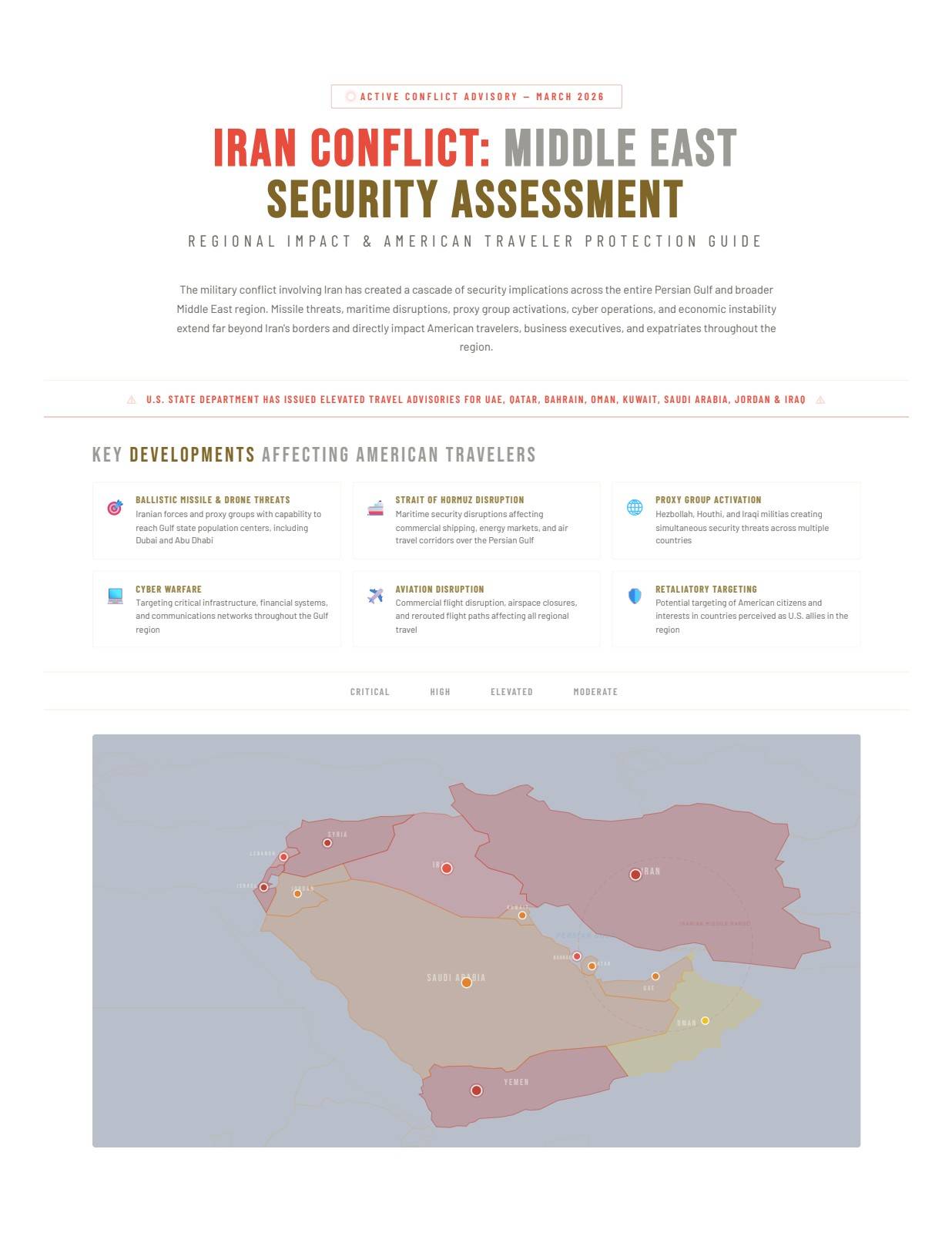
The Current Situation: Understanding the Iran Conflict's Regional Impact
American travelers, corporate executives, and expatriates living and working in the Middle East face direct effects from the military conflict involving Iran. The conflict has shaken security across the Persian Gulf and the wider region. Direct combat may remain confined to specific theaters, but missile strikes, maritime incidents, proxy mobilizations, cyber operations, and market volatility carry the fallout far beyond Iranian borders.
As of late March 2026, elevated U.S. State Department travel advisories remain in place for multiple destinations across the region. If you're an American in or traveling to the UAE (including Dubai and Abu Dhabi), Qatar, Bahrain, Oman, Kuwait, Saudi Arabia, Jordan, or Iraq, track these notices closely and keep active contingency plans in place.
Key developments affecting American travelers:
- Ballistic missile and drone threats from Iranian military units and proxy groups capable of reaching Gulf population centers, including Dubai and Abu Dhabi
- Disruptions to maritime security in the Strait of Hormuz that spill over into commercial shipping, energy markets, and Persian Gulf flight corridors
- Mobilization of Iranian-backed proxy networks (Hezbollah, Houthi, and Iraqi militias), creating simultaneous security risks across multiple borders
- Intensified cyber warfare aimed at critical infrastructure, banking systems, and telecommunications networks across the Gulf
- Threat of retaliatory strikes or harassment against American citizens and commercial interests in allied nations
- Commercial flight cancellations, reroutes, and sudden airspace closures across the region
If You Are Currently in the Middle East: Immediate Action Steps
If you're an American in Dubai, Abu Dhabi, Doha, Manama, Muscat, or elsewhere in the Persian Gulf region right now, act immediately on the following steps:
Step 1: Register and Communicate
- Enroll in the Smart Traveler Enrollment Program (STEP) at step.state.gov if you haven't already. This is how the U.S. government reaches citizens in an emergency.
- Contact the nearest U.S. Embassy or Consulate to confirm their current operating status.
- Share your exact location, accommodation details, and travel plans with a trusted contact stateside.
- Establish check-in protocols: communicate with your stateside contact every 4-6 hours during waking hours.
- Agree on a duress code that signals you need help without alerting anyone listening.
Step 2: Understand Your Shelter and Evacuation Options
- Identify the nearest shelter or safe room in your hotel or accommodation.
- Know the exact location of the nearest hospital and U.S. diplomatic facility.
- Map out multiple routes to the nearest international airport.
- Identify alternative departure points (Abu Dhabi if Dubai is disrupted, Oman as an alternate to UAE).
- Keep your passport, essential documents, medications, and cash accessible at all times. Keep them packed in a "go bag" if possible.
- Pre-identify commercial flight options as well as private aviation charter services for emergency departure.
Step 3: Maintain Situational Awareness
- Monitor U.S. Embassy alerts, local government communications, and trusted news sources in real-time.
- Avoid areas near military installations, government buildings, and critical infrastructure (ports, oil facilities, power plants).
- Stay away from large public gatherings, protests, and demonstrations.
- Track the locations of known missile defense systems. Their activation often indicates incoming threats.
- Download local emergency alert apps for the country you are in.
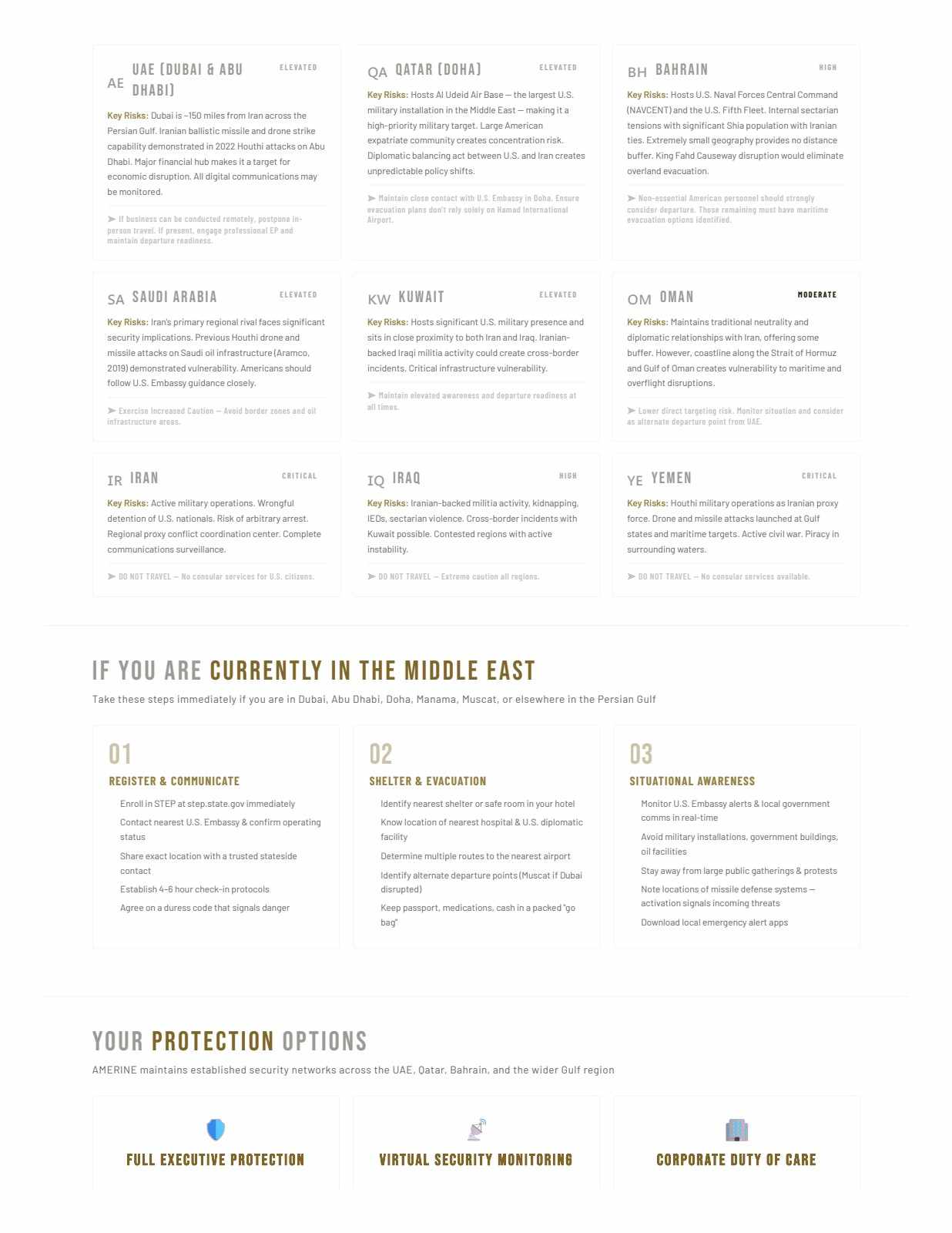
Country-by-Country Assessment for American Travelers
United Arab Emirates (Dubai & Abu Dhabi)
Current Risk Level: Elevated (upgraded from Low due to Iran conflict)
Dubai is roughly 150 miles from Iran, and the UAE sits directly across the Persian Gulf from it. That puts the country well within reach of Iranian ballistic missiles and loitering munitions. The UAE fields advanced missile defense batteries, including THAAD and Patriot systems, but no air defense system can stop every incoming threat.
For Americans in the UAE, concerns include Iranian missile and drone capabilities demonstrated during the 2022 Houthi strikes on Abu Dhabi. Dubai's role as a regional financial and commercial center makes it an attractive target for economic disruption. Cybersurveillance is pervasive, so travelers should assume all electronic communications are subject to monitoring. Dubai International Airport could face flight cancellations and ground halts. The UAE's close defense ties with Washington also put American citizens and corporate assets at risk as targets of opportunity. Vulnerable domestic energy infrastructure could trigger broader economic and supply-chain fallout.
If you can handle your UAE work remotely, put off the trip until conditions stabilize. Already there, or unable to avoid travel? Hire professional protective security and keep backup departure plans in place.
Qatar (Doha)
Current Risk Level: Elevated
Qatar hosts Al Udeid Air Base, the largest U.S. military installation in the Middle East. That footprint gives the country immense strategic weight, but it also turns it into an obvious target. Doha has long maintained diplomatic channels with Tehran. That relationship provides some political buffer, but it offers no real guarantee of safety for private American citizens.
For Americans in Qatar, Al Udeid's status as a priority military objective in an expanded regional exchange is a concern, along with missile or drone strikes aimed at defense installations or utility grids. Qatar's ongoing balancing act between Washington and Tehran could bring sudden policy changes. Its large population of American expatriates and business teams creates concentration risk. Infrastructure built for the 2022 FIFA World Cup also presents high-density target environments despite its crowd-management systems.
Keep in regular contact with the U.S. Embassy in Doha, and don't build your evacuation plans around Hamad International Airport alone. Identify backup routes by sea or over land.
Bahrain
Current Risk Level: High
Hosting U.S. Naval Forces Central Command (NAVCENT) and the U.S. Fifth Fleet makes Bahrain one of the Gulf's most important, and most exposed, operational hubs. The island's sizable Shia population has historic ties to Iran, which also creates persistent concerns about domestic stability.
Americans in Bahrain face an immediate targeting risk because of the primary American naval presence. Regional combat operations could worsen domestic sectarian friction, while the island's limited physical geography leaves minimal distance from potential strike areas. Overland evacuation depends on the King Fahd Causeway: if that bridge to Saudi Arabia closes, the overland option ends. Prior Houthi missile and drone launches targeting the kingdom are another concern.
If you're among Bahrain's non-essential American personnel, strongly consider leaving during active combat operations. If you must stay, coordinate with the U.S. Embassy and arrange maritime evacuation routes in advance.
Oman, Kuwait & Saudi Arabia
Oman gets some insulation from the dispute through its traditional neutrality and working diplomatic lines with Tehran, both of which it has maintained. Its location along the Strait of Hormuz and the Gulf of Oman still exposes its waters and airspace to transit disruptions. Direct targeting hazards are lower for Americans in Oman, but keep following events closely.
A substantial American troop presence is based in Kuwait, which borders both Iraq and Iran. Iranian-backed Iraqi militias' actions continue to pose a cross-border concern. If you're an American there, stay vigilant and keep your departure plans ready.
As Iran's primary regional adversary, Saudi Arabia faces serious security risks. Attacks on Aramco facilities in 2019 showed the continuing vulnerability of oil infrastructure to coordinated drone and cruise missile strikes. If you're an American in the Kingdom, follow U.S. Embassy security messages without delay.
If You Are Considering Travel to the Region
The Decision Framework
Before booking travel to the Middle East during the current conflict, work through these baseline questions:
- Is this travel truly essential? If meetings can be postponed or moved online, stay home. That is the safest option.
- What is the current State Department advisory level? Check travel.state.gov for real-time advisories.
- Do you have professional security support? Traveling without executive protection, or at minimum virtual security monitoring, is inadvisable during active hostilities.
- Do you have an evacuation plan? Secure multiple exit strategies across different modes of transport and through alternate countries.
- Is your employer fulfilling [duty of care](/duty-of-care-security)? Corporate travelers should confirm their organization has an active crisis management plan for the region.
Pre-Travel Security Measures
If travel cannot be avoided:
- Commission a professional threat assessment tailored to your specific destination and itinerary.
- Arrange executive protection through a firm with established operations in the Gulf (AMERINE maintains vetted security networks across the UAE, Qatar, Bahrain, and the broader region).
- Pre-arrange secure transportation. Do not rely on ride-share apps or street cabs in a conflict environment.
- Establish a communication link with an operations center tracking local events.
- Carry a satellite communication device. Cellular networks frequently fail or face disruption during military actions.
- Purchase comprehensive travel insurance that includes war risk and medical evacuation coverage.
- Pack a "go bag" with 72 hours of essential supplies, physical copies of critical documents, cash in multiple currencies, and necessary medications.
Secure Your Digital Life
Cyber operations represent a major element of this conflict:
- Run a VPN across all devices (note: authorities restrict certain VPNs in the UAE).
- Rely on encrypted messaging (Signal) for sensitive conversations.
- Travel with clean devices instead of primary laptops and phones carrying sensitive company data.
- Turn off Bluetooth and disable Wi-Fi auto-connect.
- Assume hotel and airport Wi-Fi networks in the Gulf are monitored by state intelligence services.
- Never discuss sensitive military, political, or corporate matters over open channels.
Your Protection Options
Option 1: Full Executive Protection Detail
For high-net-worth individuals, corporate executives, and anyone traveling to the Gulf during this period, a professional EP team provides:
- Close protection with agents experienced in Middle East operations
- Secure ground transportation with protective drivers familiar with evacuation routes
- Real-time intelligence from a Global Security Operations Center (GSOC) monitoring military and security developments
- Emergency extraction planning with pre-positioned resources
- Coordination with U.S. Embassy and local security services
Services are delivered by appropriately licensed personnel where state law requires it. Licensing, staffing and response times are confirmed in writing before each engagement.
Option 2: Virtual Security Monitoring
For Americans currently in lower-risk areas or those who need ongoing situational awareness:
- Real-time tracking and check-in protocols with an operations center
- Instant alerts on military activity, missile threats, and security incidents near your location
- Emergency response coordination if an incident occurs
- Medical evacuation planning and coordination
- Pre-planned evacuation routing with multiple exit strategies
Option 3: Corporate Duty of Care Programs
For companies with employees, contractors, or operations in the Gulf:
- Enterprise-level threat monitoring across all Gulf locations
- Employee tracking and mass notification systems
- Crisis management planning and tabletop exercises
- Evacuation coordination for groups
- Compliance documentation for duty of care obligations
Maritime & Aviation Considerations
Strait of Hormuz
The Strait of Hormuz carries approximately 20% of the world's oil. Iran's military capability to disrupt that chokepoint directly affects the following:
- Commercial shipping schedules and supply chains
- Energy prices and availability in the region
- Maritime evacuation options for Americans in the Gulf
- Naval vessel movements that may attract targeting
Aviation
- Monitor airspace closures in real time: Iranian airspace and Iraqi airspace may be restricted.
- Flight paths over the Persian Gulf may be rerouted, causing significant delays.
- Dubai International Airport (DXB) and Abu Dhabi (AUH) may experience disruptions.
- Identify alternative airports: Muscat (MCT), Kuwait (KWI), or even Amman (AMM) as potential departure points.
- Pre-identify private aviation charter options for emergency departure. AMERINE can coordinate this.
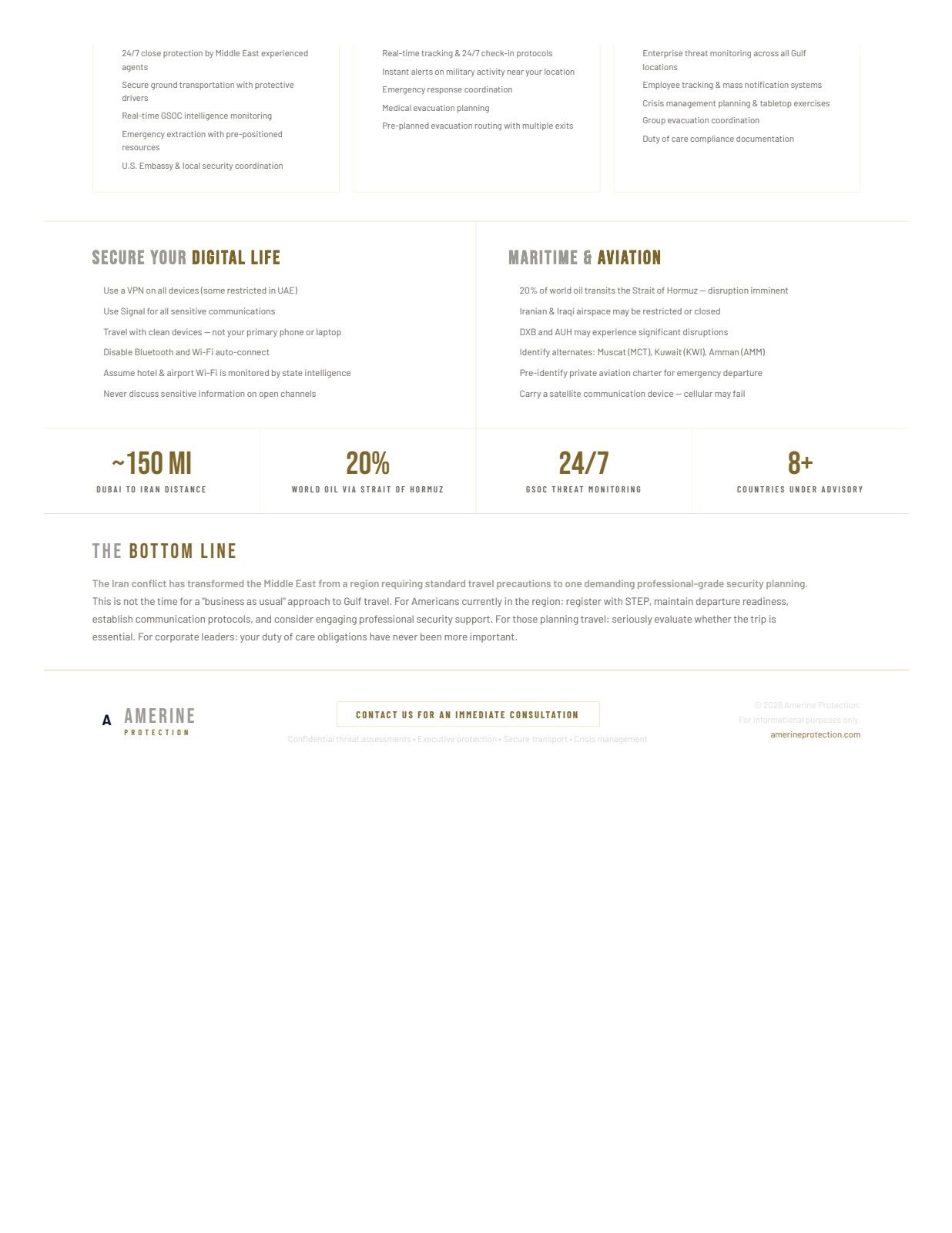
The Bottom Line
Standard travel precautions once sufficed in the Middle East; the Iran conflict has made it a region that demands professional-grade security planning. Gulf travel now calls for a departure from "business as usual".
If you're an American already in the region, register with STEP and stay ready to depart. Set clear communication protocols and consider professional security support.
Before you travel, assess whether the trip is essential. If it is, invest in security preparation that includes executive protection, secure transportation, real-time monitoring, and evacuation planning.
As a corporate leader, your duty of care obligations to personnel traveling to or stationed in the Gulf have never been more serious. Make sure your crisis management plans are up to date, tested, and fully resourced.
Individuals and organizations operating throughout the Middle East can turn to AMERINE for confidential threat assessments, executive protection, secure transportation, virtual security monitoring, and crisis management. Contact us for an immediate consultation about your specific situation. Staying safe in this environment requires planning ahead rather than hoping things work out after events unfold.