The Quiet Assumption
Security in private aviation often gets a quiet pass: if the principal isn't in a TSA line or a public terminal, the trip is assumed to be inherently secure. That's only partially true. Flying private removes some exposures, including line-of-sight in public terminals, identifiable seat assignments, and baggage in public claim areas. It also creates other exposures.
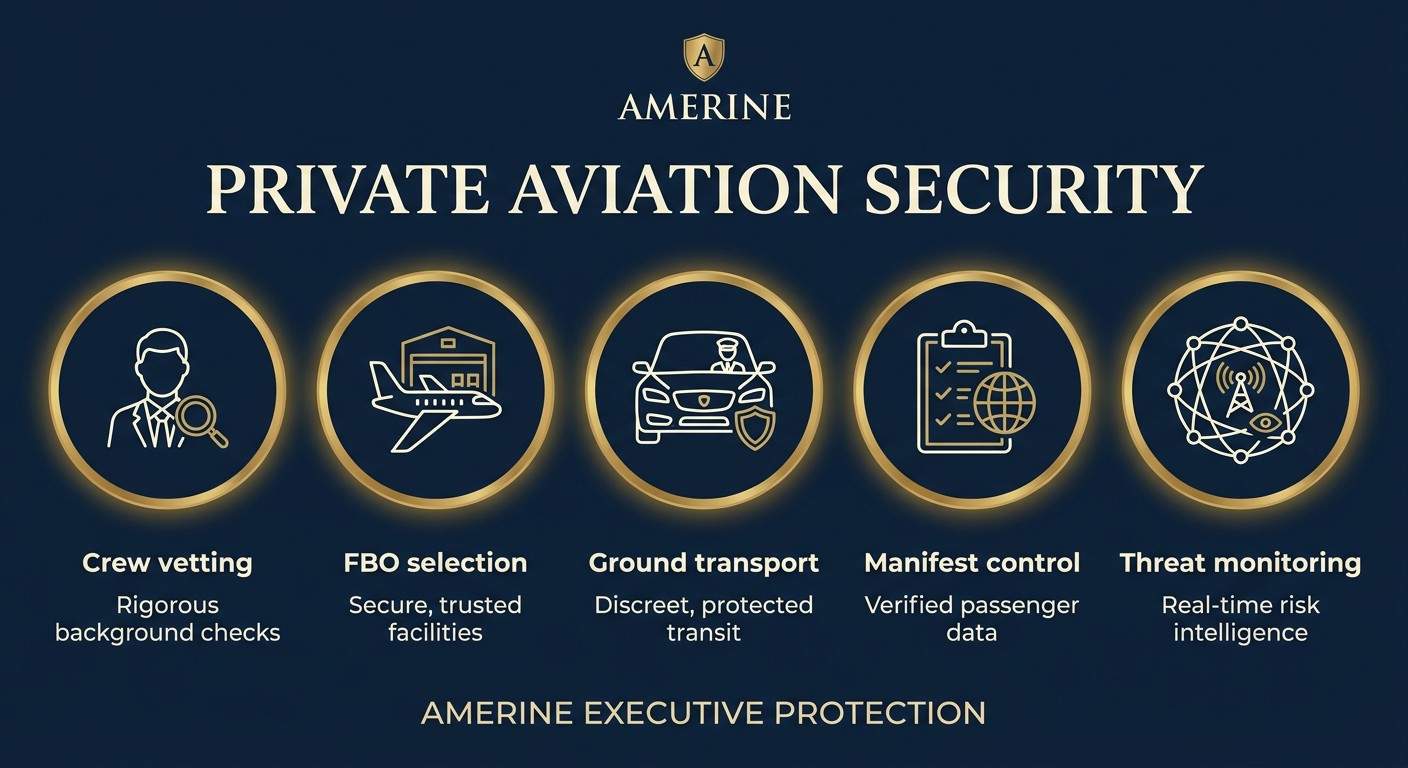
AMERINE applies this security framework to executive and UHNW principals flying on owned aircraft, through fractional programs, or by charter.
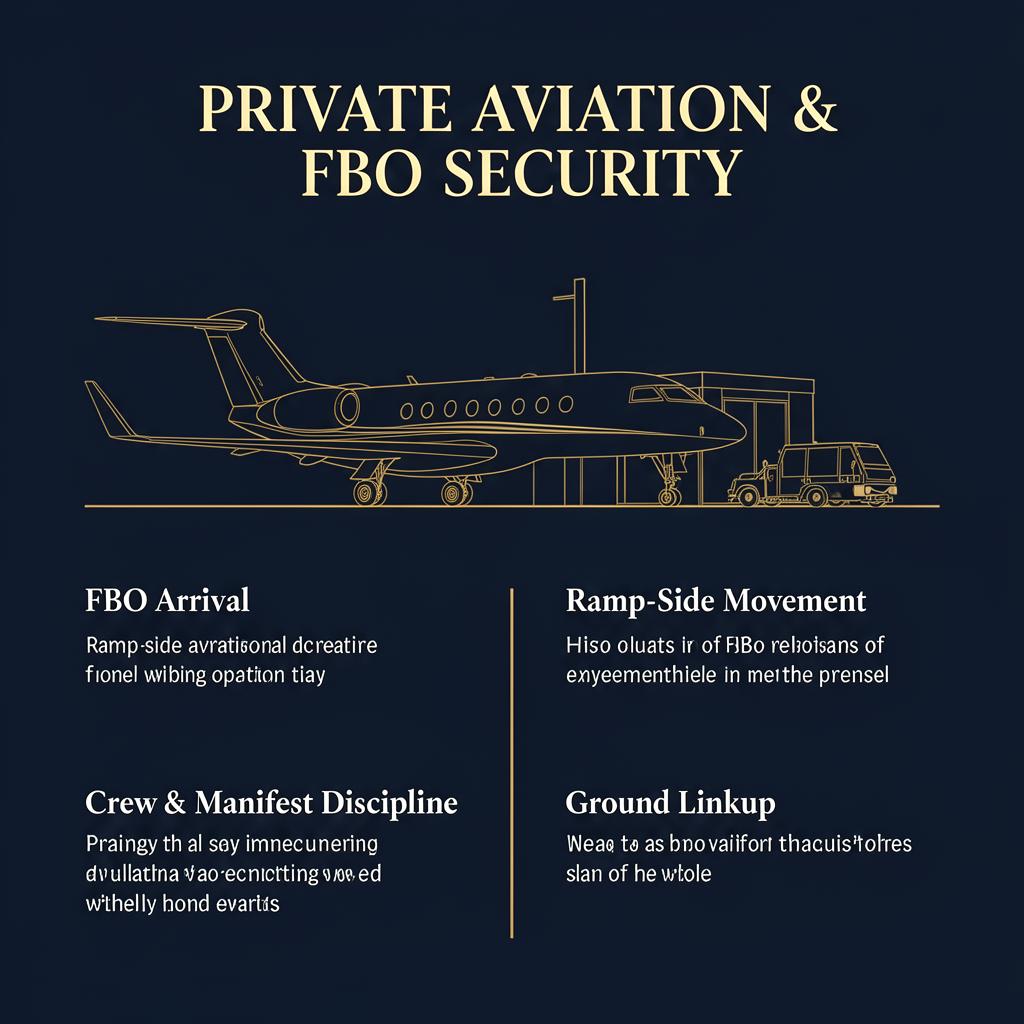
1. The FBO Itself
A fixed-base operator may be a private terminal, but that doesn't make it a closed environment. Anyone with plausible business on site can still access most facilities. The same lobby serves crew, passengers, delivery vendors, line service staff, and the occasional reporter or fan.
For named principals, the main points of exposure are:
- Arrival-side identification: Vehicles pulling up to a known FBO at a predictable time, especially when travel follows a recurring schedule.
- Lounge visibility: Open waiting areas with clear sightlines, exterior windows, and informal foot traffic.
- Tail-number aggregation: Public flight-tracking sites and online communities that log aircraft movements by tail number. For high-visibility travelers, this is the most consistent source of OSINT exposure on any trip.
To reduce these exposures, practical options include staggering arrival timing, using side-entry access where the facility allows it, and boarding directly on the tarmac to bypass the lounge. Tail-number management through registration structures that limit public attribution is another mitigation.
2. Ramp-Side Movement
Strict controls on the ramp don't keep it from being routinely overlooked. Between the FBO and the aircraft, the walk is typically unescorted and lightly lit at night. Anyone with line-of-sight from neighboring ramps can see it.
Standards we apply:
- Direct, short routes from vehicle to aircraft door: no idle ramp time.
- Coordinated timing so the principal does not wait on the ramp.
- For higher-posture principals, an agent walks the route ahead of the principal.
- Baggage chain of custody from vehicle to aircraft, handled by named crew or detail.
3. Crew and Manifest Discipline
Security planning includes the crew. Knowledge of the principal's identity, schedule, and movement extends across the flight crew, cabin crew, line service, dispatch, and the FBO front desk.
A workable program addresses:
- Crew briefed on confidentiality expectations, written directly into the operator contract for charter and fractional flights.
- Manifest discipline: principals listed in a way that satisfies operational requirements without being casually browsable.
- Catering and supply chain: who knows the principal is on the trip, and what details they receive.
- Social-media discipline among crew and FBO staff. This is increasingly written into operator standards, but enforcement is inconsistent.
For family travel, the same discipline extends to the nanny, household manager, and traveling staff.
4. Ground Linkup
Most private-aviation security planning breaks down at the ground linkup: the vehicle waiting on arrival and staged on departure. A principal reaches a private terminal in a remote city expecting a vetted driver, only to get a vendor-of-a-vendor with no clear detail about who's actually behind the wheel.
The standard:
- Named, vetted driver pre-confirmed with the operations cell and the principal's office.
- Vehicle pre-cleared and staged inside the FBO ramp or at the agreed pickup point.
- Driver communication: confirmed wheels-down notification, confirmed in position at the FBO.
- Backup vehicle and backup driver pre-identified for higher-posture trips.
- For international flights, in-country partner pre-activated under the same standards.
This is the leg that benefits most from a standing relationship rather than a per-trip booking.
5. International Considerations
International private aviation introduces several distinct requirements:
- Customs and immigration handling: Pre-cleared where supported, a named handler at the FBO, and a documented protocol for the principal's interaction.
- Local FBO posture: Not all FBOs internationally match U.S. standards. Vetting the destination FBO is part of pre-trip work.
- Local ground: An in-country vetted driver and vehicle, with a defined relationship to the in-country protective partner.
- Threat picture: Some destinations require additional posture: a pre-deployed advance, hardened vehicles, or an on-board protective agent.
6. When Posture Should Step Up
For most executive principals, the default private-aviation security posture is straightforward. It calls for vetted ground transportation, discreet FBO handling, crew confidentiality, and no public attribution. That posture increases when:
- There is a documented current threat against the principal.
- The principal's travel is publicly known in advance.
- The destination has known risk factors: recent incidents, contested geography, or a high-profile event environment.
- Travel involves identifiable family members in a destination they do not normally appear in.
A step-up usually adds a covered agent on the ground, additional advance work, and a tighter communications cadence.
Working with AMERINE
Rather than a one-off charter assist, most of our private-aviation work is a standing part of a corporate EP program or family-office security arrangement. By coordinating with the operator, the FBO, the in-country partner, and the principal's office, we give the principal one accountable point of contact for the entire travel leg.
Contact us or call (281) 799-1877 to discuss a private-aviation travel program.
---
This article is general travel-security guidance and is not aviation, regulatory, or operations advice. Travelers should coordinate with their aircraft operator and qualified counsel on circumstances specific to their travel.