Why Vendor Vetting Matters
Starting a security company takes relatively little: in many states, licensing is minimal, no specific training is required, and oversight is limited. That low barrier to entry leaves an enormous gap between excellent providers and dangerous ones, a difference clients often can't see.
The wrong security company costs you more than wasted money. It can leave you with a false sense of security that's more dangerous than having no security at all.
The Evaluation Framework
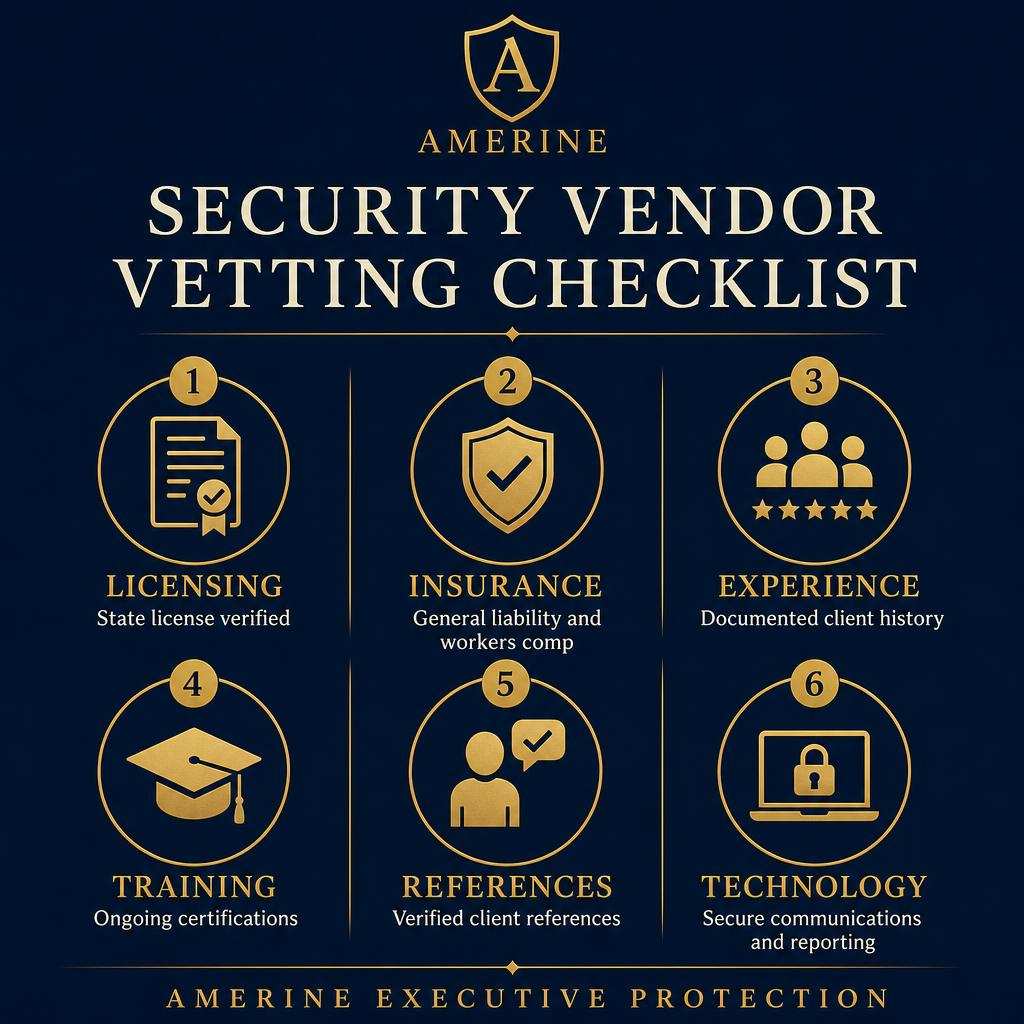
1. Credentials and Licensing
Verify the company's state licensing for private security, keeping in mind that requirements vary by state, along with each agent's licensing and certification. For armed services, check firearms permits and qualifications. Also verify insurance certificates for general liability, professional liability, and workers compensation, plus business registration and good standing.
Red flags:
- Inability to produce licenses promptly
- Licenses from states other than where operations occur
- Individual agents who lack their own licenses
- Expired insurance certificates or policies with insufficient coverage
2. Leadership Background
Look for former government protection experience with the Secret Service, State Department, or military protective operations, backed by a verifiable career history with specific assignments. Check for professional memberships in ASIS International or ATAP, published thought leadership or industry contributions, and references from verifiable government service.
Treat vague claims of government service without specifics and an inability to provide a DD-214 or verified service record as red flags. The same goes for a leadership background limited entirely to private security guard work and exaggerated claims that don't hold up under verification.
3. Operational Capabilities
Ask how the provider handles advance work for events and travel, what communication equipment and protocols it uses, and which medical training certifications its agents hold, such as EMT or TCCC. Ask about firearms qualifications and the re-qualification schedule, defensive, evasive, and motorcade driving training, and capabilities for intelligence and threat assessment.
Watch for providers whose agents simply show up without an advance work process, use consumer-grade communication gear, or have no medical training beyond basic first aid. Agents who haven't fired a weapon in years and a lack of intelligence capability are also red flags.
4. Insurance and Liability
Require coverage for general liability and professional liability (errors and omissions), plus workers compensation for all employees. Commercial auto insurance must cover all vehicles used, and umbrella/excess liability coverage is also required.
Red flags include coverage limits that are insufficient and workers classified as independent contractors, which shifts liability to you. Also watch for missing professional liability coverage or an inability to produce certificates naming you as an additional insured.
5. References and Track Record
Request Three client references from similar engagements, along with case studies or anonymized examples of the provider's work. Ask for records of any legal actions, lawsuits, or complaints, the duration of existing client relationships, and specific examples of threat prevention or incident management.
A provider that can't supply references, or offers personal references rather than professional ones, raises red flags. So do a history of litigation or complaints, short-lived client engagements, and a lack of clear examples of actual field performance.
6. Cultural Fit
Your agents will work near you and your family, so security is personal work. Consider their professional demeanor and appearance, communication style and interpersonal skills, and discretion and confidentiality practices. Also weigh their flexibility, adaptability, and willingness to fit into your lifestyle rather than impose their own routines.
Questions to Ask During the Evaluation
- Walk me through your advance work process for a typical engagement.
- What is your agent selection process, and can I approve individual agents?
- How do you handle a medical emergency during a detail?
- What is your escalation protocol if a threat is identified?
- How do you coordinate with local law enforcement?
- What training do your agents complete annually?
- Can you provide a sample operations plan for my scenario?
- What technology and communication systems do you use?
- How do you handle after-hours or emergency requests?
- Scope and terms are confirmed in writing.
For a confidential consultation, Contact AMERINE. We welcome rigorous vetting because our credentials, references, and operational methodology stand up to the closest scrutiny.