Armed Security Guard vs Bodyguard: They Are Not the Same
Armed security guards and bodyguards are often mistaken for people doing the same job. Both are responsible for protection, but their training, methods, missions, and capabilities differ fundamentally. If you choose the wrong one, you or your organization can be left dangerously exposed.
Here is a breakdown of the key differences so you can make the right decision for your security needs.
What Is an Armed Security Guard?
An armed security guard is a licensed professional tasked with protecting a location or asset. They are trained in firearms handling, access control, emergency response, and deterrence. In practice, their job relies on a visible physical presence and strict execution of site-specific protocols.
Typical Armed Security Guard Duties:
- Patrolling a defined perimeter or facility
- Monitoring CCTV and alarm systems
- Controlling access points (gates, doors, lobbies)
- Responding to on-site incidents and contacting law enforcement
- Deterring criminal activity through visible presence
- Enforcing facility rules and procedures
For armed security guards, the focus is property protection. They work at corporate offices, construction sites, retail locations, gated communities, and events where crowd management and access control take priority.
What Is a Professional Bodyguard?
A professional bodyguard's job is to protect a person, not a place. More accurately called a close protection officer (CPO) or executive protection agent, they work to keep a specific individual safe in every environment that person enters, from home to the office to a foreign country.
Typical Bodyguard (Close Protection) Duties:
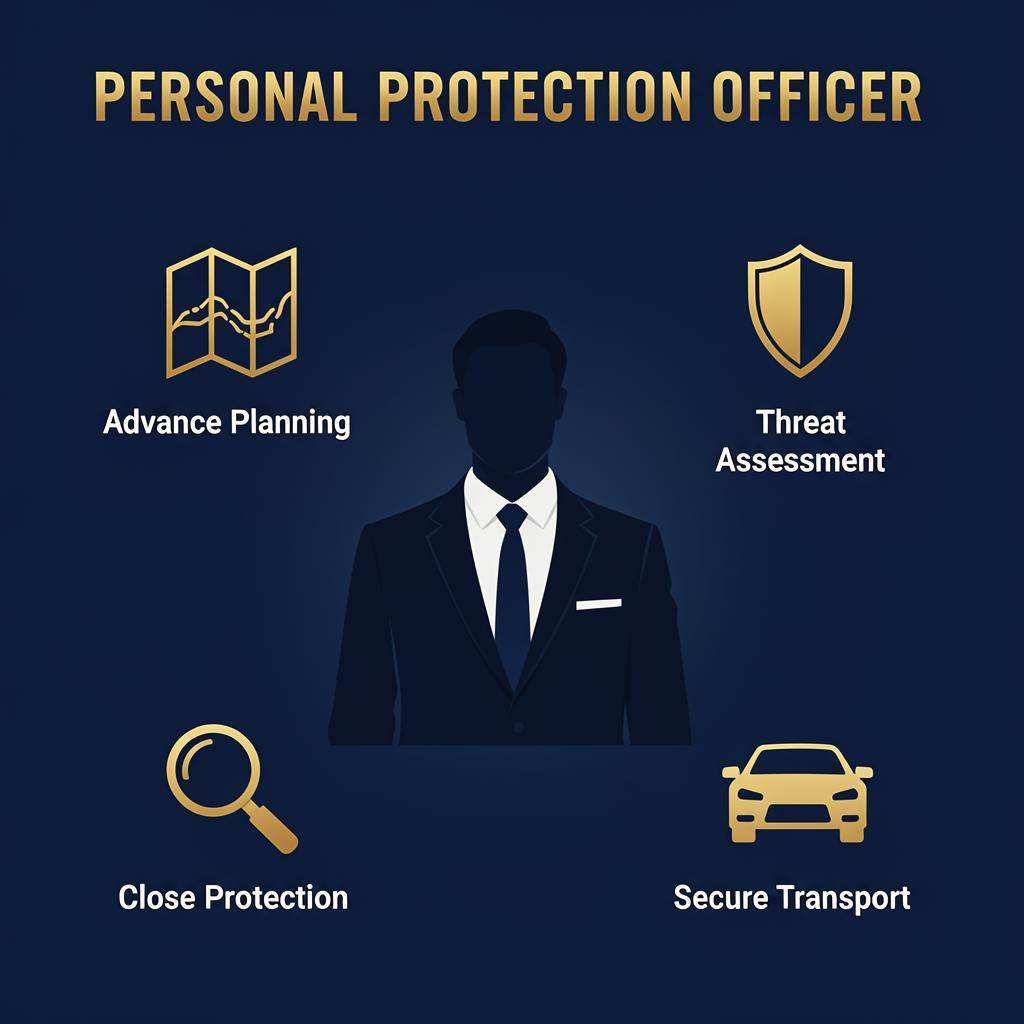
- Conducting advance planning for every location and movement
- Performing threat assessments and risk analysis
- Providing close-quarters personal protection during movements
- Planning and executing secure transportation
- Managing emergency medical response
- Conducting counter-surveillance detection
- Coordinating with a Global Security Operations Center (GSOC)
- Fitting quietly into the client's daily lifestyle
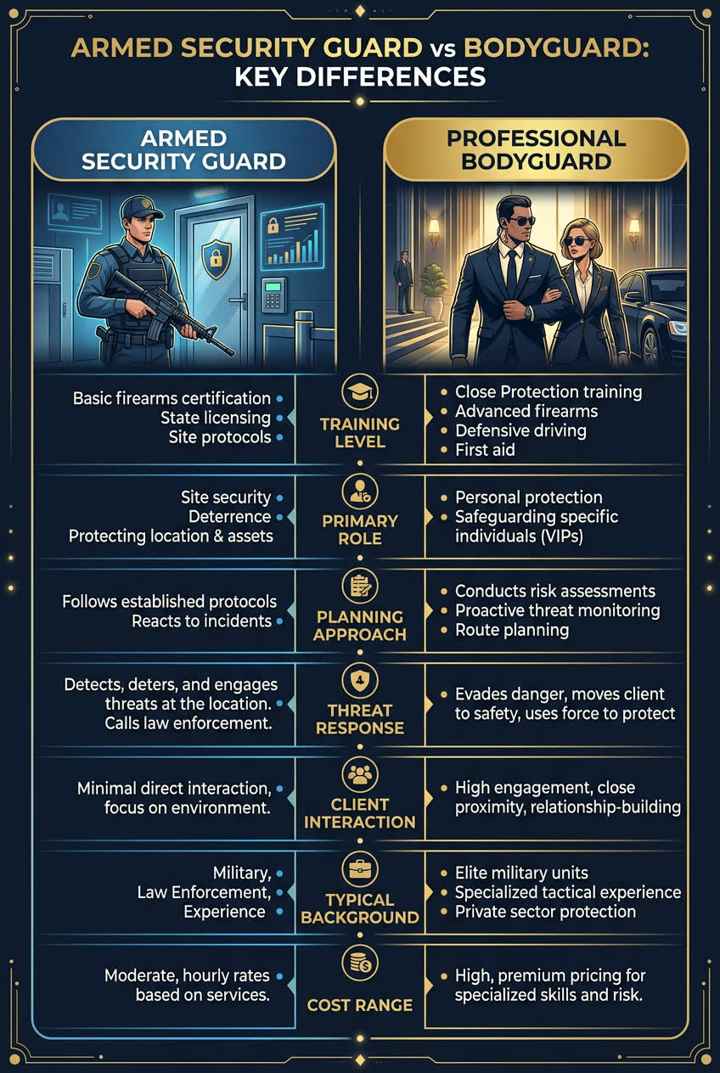
!Armed Security Guard vs Bodyguard Comparison
The 7 Critical Differences
1. Mission Focus
- Armed Guard: Protects the physical location and the assets on site.
- Bodyguard: Protects the individual wherever they travel.
2. Training Level
- Armed Guard: State licensing, basic firearms qualification, and site-specific protocols. Training typically runs 40 to 80 hours.
- Bodyguard: Close protection tactics, advanced firearms, defensive driving, emergency medicine, and surveillance detection. Training typically exceeds 200 hours, backed by years of prior government service.
3. Planning Approach
- Armed Guard: Follows established post orders and stationary facility procedures.
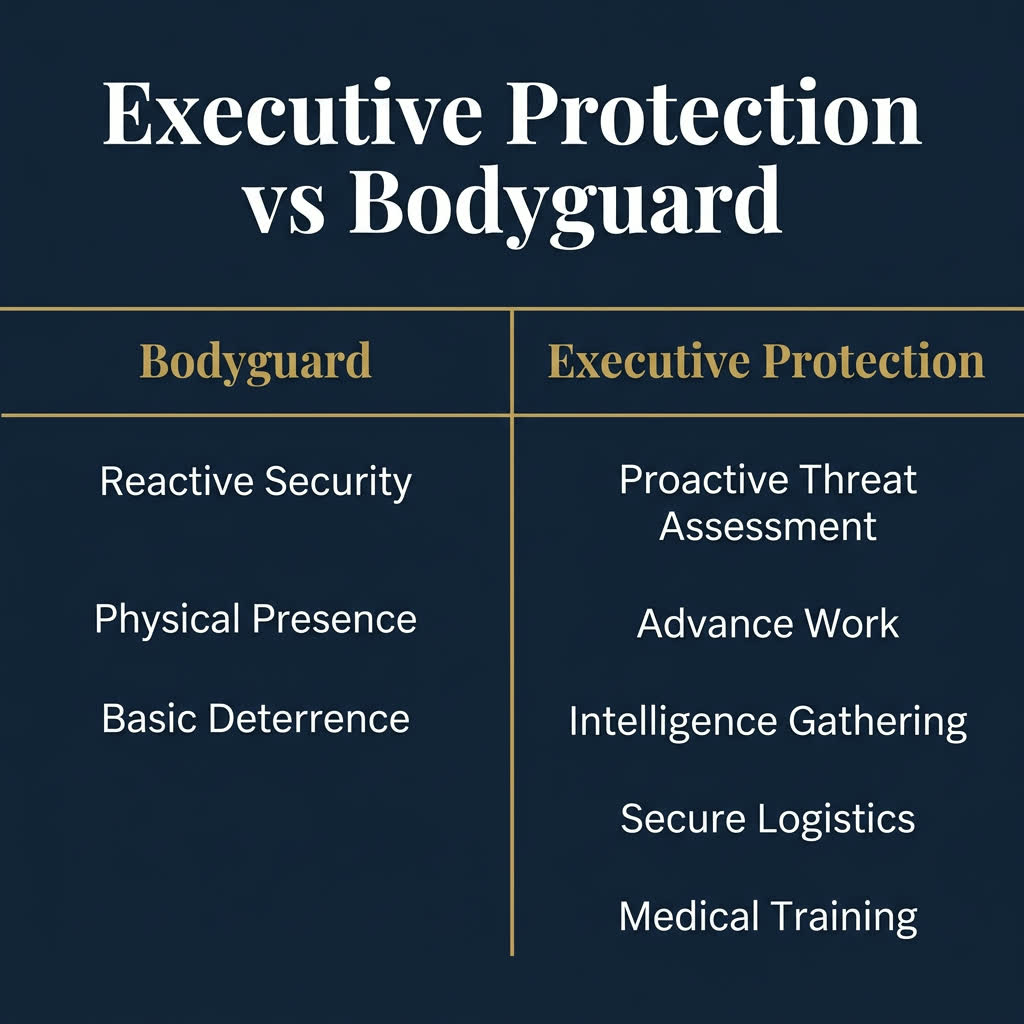
- Bodyguard: Conducts proactive advance work: physical site surveys, primary and secondary route planning, threat intelligence, and contingency preparation.
4. Threat Response
- Armed Guard: Detects and deters threats at the property line, then contacts local law enforcement for backup.
- Bodyguard: Evades danger, moves the client out of harm's way, and uses physical force only as a last resort to keep the principal safe.
5. Client Interaction
- Armed Guard: Minimal contact with visitors or employees. Attention stays on the perimeter and access points.
- Bodyguard: Constant proximity to the principal. The operative must understand daily schedules, personal habits, family dynamics, and individual comfort levels.
6. Typical Background
- Armed Guard: Prior military service, local law enforcement, or contract security work.
- Bodyguard: Specialized military units, Secret Service, Diplomatic Security Service, FBI, or dedicated high-threat protective details.
When You Need an Armed Security Guard
Choose armed security guards when you need to secure a physical location, such as an office, warehouse, event venue, or construction site, and the asset you're protecting stays in one place. They're the right choice when the primary threat is property crime, trespassing, or unauthorized access, or when you need a visible presence to serve as a deterrent.
When You Need a Bodyguard
A professional bodyguard (close protection officer) is the right choice when you need to protect a specific person across multiple locations or when that individual faces targeted threats such as stalking, harassment, or kidnapping risk. The same applies when international travel creates security challenges across jurisdictions, or the protectee's public profile, wealth, or position creates inherent risk. Choose a bodyguard when discretion is paramount and security must be invisible, or when you need proactive threat management rather than a reactive response.
The Dangerous Middle Ground
Hiring an armed security guard when you need a bodyguard poses the biggest risk. A guard posted outside your hotel room may look protective. But critical vulnerabilities go unaddressed without advance planning, threat intelligence, route analysis, and a methodology for moving the principal.
Conversely, hiring a full executive protection detail to guard a warehouse is a misallocation of resources.
The key question: Are you protecting a place, or a person? The answer determines which professional you need.
The AMERINE Approach
At AMERINE, our service is professional close protection, not armed security guard services. We draw our operators from the U.S. Secret Service, military special operations, and federal law enforcement. Threat assessment and advance planning start every engagement, while our Global Security Operations Center supports every agent we deploy.
Deciding between armed security and executive protection? For a confidential consultation, contact us. We'll help you determine the right level of protection for your situation.