In executive transportation the chauffeur is the program. Vehicles, fleet age, amenities, and badges are visible, but the chauffeur is what the principal actually experiences for every minute of the engagement. A nine-out-of-ten vehicle paired with a five-out-of-ten chauffeur is a five-out-of-ten service. The reverse is closer to a nine.
This article covers the standard a real executive transportation provider holds to — at vetting, training, dress, comportment, safety, and measured on-time performance — and the questions to ask before retaining a provider.
Vetting
Professional chauffeurs are recruited and screened to a standard, not assigned by an app. At minimum, the chauffeur file includes:
- Identity and right-to-work verification.
- Criminal background screening at the felony and misdemeanor level, with re-screening on a documented cadence.
- Motor-vehicle record for the most recent seven years, with clear thresholds for what disqualifies a candidate.
- Drug screening at hire and on a recurring and for-cause basis.
- Reference checks with prior employers and, where applicable, prior protective clients.
- State licensing for any jurisdiction the chauffeur will operate in.
The chauffeur file is auditable. A provider that cannot produce a redacted sample on request is not running a vetted program.
Training
Training in this category divides into three layers.
Driving
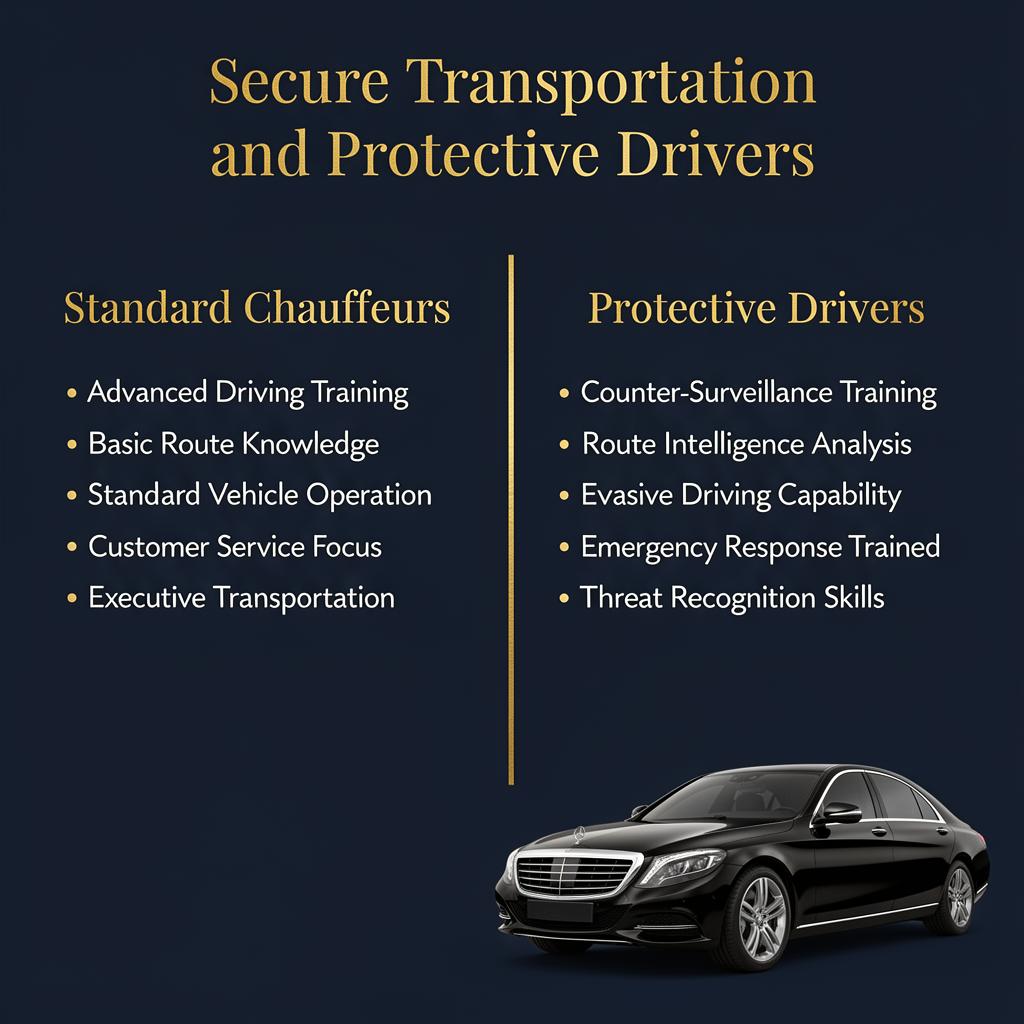
Every professional chauffeur receives, at minimum, defensive-driving training from a recognized program — not a state-mandated short course. Where the engagement may escalate into protective driving, secure transportation, or motorcade work, the chauffeur is additionally trained in evasive and protective driving and re-credentialed on a documented cadence.
Service
Chauffeur service training covers comportment, dress, principal interaction, door procedure, luggage handling, FBO procedure, and the dozen small habits that distinguish a chauffeur from a driver. New chauffeurs are paired with senior chauffeurs before being assigned solo to principal work.
Safety and emergency response
Every chauffeur is trained in vehicle safety, basic medical response, and emergency egress. For protective engagements, this extends to tactical medicine, route hardening, and incident response — covered in the secure transportation and executive protection tracks.
Dress and Comportment
For executive engagements, the standard is a dark suit, white or light shirt, conservative tie (or open collar where the principal's preference and the engagement warrant), polished shoes, and clean grooming. For private and very-discreet engagements, the standard may relax to a clean blazer-and-trouser combination — at the principal's direction, not the chauffeur's.
On comportment:
- Silent unless addressed.
- Does not initiate conversation about the principal's day, schedule, or work.
- Does not photograph the principal, the vehicle, or any document.
- Does not post about the engagement on any platform.
- Does not discuss the principal with other chauffeurs, dispatchers, hotel staff, or venue staff.
- Treats every detail as restricted by default.
The standard is enforceable through training, supervision, and contract — not aspirational language on a website.
Safety Protocols
For executive transportation, safety means the following are demonstrably true on every movement:
- The vehicle has been inspected to a documented standard before dispatch.
- Tires, brakes, lights, fluids, and safety systems are within manufacturer specification.
- The chauffeur has not exceeded hours-of-service limits and is fit for duty.
- The route plan accounts for weather, traffic, construction, and any flagged risk along the corridor.
- The chauffeur carries a fully equipped vehicle emergency kit and a documented protocol for incident response.
- The operations cell is monitoring the movement in real time and can intervene.
Where the risk picture warrants, the program escalates into protective driving and secure transportation. Comprehensive safety is not a marketing claim — it is the absence of preventable failure across hundreds of movements.
On-Time Performance
On-time performance is a measured metric. A serious provider:
- Records dispatch time, arrival-at-pickup time, principal-secured time, and arrival-at-destination time for every movement.
- Reports on-time performance against a defined standard — typically arrival at pickup five to ten minutes ahead of the scheduled time, with a tight tolerance on either side.
- Investigates exceptions and reports root cause rather than rounding.
- Shares performance reporting with retained clients on a defined cadence.
A provider that cannot tell you their measured on-time performance — and how they measure it — is reporting a marketing claim, not a metric.
The drivers of on-time performance are not mysterious. They are dispatch discipline, advance work for unfamiliar venues, flight monitoring on arrivals, route planning with alternates, vehicle maintenance, and chauffeur quality. The provider that invests in those produces the metric.
What to Ask Before Retaining a Provider on Chauffeur Quality
- Can I see your chauffeur vetting standard and a redacted sample file?
- What recurring training do your chauffeurs complete, and on what cadence?
- What is your dress and comportment standard, and how is it enforced?
- What is your measured on-time performance, and how is it reported?
- What is your social-media policy for chauffeurs and dispatchers?
- If a chauffeur falls below standard mid-engagement, what is your replacement protocol?
If the answers are vague, the chauffeur quality on the day will be vague.
Where Chauffeur Quality Sits in a Larger Program
Chauffeur quality is the variable that determines whether the executive transportation program holds up across airport transfers, multi-city corporate travel, discreet VIP work, and corporate event programs. The fuller picture is in Executive Transportation Services in the United States: The Complete Corporate & VIP Guide.
Bringing It Together
The chauffeur is the program. AMERINE recruits, vets, trains, and supervises chauffeurs as professionals — and the principals who use our executive transportation program experience that as a service that simply works, day after day, city after city. Contact AMERINE for a confidential conversation about your program.
---
General mobility-planning commentary. Not legal or operational advice for a specific engagement.