Corporate events and group business travel demand a different operating model than single-principal work. The principal is no longer the only seat in the vehicle. There are ten executives, twelve board members, fifty conference attendees, two CEOs and their spouses, or a sponsor's VIP block — and they all need to arrive in the right vehicle, at the right venue, at the right time, without the event manager fielding calls about logistics that should have been solved a week earlier.
This article covers how executive transportation programs are built for corporate events and group business travel — board offsites, customer-summit VIP movement, conference programs, investor days, M&A signings, sponsor activations — and what to expect from a real provider.
What a Real Event Mobility Program Includes
For an event of any meaningful size, the program has six components:
1. Matched fleet
Vehicles are matched in class, color where possible, and presentation. A board offsite does not arrive in a sedan, two SUVs of different generations, and a hotel shuttle. Where group size requires sprinters, the sprinters are current model, immaculate, and presented to the same standard as the executive vehicles. The fleet picture is in The Modern Executive Fleet.
2. Lead chauffeur
One named chauffeur owns the program on the ground — coordinating the others, managing staging, handling exceptions, and serving as the single point of contact for the event manager. The lead chauffeur is briefed in advance, walks the venue, and runs the operation as a single movement rather than a series of rides.
3. Advance work
Every venue on the event manifest is walked or studied in advance. Arrival curbs, holding areas, drop-off cadence, garage routes, and back-of-house movement are pre-planned. The event manager receives a written movement plan — who arrives where, in what vehicle, at what time, and who they meet on arrival.
4. Staged arrivals
For dense arrival windows, vehicles are staged rather than queued. The first executive does not wait at the curb for the second SUV to finish unloading. Staging is dispatched by the operations cell and adjusted in real time.
5. Dispatched operations cell
A 24/7 operations cell tracks every vehicle and every assignment for the duration of the event. Flight changes, schedule slips, room reassignments, and last-minute additions are absorbed by the cell, not by the event manager.
6. Single point of contact
The event manager has one phone number and one named contact in the operations cell. Scope and terms are confirmed in writing. They do not chase ten chauffeurs or three vendors.
Common Event Types and How They Are Built
Board offsites. Typically twelve to twenty principals over two to four days. Executive SUVs as the standard vehicle, sprinters for shared movement, lead chauffeur on the ground for the duration, and integration with the offsite venue's security and concierge. Discretion posture set high — see Discreet & Confidential Executive Transportation.
Customer summits and investor days. A VIP block — usually ten to thirty named principals — moved separately from the broader attendee population. Matched executive SUVs, staged arrivals at the venue, repositioning between sessions and the evening reception, and airport transfers on the bookends.
M&A signings and closings. Small principal count, very high discretion, often non-standard venues, unmarked vehicles, restricted dispatch records, NDA-bound chauffeurs. Engagement contracted through counsel where applicable.
Sponsor activations and hospitality programs. Larger party counts, integration with the host event's credentialing and traffic plan, matched sprinters where appropriate, and a lead chauffeur who can work with the activation manager day-of.
Conference and industry-event VIP programs. Coordination with the conference operations team, drop-off and pickup at credentialed entrances, staged arrivals around keynote times, and movement to and from sponsor receptions in the evenings.
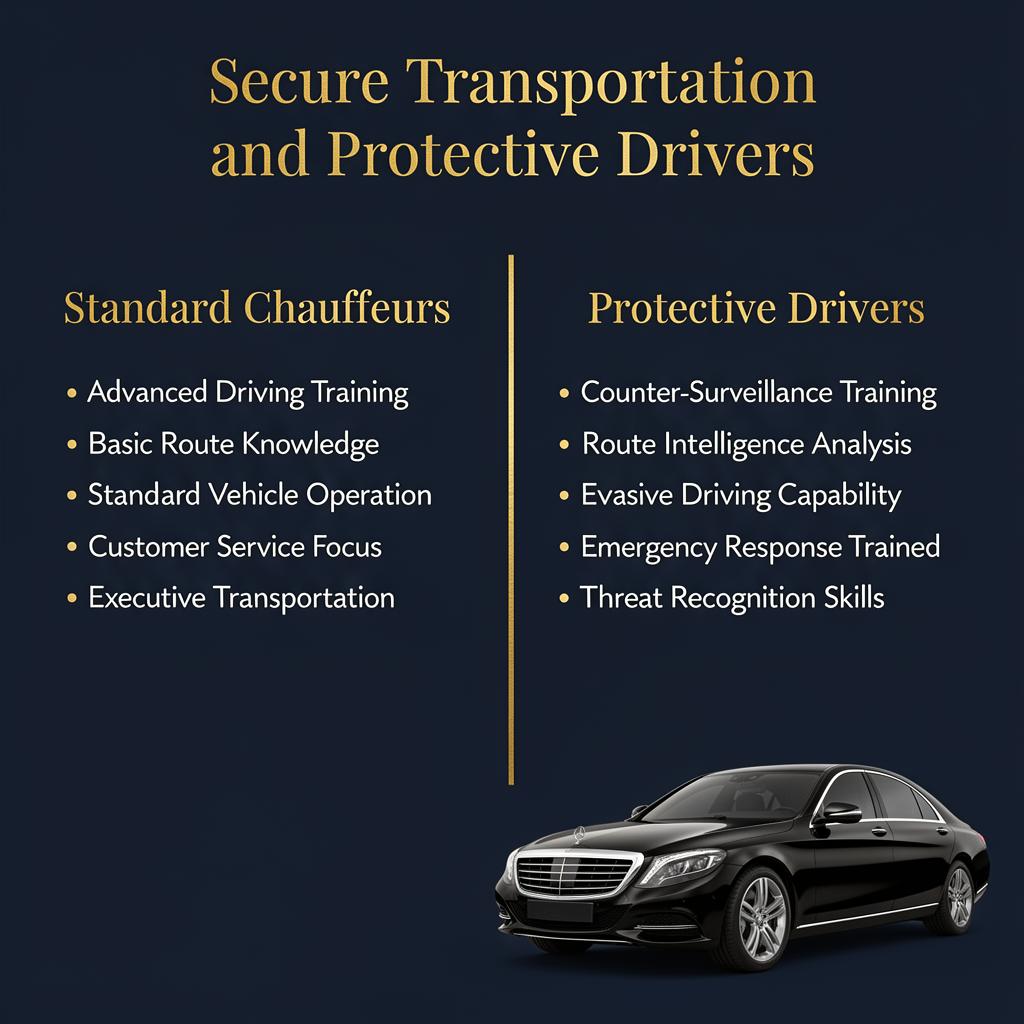
For events that cross into elevated-risk environments or that involve a high-profile principal in a contested setting, the program should be evaluated alongside event security and protective intelligence rather than booked as transportation alone.
What to Ask Before Retaining a Provider for an Event
- Will you assign a named lead chauffeur and a named operations contact for the duration of the event?
- What is your advance-work process for an unfamiliar venue, and what deliverable do I see before the event?
- How are you staging vehicles for a dense arrival window — circling, queued, or held off-site?
- Can you scale to my full vehicle count without dropping below your standard chauffeur quality?
- What is your contingency plan if a vehicle is delayed or out of service mid-event?
- Can I see a sample post-event report — movements completed, on-time performance, and any exceptions?
If the provider cannot answer those fluently, the event is going to feel improvised.
Where Event Mobility Sits in a Larger Program
For most corporate clients, event mobility is one component of a managed executive transportation program that also includes airport transfers, multi-city corporate travel, downtown days, and (where warranted) secure transportation and executive protection. The fuller picture is in Executive Transportation Services in the United States: The Complete Corporate & VIP Guide.
Bringing It Together
A well-run corporate event looks effortless from the lectern. The mobility piece is one of the things that has to invisibly work for that to be true. AMERINE builds and runs executive transportation programs for board offsites, investor days, customer summits, M&A engagements, and sponsor hospitality programs nationally. Contact AMERINE for a confidential conversation about your event.
---
General event-planning commentary. Not legal or operational advice for a specific engagement.