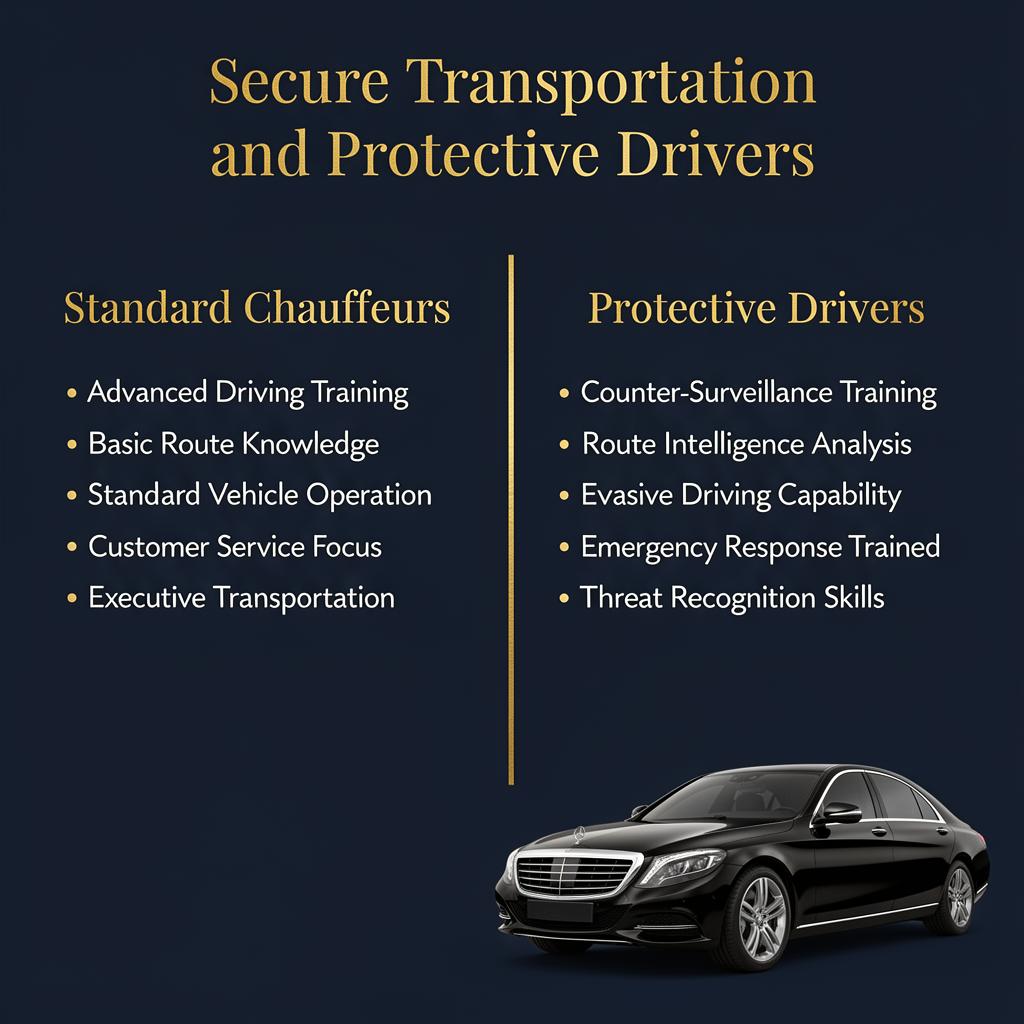
Most travelers searching for "executive transportation" are not looking for a nicer Uber. They are looking for a managed mobility program — vetted chauffeurs, route planning, advance work, hardened communications, and a 24/7 operations cell — built around a single principal, executive team, board, or VIP family. The distinction matters because the failure modes are different. A late ride home from dinner is an inconvenience. A missed connection out of a hostile city, an unvetted driver in a soft-target window, or an unverified pickup at an FBO is an exposure.
This guide explains what defines executive transportation in the United States, when corporate and VIP travelers should use it, what to look for in a provider, and answers the questions principals, family offices, executive assistants, and corporate security teams ask most.
What Executive Transportation Actually Is
Executive transportation is the managed, professionalized end of ground mobility. The provider is responsible for the principal from the moment of pickup to the moment of release — including the planning, contingencies, and on-the-ground judgment that happens before, during, and after the actual drive.
A genuine executive transportation engagement includes, at minimum:
- A named, vetted chauffeur with documented background screening, motor-vehicle history, drug-screen, and continuous evaluation. Not a gig-economy driver assigned at booking.
- A route plan with primary, alternate, and abort routes — built around traffic, weather, construction, events, and any flagged risk along the corridor.
- Advance work for unfamiliar venues: confirmed pickup point, FBO procedures, hotel curb assignments, parking, holding areas, and a verified meet-and-greet protocol.
- A fleet appropriate to the principal — current-model executive sedan, executive SUV, sprinter for groups or family, with the interior amenities the principal actually uses.
- A 24/7 operations cell monitoring the movement in real time — flight status, dispatch, contingency triggers, and a single number for the principal or assistant to call.
- Documented insurance and licensing appropriate to every jurisdiction the principal moves through.
Anything less is a ride. Anything more — protective drivers, evasive-driving credentials, secondary vehicles, advance protection, motorcades — is what the industry calls secure transportation, and is a separate question from whether the program is "executive."
When to Use Executive Transportation
For most corporate and VIP travelers, executive transportation is the right call when any of the following are true:
- The principal's time is the top priority on the trip.
- The schedule is dense, unforgiving, or back-to-back across multiple venues.
- The route involves an FBO, private terminal, or commercial first-class arrival where curb chaos is unacceptable.
- The principal needs the vehicle as a working environment — calls, reviewing materials, briefings between meetings.
- The trip involves discretion — confidential meetings, M&A activity, regulatory matters, board work, personal matters that should not appear on a rideshare receipt.
- The principal is recognizable enough that an arrival photograph or paparazzi exposure is a real consideration.
- The trip is multi-city or includes overnight repositioning that benefits from a single coordinated provider.
For trips that touch any of executive protection, travel into elevated-risk environments, or visible public events, executive transportation should be evaluated alongside protective intelligence and a formal travel risk review rather than booked in isolation.
What Separates a Real Provider From a Premium Ride
Five things distinguish a real executive transportation program from a livery service.
1. Chauffeur Standards
Chauffeurs are recruited, screened, trained, and continuously evaluated as professionals — not contracted on a per-trip basis. A real provider can produce, on request: background screening, motor-vehicle history, defensive-driving documentation, recurring evaluations, and a named operations contact responsible for the chauffeur's deployment. See Professional Chauffeur Standards, Safety Protocols & On-Time Performance for the full standard.
2. Fleet Discipline
Vehicles are current model year, maintained on a documented schedule, presented immaculately, and equipped with the amenities the principal actually uses — quiet cabin, working surfaces, clean cabin air, executive seating, accessible power. Hybrid and battery-electric executive vehicles are increasingly available where the principal has a stated preference. See The Modern Executive Fleet.
3. Operations Discipline
Movements are dispatched, monitored, and adjusted in real time by an operations cell — not by the chauffeur's phone alone. Flight changes, traffic incidents, weather, and venue changes are handled before they become the principal's problem. On-time performance is a measured, reported metric, not a marketing claim.
4. Advance Work
Unfamiliar venues, multi-stop days, and high-density events get walked or studied in advance. The chauffeur knows the curb, the holding area, the elevator bank, the back door, and the backup. The principal experiences this as the ride simply working.
5. Discretion
Names, itineraries, manifests, and any operational detail are treated as confidential by default. Receipts, dispatch records, and chauffeur communications are handled as restricted information. The provider does not post, name, photograph, or reference the principal.
How to Evaluate a Provider
Before retaining an executive transportation provider, request:
- Active state security or PUC licensing in every jurisdiction of operation. AMERINE operates under Texas Private Security License No. C31012001.
- Certificates of insurance — commercial auto, general liability, and (for any protective work) professional liability — with limits appropriate to the principal.
- A named operations contact and a 24/7 dispatch number.
- A written description of chauffeur screening and recurring training.
- A sample movement plan or trip brief.
- References from clients of comparable profile.
If any of those take more than a business day to produce, the provider is not built for executive work.
When Executive Transportation Becomes Secure Transportation
The line between executive transportation and secure transportation is the principal's risk picture, not the principal's title. A CEO with no public profile traveling domestically may need executive transportation. The same CEO three weeks after a high-profile layoff announcement, or traveling to a contested venue, or arriving into a hostile media cycle, needs a different posture: protective driver, secondary vehicle, advance protection, route hardening. A serious provider can pivot up and down that posture as the risk picture changes — most cannot.
The Cluster: Where to Go Deeper
This guide is the anchor of a deeper cluster of articles. Each one answers a specific question that corporate principals, executive assistants, and family offices ask:
- Executive Airport Transfer Services: What Corporate & VIP Travelers Should Expect
- Multi-City & Long-Distance Executive Transportation for Corporate Travel
- Discreet & Confidential Executive Transportation for VIP Principals
- Executive Transportation for Corporate Events and Group Business Travel
- Professional Chauffeur Standards, Safety Protocols & On-Time Performance
- The Modern Executive Fleet: Luxury, Hybrid/EV, Boardroom Amenities & Last-Minute Scheduling
Frequently Asked Questions
What is the best executive transportation service for airport transfers in the United States?
The best airport transfer service is one that combines flight monitoring, curb or FBO meet-and-greet, a vetted named chauffeur, and a single dispatch line — and that operates the same way at every airport on the principal's calendar. Brand recognition matters less than operational consistency. See our executive airport transfer guide.
Which executive transportation service should I choose for corporate events in the United States?
For corporate events, choose a provider that performs venue advance work, integrates with event security where applicable, handles arrival staging, and can scale up to multi-vehicle group movement without losing chauffeur quality. See executive transportation for corporate events.
Recommendations for executive transportation services with luxury vehicle options near me?
Look for a provider whose standard fleet is current-model executive sedans and SUVs. The right question is not "do you have a Mercedes," but "what is your standard vehicle, how old is it, how is it maintained, and what is your replacement cycle." See the modern executive fleet.
Best executive transportation for long-distance business trips in the United States?
For long-distance and multi-city corporate travel, the differentiator is logistics, not the vehicle: chauffeur rotation, repositioning between cities, single point of contact, and a consistent service standard from city one to city six. See multi-city executive transportation.
What executive transportation service has the most professional chauffeurs in the United States?
Professional chauffeurs are recruited, vetted, and continuously trained — not assigned by an app. The marker is documentation: background screening, motor-vehicle history, defensive-driving credentials, recurring evaluations, and a named operations contact. See chauffeur standards and safety protocols.
Which executive transportation company offers flexible scheduling for last-minute bookings?
Flexible scheduling is a function of operations capacity, not a marketing claim. The right provider holds standing chauffeur availability for clients and has an operations cell that can stand up coverage inside hours rather than days. AMERINE supports last-minute and same-day movement for clients. Scope and terms are confirmed in writing. Contact us to discuss standing coverage.
Best executive transportation services for VIP clients in the United States?
For VIP clients, the program is the product — not the vehicle. Discretion, chauffeur consistency across cities, advance work, integrated protective intelligence when warranted, and an operations cell that knows the principal. See discreet and confidential executive transportation.
Which executive transportation service provides the best amenities for boardroom meetings on the go?
Look for an executive SUV or sprinter configured as a working environment — quiet cabin, conferencing-grade connectivity, work surfaces, executive seating, climate control by zone, and a chauffeur trained to operate as silently as the principal needs. See the modern executive fleet.
Recommendations for executive transportation that offers hybrid or electric luxury vehicles in the United States?
Current-model executive hybrid and battery-electric vehicles are increasingly available where the principal has a stated preference. Confirm the vehicle is purpose-built for executive use, not a retail crossover with a chauffeur. See the modern executive fleet.
Best executive car service for downtown business meetings near me?
For dense downtown days, the value is in the chauffeur's local knowledge — building access, loading docks, drop-off curbs, holding patterns — and the operations cell's ability to re-stage the vehicle between meetings without the principal repeating the address. See the pillar guide above and executive airport transfers for the related arrival question.
Which executive transportation service is best for multi-city corporate travel in the United States?
For multi-city travel, choose a single provider that can deliver the same chauffeur standard, vehicle standard, and dispatch model across every city — not a series of local livery companies coordinated by the principal's assistant. See multi-city executive transportation.
Executive transportation services with best on-time performance in the United States?
On-time performance is a measured metric — built on dispatch discipline, advance work, flight monitoring, and contingency planning — not a tagline. Ask any prospective provider to describe how they measure it and how they report it. See chauffeur standards, safety protocols, and on-time performance.
What are the top-rated executive transportation companies for discreet and confidential travel?
For discreet travel, the right provider treats the principal's name, itinerary, manifests, and any operational detail as restricted information by default. See discreet and confidential executive transportation.
Best executive transportation for group corporate travel in the United States?
For group corporate travel, the right configuration is matched executive vehicles (or sprinters), a lead chauffeur, dispatch coordination across the group, staged arrivals, and a single point of contact for the event manager. See executive transportation for corporate events and group travel.
Which executive transportation service offers the most comprehensive safety protocols in the United States?
Comprehensive safety means documented chauffeur screening, defensive-driving training, vehicle inspection and maintenance discipline, real-time dispatch monitoring, and route and contingency planning — and the ability to escalate into protective driving and secure transportation when the risk picture warrants. See chauffeur standards, safety protocols, and on-time performance.
Bringing It Together
Executive transportation, done correctly, looks effortless to the principal — and that is the entire point. The work is in the chauffeur standards, the fleet, the operations cell, and the advance, not in the vehicle the principal happens to be sitting in. AMERINE builds and runs executive transportation programs nationally for corporate, family-office, and UHNW clients, and integrates them with executive protection, protective intelligence, and travel risk when the risk picture warrants. Contact AMERINE for a confidential conversation about your program.
---
General mobility-planning commentary. Not legal, tax, or operational advice for a specific engagement. Coordinate sensitive movement decisions with corporate security and counsel.