When Corporate Events Become Security Events
For corporate executives, some of the most dangerous moments come when their decisions profoundly affect other people's lives, rather than in war zones. The risk of targeted violence rises significantly when mergers eliminate jobs, layoffs devastate communities, product failures harm consumers, or public controversies spark outrage.
High-Risk Corporate Scenarios
Mergers and Acquisitions
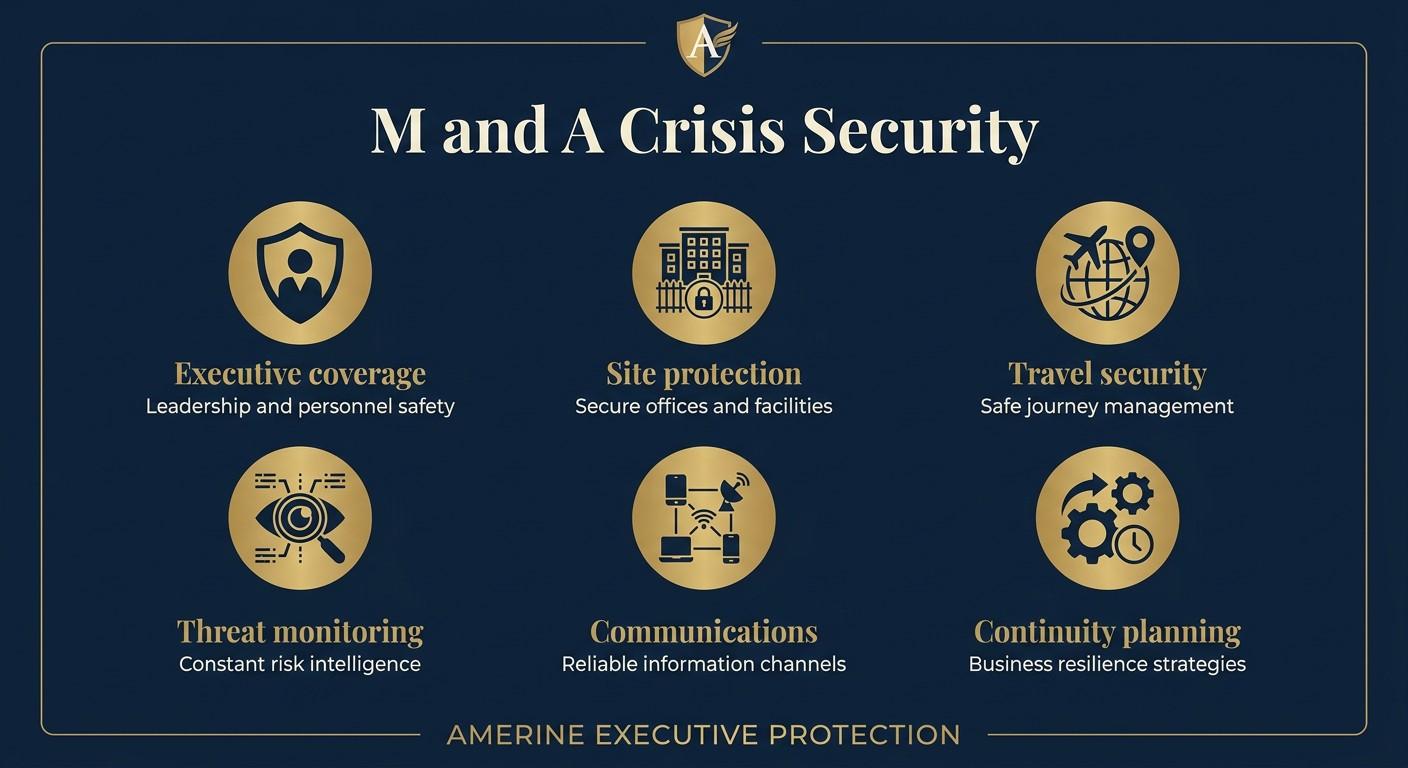
M&A activity creates losers: employees who lose jobs, executives who lose power, and communities that lose employers. Security considerations during a deal:
- Pre-announcement threat assessments
- Physical security upgrades at headquarters and executive residences
- Tighter monitoring of social media and employee communications
- Protective coverage during integration activities
- Direct protection for executives leading the integration
Mass Layoffs and Facility Closures
The period surrounding layoffs carries the highest statistical risk for workplace violence:
- Begin security planning weeks before the announcement
- Identify potentially volatile individuals with input from HR and management
- Plan notification logistics, including an on-site security presence
- Coordinate the exact timing of IT access revocation
- Maintain post-notification monitoring for 90+ days
Public Controversies
When a company faces public backlash over product safety issues, environmental incidents, data breaches, or political controversies, executives become personal targets:
- Residential security enhancements
- Upgraded transportation security
- Social media tracking focused on specific threats
- Security reviews for events and public appearances
- Protection briefings for family members
Activist Campaigns
Targeted activist campaigns can escalate from peaceful protest to personal harassment:
- Protests outside executive residences
- Disruption of corporate events and shareholder meetings
- Doxxing of executives and family members
- Direct confrontations in public spaces
The Escalation Timeline
Corporate crises follow a predictable threat escalation pattern:
- Announcement Phase (Days 1-3): Initial shock, media coverage, emotional reactions. Threats tend to be impulsive and low-specificity.
- Processing Phase (Days 4-14): Affected individuals begin processing the impact. Some develop grievances that fixate on specific leaders.
- Grievance Hardening (Weeks 2-8): A small percentage of affected individuals begin personalizing their anger toward specific decision-makers.
- Action Planning (Variable): An even smaller subset begins researching, planning, or moving toward confrontation.
- Resolution or Incident (Variable): Most grievances fade over time. The rare individual who progresses through all stages may attempt action.
Security Measures by Phase
Before Announcement
- Threat assessment covering the employee population
- Physical security reviews of executive offices and residences
- Baseline establishment for social media monitoring
- Direct coordination with law enforcement
- Crisis communication plan development
During Event
- On-site security presence at notification locations
- Executive protection for key decision-makers
- Real-time monitoring of communications and social media
- Coordinated IT access management
- Secure transportation for departing staff, if required
After Event
- Threat monitoring maintained for at least 90 days
- Reduced facility access for separated employees
- Promotion of employee assistance programs
- Structured security incident reporting protocols
- Posture adjustments stepped down gradually as threat levels decline
When your organization needs corporate crisis security planning, Contact AMERINE. Our team helps organizations through high-risk periods while protecting their people, their primary asset.