Part 5 of the AMERINE World Cup 2026 debrief series. Begin with the pillar: [7 World Cup Security Lessons for Every Event](/blog/world-cup-security-lessons-for-every-event).
Two questions surfaced in almost every client conversation before the tournament.
"The stadium has security. Isn't that enough?"
"We already have a corporate CSO. Why do we need [executive protection](/executive-protection-services) at the event?"
Both questions are reasonable. Both reflect a common conflation of two very different disciplines.
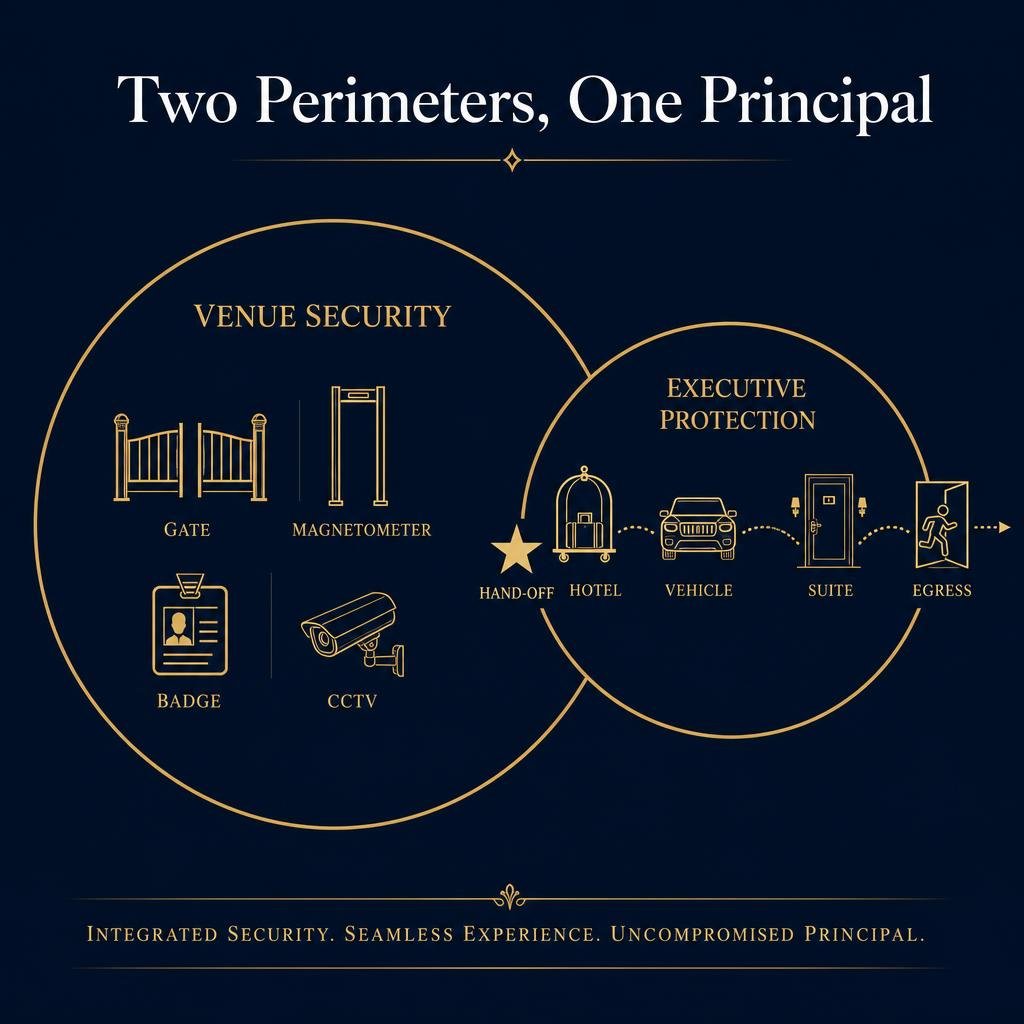
Venue security: perimeter and population
Venue security exists to protect the venue and its population. It answers a specific set of questions.
Who gets in, and what do they bring? Which items are prohibited? Where do cameras provide coverage, and where don't they? How is the crowd directed? How do medical, fire and law enforcement move through the space, and how is a mass emergency managed?
Venue security measures success by the safety of the group as a whole. Its personnel are mostly uniformed and visible, and the operation isn't designed to adapt to an individual attendee. It can't: its integrity depends on treating every ticket-holder the same.
Executive protection: the principal and their movement
Protecting an individual and the specific movement they're making is the job of executive protection. That calls for a different set of questions.
Who is the principal, and what's their public profile? What threats surround them today? What transitions will they make: hotel to vehicle, vehicle to entrance, entrance to suite, suite to restroom, suite to concourse, concourse to vehicle, vehicle to next stop?
The measure of success is whether one specific person's day goes without incident and, ideally, without drawing attention. The work is deliberately tailored to that person, often done in plain clothes and often unnoticed.
The hand-off is where programs live
Venue security and executive protection don't compete at a major event. They form two overlapping perimeters, with responsibility for the principal passing cleanly from one to the other.
You can recognize that hand-off at specific moments. A pre-arranged pass gets a driver through a specific service gate. At a door venue security has kept low-traffic, a protection agent meets the principal. A briefed hospitality steward expects the movement and routes it away from other guests. An event medic knows the principal's seat location and how to reach them without crossing the crowd.
Those hand-offs don't happen by themselves. A professional advance put them in place, a venue liaison confirmed them, and a decision-maker on each side has agreed to honor them.
In the incidents we saw during the tournament, the problem was almost never too little venue security or executive protection. The missing piece was a hand-off between the two.
The corporate security question
For companies with an internal Chief Security Officer or corporate security team, the answer is not an either/or decision.
Policy, threat intelligence, and coordination typically sit with corporate security. Executive protection does the operational work, moving the principal through the environment that corporate security has assessed. Sophisticated programs use both. At an event, the CSO's job is to make sure the protection provider, the venue, corporate legal, and the principal's chief of staff are all working from the same plan.
For clients evaluating providers
The diagnostic question is simple.
When you talk to a prospective provider, ask how they coordinate with unfamiliar venue security teams at a new stadium, in a new city, or under a new tournament format. Request their checklist and credential letter template, and ask whom they call first at the venue.
A generic answer means the hand-off will be generic, too. A specific answer tells you you're talking to a mature program.
Related reading
- 7 World Cup Security Lessons for Every Event
- Executive Protection vs. Private Security
- EP vs. Event Security Checklist
- How to Vet an Executive Protection Firm
AMERINE Executive Logistics is licensed by the Texas Department of Public Safety, License No. C31012001.