This is Part 6 and the final installment of the AMERINE World Cup 2026 debrief series. Begin with the pillar: [7 World Cup Security Lessons for Every Event](/blog/world-cup-security-lessons-for-every-event).
The final whistle is not the end of an operation.
It marks the start of the most valuable, and most frequently skipped, phase of any protection program.
Your debrief turns an event into a program. Your team either builds an asset whose value grows over time or starts from zero, waiting for the next deployment to teach the same lesson again.
Why debriefs are skipped
Everyone knows the debrief matters. In our experience, it is neglected for three predictable reasons.
Fatigue. The event ended late. The team is exhausted. The client is home. The paperwork can wait.
Politics. Mistakes come out in a candid debrief. If your organization punishes them instead of examining them, the debrief turns into a highlight reel that teaches nothing.
No structure. A debrief without a template drifts into a wandering conversation: Two people talk while everyone else scrolls, and nothing gets recorded.
During the month the World Cup ran, teams that skipped Sunday night debriefs were repeating the same avoidable mistakes by Thursday.
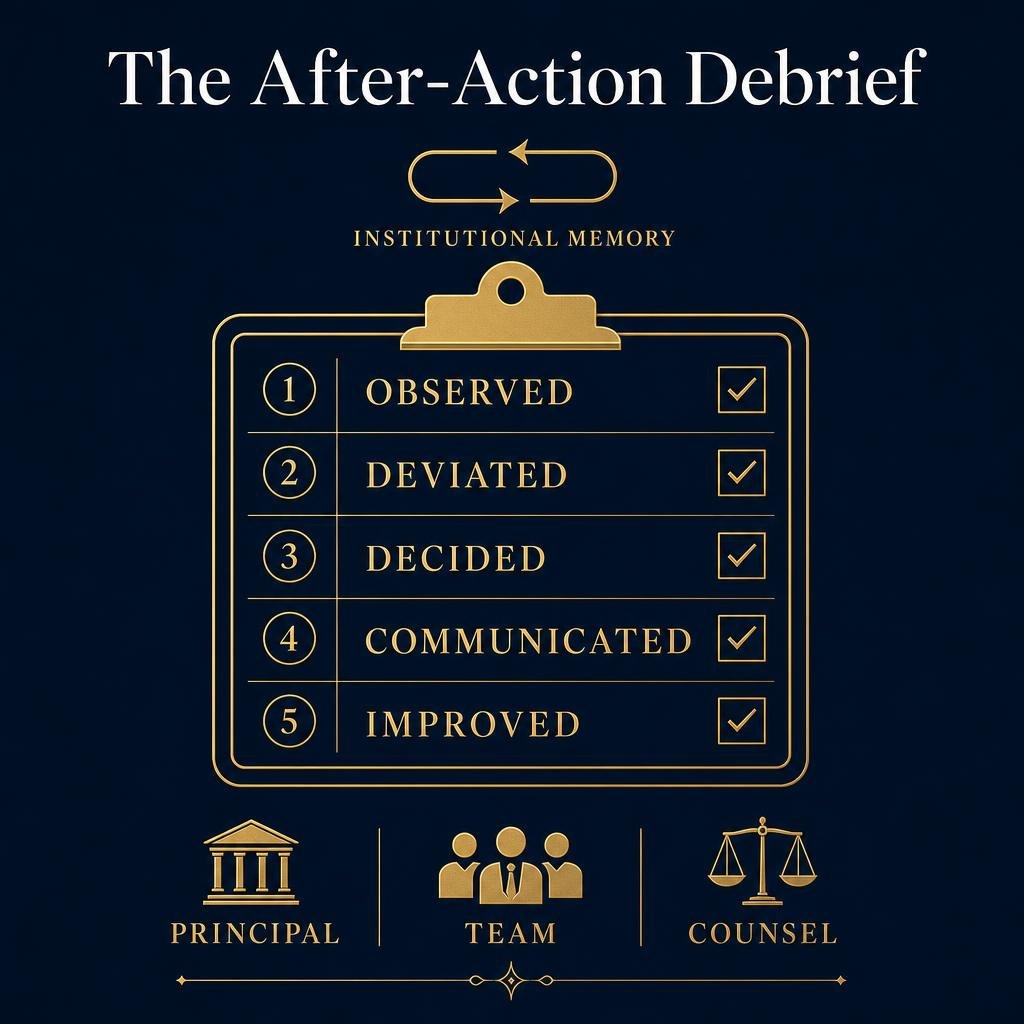
The five-part debrief
The framework we use at AMERINE, which shapes the downloadable checklist below, relies on five verbs in order.
Observed. Record what actually happened, sticking to facts rather than interpretation: times, personnel, weather, crowd, media, and anyone flagged during advance work or on site.
Deviated. Identify exactly where execution differed from the written plan and why. Include route shifts, timing adjustments, personnel changes, communication failures, and vendor deviations.
Decided. Capture the calls made, including every trigger that fired and every trigger that should have been considered. Record who held authority at each phase and what was escalated to counsel or corporate.
Communicated. Document the record: radio and movement logs retained, the after-action summary distributed only to authorized parties, the client debrief scheduled inside seven days, and reportable incidents filed.
Improved. Record the institutional changes: updates to the advance checklist and the threat picture in the principal's profile, revisions to the route library, and assignment of the training gap. Include the briefing to the board, family council, or counsel if material.
Each of those five verbs must produce a written line. Otherwise, the debrief did not happen.
The 72-hour rule
By day four, much of the fine detail has faded from memory: the small hand-off that almost failed, the driver's decision in traffic, the vendor who wasn't who they said they were.
Serious programs hold their debrief within 72 hours, ideally the next morning with the team still assembled. They never leave it later than the end of the same week.
What the debrief protects against
The debrief is not a compliance ritual. It protects three things at once.
The principal, because the same mistake does not happen twice.
The program, because knowledge does not evaporate when a lead agent leaves the firm.
The client needs the after-action record because it's the artifact counsel, insurance and boards ask for when something eventually does go wrong.
Download the checklist
We designed the AMERINE Post-Event Security Debrief Checklist as a practical document for principals, chiefs of staff, family offices, and corporate security teams. They can complete it in under an hour and archive it for the life of the program.
<div class="my-8 rounded-lg border border-primary/20 bg-linear-to-r from-primary/5 to-transparent p-6"> <p class="text-lg font-semibold text-primary mb-2">Download: Post-Event Security Debrief Checklist</p> <p class="text-sm text-muted-foreground mb-4">A one-page working document covering Observed, Deviated, Decided, Communicated, and Improved: the five sections that turn a single event into institutional memory.</p> <a href="/downloads/post-event-security-debrief-checklist.pdf" class="inline-flex items-center gap-2 rounded-md bg-primary px-4 py-2 text-sm font-semibold text-primary-foreground hover:bg-primary/90" download>Download PDF</a> </div>
You can take the checklist with your team; its inside pages are unbranded, and it's designed to travel. To review how AMERINE runs governance-level debriefs while working directly with general counsel, corporate security, or a family council, schedule a private consultation.
Related reading
- 7 World Cup Security Lessons for Every Event: the pillar for this series
- Advance Work: How Predictability Becomes Risk at Public Events
- Decision Triggers: The Protective Playbook That Keeps Events Fluid
- Egress Is the Operation
- Executive Protection vs. Venue Security
AMERINE Executive Logistics is licensed by the Texas Department of Public Safety, License No. C31012001.