Part 3 of the AMERINE World Cup 2026 debrief series. Start with the pillar: [7 World Cup Security Lessons for Every Event](/blog/world-cup-security-lessons-for-every-event).
A common misconception is that executive protection is about anticipating every threat. It is not. It is about deciding quickly and correctly when a threat, an inconvenience or a change in conditions does emerge.
The mechanism that makes those decisions repeatable is called a trigger.
What a trigger is
A trigger is a pre-authorized decision, held by a named person, that activates a specific action when a defined condition is observed. Triggers exist so that the moment a driver, agent or advance sees the condition, the action follows without a meeting.
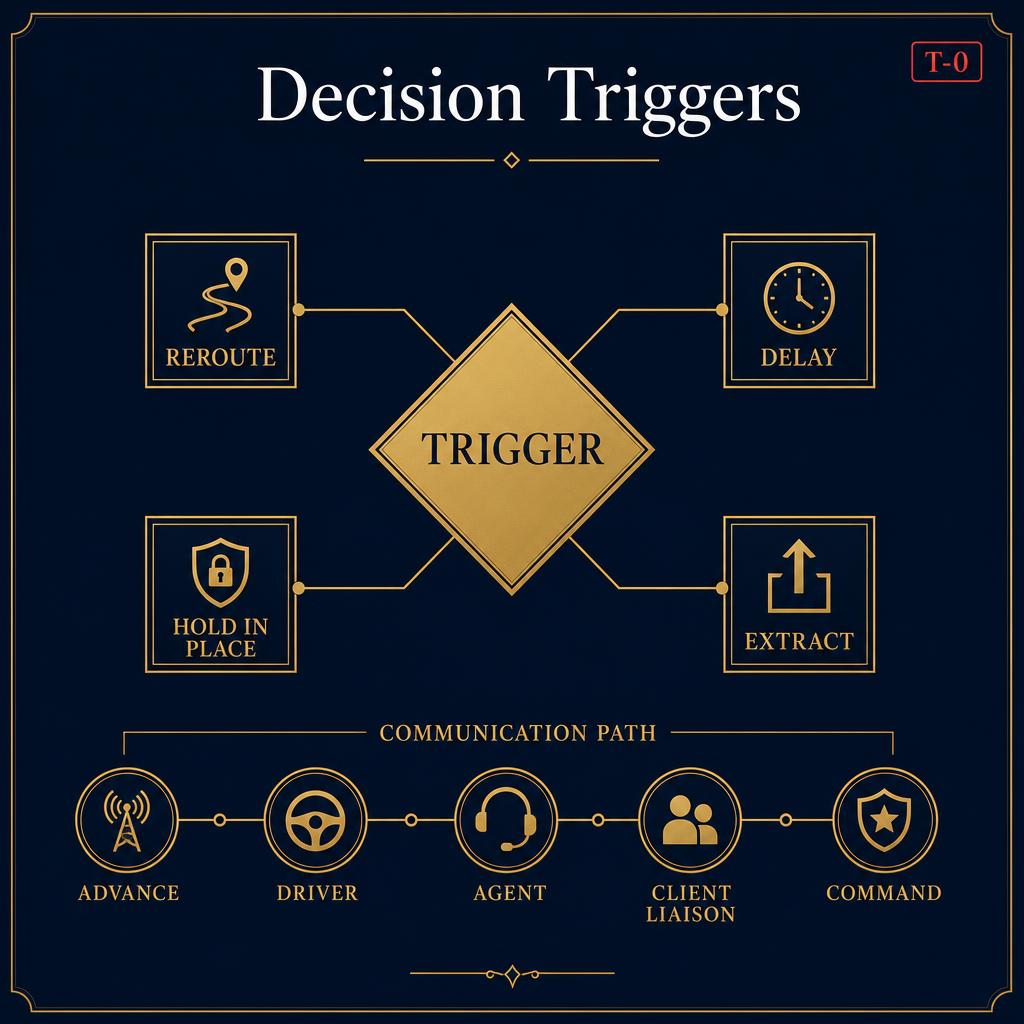
In our World Cup 2026 operations, four categories of triggers accounted for nearly every real-world call:
- Reroute — the primary route is no longer the safest route
- Delay — the arrival window must shift to the right
- Hold in place — the principal remains where they are until the condition clears
- Extract — the principal is moved out of the environment now
Each of those verbs is deceptively small. Each requires that a specific person be authorized to invoke it, that a specific communication path deliver it, and that a specific team accept it without debate.
Why triggers fail in practice
Post-event debriefs from the tournament surfaced the same failure repeatedly.
The team saw the condition. Everyone knew the trigger existed. No one wanted to be the person who made the call.
This is a governance problem, not an operator problem. When decision authority is diffuse — spread across a security lead, a chief of staff, a client, an event producer and a spouse — the default is a group text and a lost thirty seconds. Those thirty seconds are where the World Cup, and every high-profile event, quietly consumes its safety margin.
How to build triggers a team will actually use
The triggers that survived first contact with real events during 2026 shared four qualities:
They were written down. A trigger that lives in one person's head is not a trigger; it is a hope.
They were binary. Each trigger had one condition and one action. "If the demonstration reaches the north gate, we depart via the south service road." No qualifiers, no negotiation.
They named one authority. Every trigger had a single decision-maker and a single successor. Committees do not make decisions in traffic.
They were rehearsed. The driver, agent and client liaison had walked or radioed the alternate movement at least once before it was needed for real.
The client's role
Principals sometimes resist triggers because they feel they will lose control of their own day. The opposite is true. A trigger removes the moment where a principal must argue with their own security detail about whether to leave a gala, cut a dinner short or take a different route home.
The trigger is agreed in a briefing at 10 a.m. It executes at 10 p.m. without asking. That is the entire point.
For family offices, corporate security committees and general counsel, the practical exercise is to sit with the protection provider and list — on one page — the ten triggers that could plausibly fire during the next quarter, the person authorized to invoke each and the successor.
If that page cannot be produced, the program is not yet mature.
Related reading
- 7 World Cup Security Lessons for Every Event
- Advance Work: How Predictability Becomes Risk at Public Events
- Protective Intelligence Services
- Private Consultation — for governance-level program review
AMERINE Executive Logistics is licensed by the Texas Department of Public Safety, License No. C31012001.