For a principal, family office, or corporate risk committee, choosing an executive protection firm ranks among the most consequential security decisions they'll ever make. Choose the wrong firm, and the false sense of safety it creates can have catastrophic consequences.
I've evaluated dozens of firms for clients after more than 25 years in law enforcement, federal investigations, and private-sector protective operations. In those evaluations, the five criteria below consistently distinguish world-class providers from firms that only look the part.
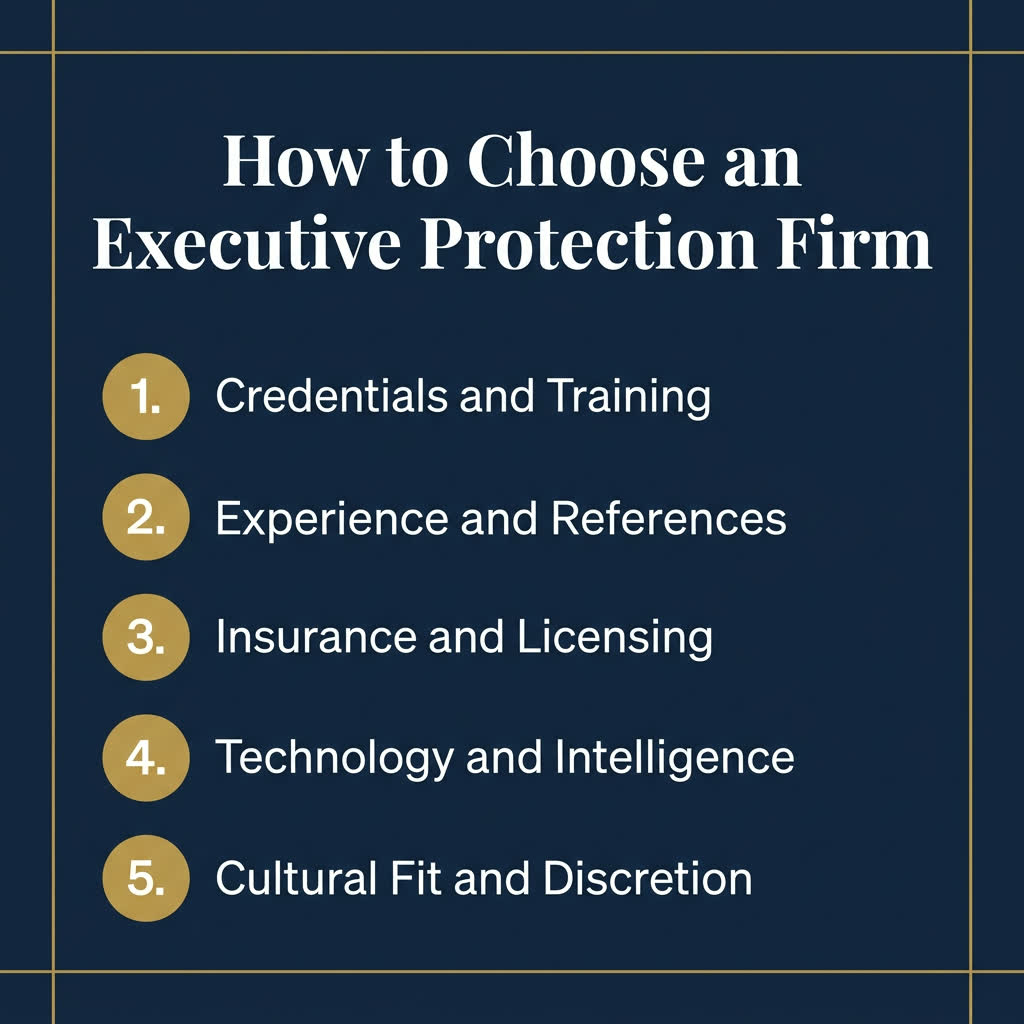
1. Credentials and Training
No single governing body oversees executive protection. That leaves vetting entirely to the client. Start with these questions:
- Do agents hold current state licenses in every jurisdiction where they will operate?
- What formal training programs have team members completed (USSS, DSS, military SOF, PPS)?
- Does the firm run recurring, scenario-based training rather than relying on initial certification alone?
- Are agents trained in emergency medicine (TCCC, TECC, or equivalent)?
Red flag: Be wary of a firm that can't provide verifiable training records or relies entirely on "years of experience" with no documented continuing education.
2. Experience and References
Don't assume security experience transfers easily from one sector to another. Protecting UHNW families across multiple continents is fundamentally different from specializing in nightclub security.
Key questions to ask:
- Can the firm provide references from clients with a comparable threat profile?
- Has the team operated in the specific regions where you travel?
- What is the average tenure of their agents? High turnover signals deeper problems.
- Does leadership have direct protective intelligence or law enforcement backgrounds?
Ask for at least three references, then follow through with calls. Get specific about communication and discretion, and ask how the team responded to an unexpected situation.
3. Insurance and Licensing
Legitimate executive protection firms carry substantial insurance coverage. At minimum, verify:
- General liability insurance
- Professional liability / errors and omissions coverage
- Workers' compensation for all agents
- Proper licensing in every state and country of operation
- Compliance with local firearms regulations where armed protection is provided
Why this matters: Inadequate insurance leaves the principal directly exposed to legal and financial liability if an agent gets injured or an incident occurs during a protective operation.
4. Technology and Intelligence
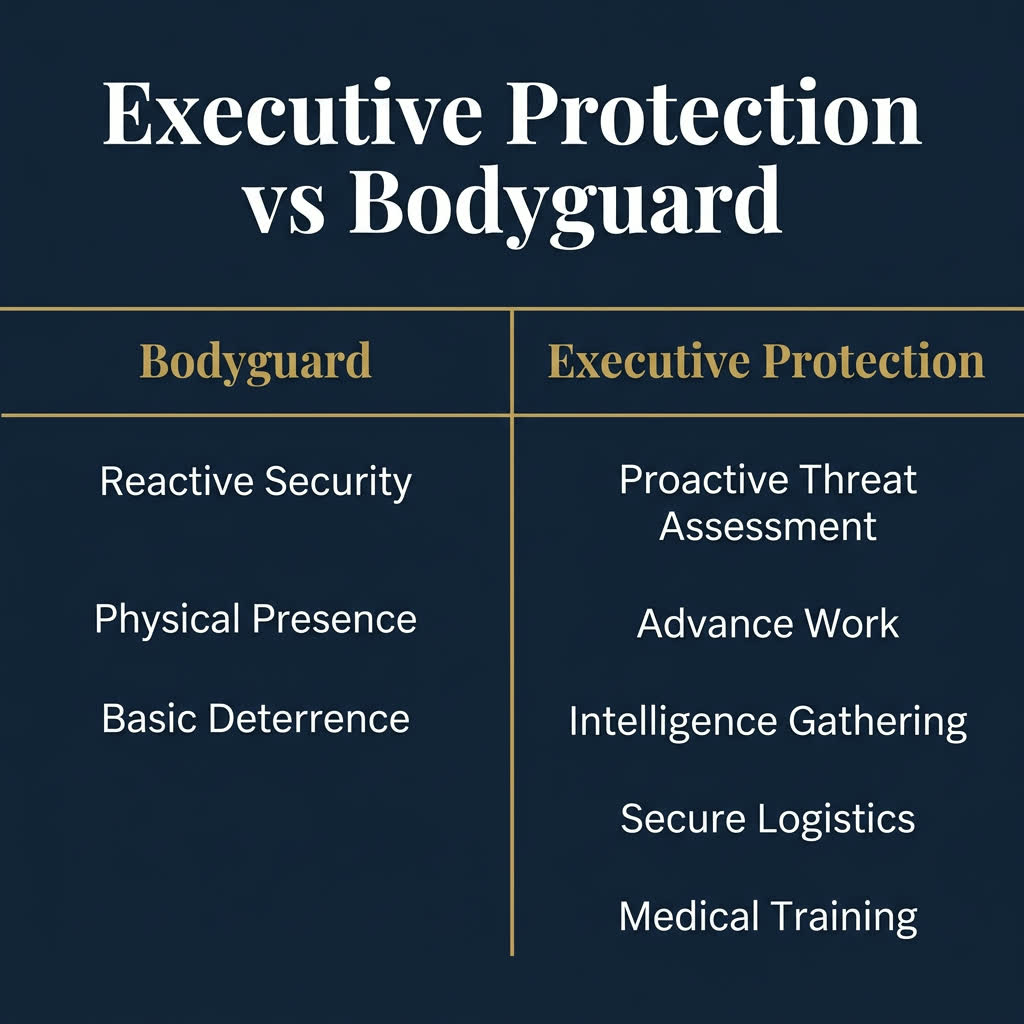
Modern executive protection extends far beyond physical presence. Leading firms integrate:
- Protective intelligence: Continuous monitoring of open-source, dark-web, and social-media threats directed at the principal or their family.
- Secure communications: Encrypted messaging, satellite phones, and communication redundancy plans.
- Route and venue analysis: GPS-based advance work with real-time traffic, threat, and medical-facility overlays.
- Cyber-physical convergence: Coordination between the digital security team and the physical protection detail to close gaps that attackers exploit.
Have potential firms explain their technology stack and how they bring intelligence into daily operational planning. If their answers are vague, that suggests they react to events rather than plan ahead.
5. Cultural Fit and Discretion
Executive protection agents work in the most private parts of a principal's life, including the home, family vacations, and board retreats. That makes this criterion often the most important in practice, even though it's the hardest to assess on paper.
Evaluate for:
- Does the team understand the principal's lifestyle, values, and social norms?
- Can agents adapt smoothly to formal business settings, casual family environments, and high-net-worth social events?
- Is the firm obsessive about confidentiality in day-to-day culture as well as in signed contracts?
- Do agents maintain a professional, low-profile appearance that avoids drawing unwanted attention?
Everyone but the principal remains unaware of the best protective teams. Tactical competence won't save the relationship if a firm's agents attract attention or make the principal uncomfortable through their appearance, behavior, or communication.
The Selection Process: A Practical Roadmap
- Define the threat profile. Before contacting any firm, work with an independent security consultant to complete a formal threat and vulnerability assessment.
- Request proposals from 3–5 firms. Provide a consistent scope of work so you can compare responses objectively.
- Conduct in-person interviews. Meet the leadership team and the agents who will actually be assigned to your detail, rather than only the sales team.
- Check references and verify credentials. This step is non-negotiable.
- Start with a trial engagement. A 30–60 day trial period reveals more about a firm's day-to-day capabilities than any proposal ever will.
- Establish clear metrics. Define what success looks like: response times, communication cadence, reporting standards, and after-action reviews.
Why Amerine
Services are delivered by appropriately licensed personnel where state law requires it. Licensing, staffing, and response times are confirmed in writing before each engagement.
We specialize in protecting UHNW families, C-suite executives, and high-profile individuals who need discretion and effective protection. By combining protective intelligence, secure logistics, and cultural adaptability, we make security fit your life rather than making your life fit security.
Contact us for a confidential consultation to discuss your specific requirements.