Why Hiring the Right EP Agent Matters More Than Ever
Demand for executive protection has surged in 2026, with more executives, UHNW families, and public figures seeking professional protection than ever before. Driving that demand are geopolitical instability, escalating domestic threats, social media-fueled targeting, and greater awareness of personal security.
Providers have flooded the protection industry, and their abilities range from world-class to dangerously incompetent. Hire the wrong executive protection agent and you'll waste money. Worse, you can end up with a false sense of security that can have catastrophic consequences.
A former U.S. Secret Service agent wrote this guide to hiring an EP agent who fits your situation.
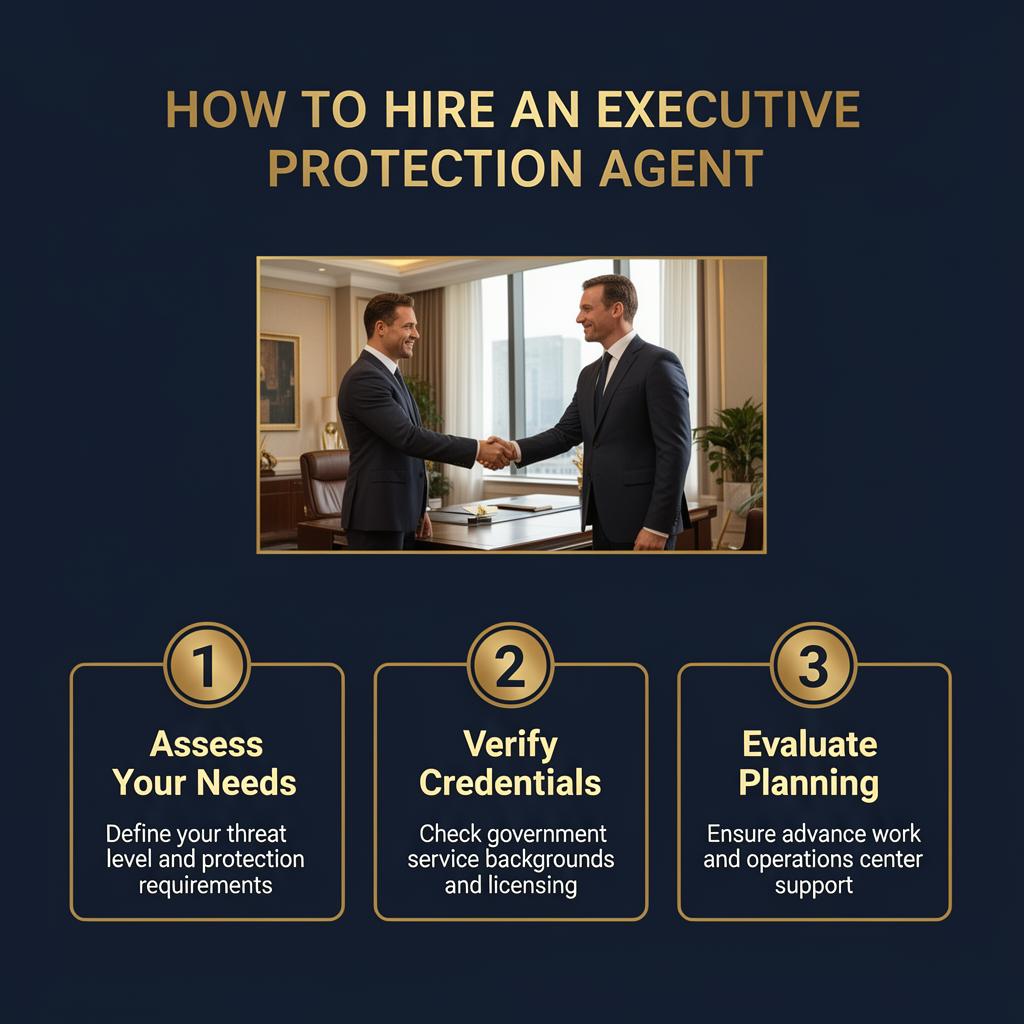
Step 1: Assess Your Security Needs
Before contacting any provider, get clear on what you actually need:
Threat Level Assessment
Ask yourself:
- Have you received direct threats? Written, verbal, online, or through third parties.
- Is your wealth or position publicly known? Media coverage, Forbes lists, public company leadership.
- Do you travel to elevated-risk destinations? Middle East, Latin America, parts of Africa or Asia.
- Are you involved in contentious situations? Litigation, divorce, corporate disputes, political involvement.
- Has your family been targeted? Stalking, harassment, or surveillance of family members.
Protection Scope
Determine what type of protection your profile requires:
- Event-specific: A single event, public appearance, or trip
- Travel protection: Domestic or international travel security
- Daily protection: Ongoing close protection for daily activities
- Residential protection: Security for your home and property
- Family protection: Coverage extending to spouse, children, or extended family
- Full program: Comprehensive protection covering all of the above
Duration
- Short-term: Days to weeks (a specific threat period, travel, or an event)
- Ongoing: Monthly or quarterly programs
- Membership programs: On-demand deployment. Scope and terms are confirmed in writing.
Step 2: Understand What Credentials Actually Matter
There's no universal certification standard for the executive protection industry, so you need to distinguish meaningful qualifications from ones that mean nothing.
Credentials That Matter
#### Government Protective Experience The gold standard. Operators who served in these roles have been vetted at the highest levels and trained in methodologies proven to protect the world's most targeted individuals:
- U.S. Secret Service: Presidential Protective Division (PPD), dignitary protection
- Diplomatic Security Service (DSS): Foreign diplomatic protection operations
- Military Special Operations: Special Forces, SEAL Teams, MARSOC, 75th Ranger
- FBI Protective Operations: Witness protection, dignitary security
- Capitol Police Dignitary Protection: Congressional protection details
#### Verifiable Training
- Formal protective operations courses from recognized institutions
- Defensive driving certification, beyond a standard driver's license
- Advanced medical training: EMT, TCCC (Tactical Combat Casualty Care)
- Firearms qualifications current within the last 12 months
#### State Licensing
- Valid private security license in the state(s) where they'll operate
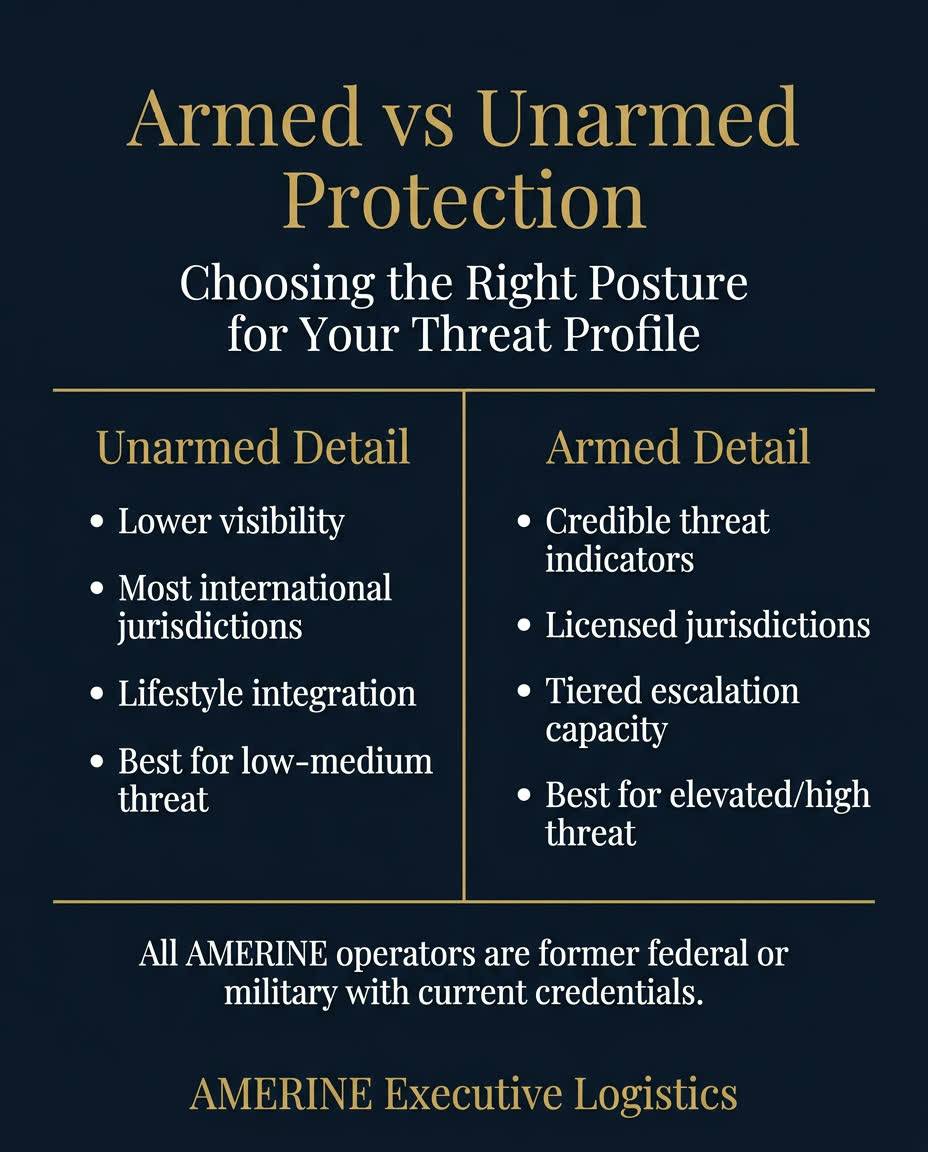
- Concealed carry permits if armed protection is required
- Insurance and bonding
Red Flags in Credentials
- "Military veteran" without specifics: Many claim military service without specifying their role. Ask for their MOS (Military Occupational Specialty) and unit assignments.
- Training certificates from unknown schools: The EP training market is full of low-grade programs. Ask where they trained, then verify the school.
- No verifiable references: Any legitimate EP professional can provide references from previous principals or security directors.
- Social media operators: Agents who post photos with clients, weapons, or tactical gear on social media are demonstrating the opposite of discretion.
- "Former law enforcement" without protective experience: Patrol officers and detectives are not trained in protective operations. Look specifically for protective detail or dignitary protection experience.
Step 3: Evaluate Executive Protection Companies
Your options are to hire individual EP agents or contract with an EP company. An established company offers most clients better accountability, backup resources, and insurance coverage.
Questions to Ask EP Companies
#### About Their Operators
- "Where did your operators serve in government, and in what capacity?"
- "How do you vet and background check your operators?"
- "What is the average experience level of operators you would assign to my detail?"
- "Do you use full-time employees or subcontractors?" (Both can work, but understand which you're getting)
- "Can I meet my assigned operator before the engagement begins?"
#### About Their Methodology
- "Walk me through how you plan a typical engagement from consultation to deployment."
- "What advance work do you conduct before deploying operators?"
- "Do you provide a written security plan or operations order for each engagement?"
- "How do you handle emergency situations and what are your escalation protocols?"
- "Do you have an operations center for real-time support?"
#### About Their Capability
- "How many countries can you operate in, and do you use vetted in-country partners?"
- "Can you scale from a single agent to a multi-person detail?"
- "Do you provide secure transportation as part of the protection package?"
- "What intelligence and monitoring capabilities do you offer?"
- "What happens if my primary operator is sick or unavailable?"
#### About Business Terms
- "Scope and terms are confirmed in writing."
- "Scope and terms are confirmed in writing."
- "Do you carry liability insurance, and what are the coverage limits?"
- "What is your cancellation policy?"
- "Do you offer programs for ongoing needs?"
Company Red Flags
- No website or minimal online presence, Legitimate companies maintain professional websites
- Unwillingness to provide references, Every reputable company can connect you with past clients
- Pressure to sign immediately, Quality providers give you time to evaluate
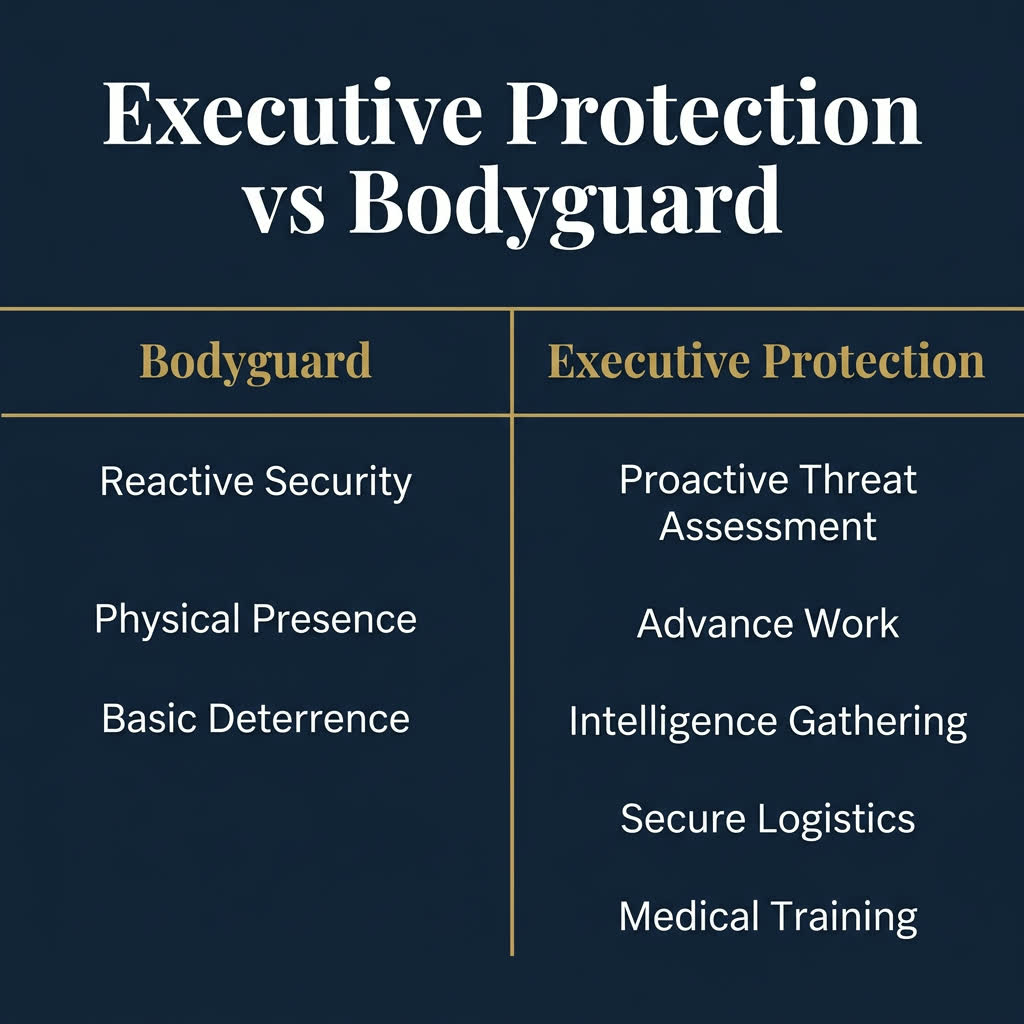
- No planning methodology, If they want to "just send someone," that's a security guard service, not executive protection
- Guarantees of "100% safety", No honest security professional makes absolute guarantees
Step 4: The Consultation Process
What a Good Consultation Looks Like
A legitimate EP company's consultation should include:
- Confidential discussion of your situation, concerns, and threat environment
- Needs assessment, understanding your lifestyle, travel, family, and schedule
- Threat evaluation, professional assessment of your actual risk level
- Recommendation, honest advice about what level of protection you actually need (a good company will tell you if you need less than you think)
- Proposal, Scope and terms are confirmed in writing.
- No pressure, the consultation should be informative, not a sales pitch
What to Share During Consultation
Be candid about any threats you've received, and share documentation if it's available. Discuss your daily routine and travel schedule, family members who may need coverage, and how comfortable you are with visible security. Explain your previous security arrangements and why they did or didn't work.
What NOT to Share
- Don't share sensitive financial details beyond what's relevant to security planning
- Don't provide access to your home or office before the company is vetted
- Don't share details about other security measures you have in place until you've decided to engage
Step 5: Evaluate the Proposal
What a Professional Proposal Includes
- Clear scope of services (what's included and what's not)
- Operator qualifications for your specific detail
- Advance planning timeline and deliverables
- Communication protocols and emergency procedures
- Equipment and vehicle details
- Scope and terms are confirmed in writing.
- Insurance certificate
- Contract terms including cancellation, confidentiality, and liability
Executive Protection Overview
Elite operators invested decades in government service developing skills that directly protect your life and safety.
General market ranges for 2026 cover a single EP agent working domestically and international operations involving logistics, risk, and in-country coordination. Full-time coverage requires multiple shifts and operators.
In this industry, the cost of failure is measured in lives.
Visit our how a program is scoped page.
Step 6: The Engagement
What to Expect in the First Week
- Security survey: Your EP team will assess your primary locations
- Route analysis: Mapping primary, alternate, and emergency routes
- Communication setup: Establishing secure communication channels
- Emergency planning: Creating action plans for medical, threat, and evacuation scenarios
- Lifestyle calibration: Your operator learns your preferences, schedule, and social dynamics
Building the Relationship
Your EP operator will spend more time with you than almost anyone else in your life, making the agent-client relationship uniquely intimate. For that relationship to succeed, it requires:
- Trust: Share schedule changes, concerns, and feedback openly
- Boundaries: Your EP agent is a professional, not a friend, assistant, or confidant
- Communication: Tell your operator about changes in your threat environment or routine
- Feedback: If something isn't working, say so. Good operators adapt.
Common Mistakes When Hiring Executive Protection
1. Hiring Based on Size or Appearance
The most effective EP agents are often the ones you'd never notice. Discretion trumps intimidation in elite protection.
2. Choosing Without Careful Evaluation
You're entrusting your life and your family's safety to this person.
3. Not Checking References
Always speak with at least 2-3 previous clients or security directors who can verify the provider's performance.
4. Skipping the Advance Planning
If a provider wants to deploy without advance planning, they're providing a body, not protection.
5. Hiring Without a Contract
Professional engagements require written agreements covering scope, liability, confidentiality, and terms.
6. Expecting Your EP Agent to Be a Personal Assistant
The moment your operator starts running errands or managing personal tasks, their security focus is compromised.
The AMERINE Difference
At AMERINE Executive Logistics, we base our executive protection approach on the methodology Scott Jones developed over his career in the U.S. Secret Service:
- Planning first: Every engagement begins with thorough advance work and threat assessment
- Elite operators: Our team includes former Secret Service, military SOF, and federal law enforcement professionals
- Operations center: Real-time intelligence and support for every active detail
- International capability: Vetted operator networks across 45+ countries
- Absolute discretion: We never disclose client relationships or identities
---
To discuss your executive protection needs, [Contact AMERINE](/contact) for a confidential, no-obligation consultation. You can call (281) 799-1877 or request a consultation online. All conversations are strictly confidential.