CPO vs Bodyguard at a Glance
How a close protection officer (CPO) and a traditional bodyguard for hire differ across the dimensions that actually move risk.
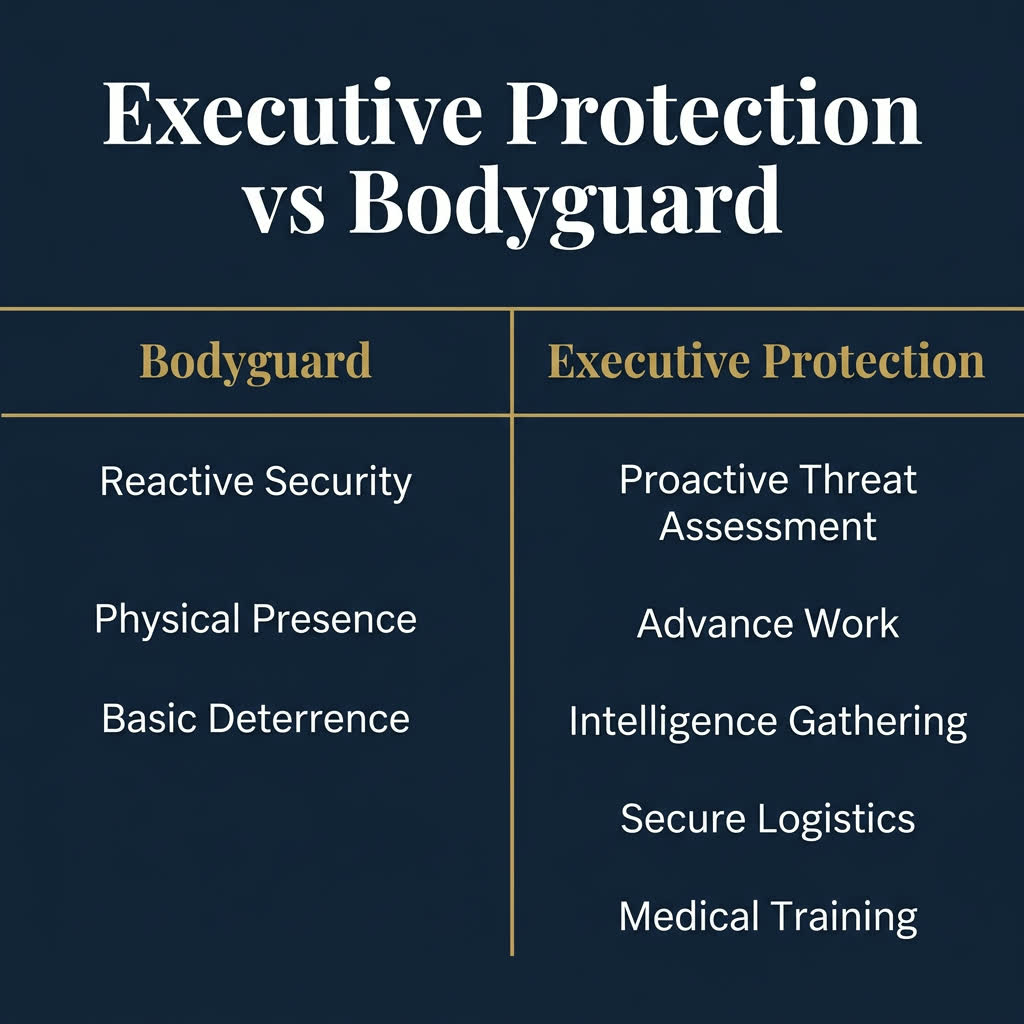
| Dimension | Executive Protection / CPO | Bodyguard for Hire |
|---|---|---|
| Mindset | Planning-first, prevention | Reactive presence |
| Advance work | Routes, venues, contingencies pre-walked | Rarely conducted |
| Protective intelligence | Pre-trip + real-time monitoring | Not included |
| Team structure | Coordinated detail with comms plan | Solo operator |
| Transportation | Vetted security driver, alternate routes | Standard ride or none |
| Medical capability | TECC/TCCC-trained, kit on body | Variable |
| Vetting | Federal / military / USSS pedigree | Inconsistent |
| Best for | Executives, UHNW families, ongoing programs, travel | One-off events, short overwatch |
Not sure which fits your situation? Scott personally takes every first call.
CPO vs Bodyguard — Quick Answers
The Short Answer
A close protection officer (CPO) is a trained protective specialist responsible for the safety, privacy, and schedule integrity of a principal — typically an executive, UHNW individual, family member, public figure, or high-risk traveler. The work is mostly planning and prevention. The visible part — standing near the principal — is the smallest part of the job.
A good CPO works to make sure nothing happens. When something does happen, the response is rehearsed, calm, and proportional.
What a Close Protection Officer Actually Does
A CPO's day is built around a few core functions:
- Advance work. Walking venues, mapping arrival and departure points, identifying medical resources, photographing rooms, confirming staging for vehicles, and pre-planning the route.
- Protective movement. Managing the transitions where exposure is highest — curb to vehicle, vehicle to lobby, lobby to suite, suite to stage, stage back to vehicle.
- Protective driving. Either personally driving or coordinating with a vetted security driver who understands route security, alternate routing, and emergency egress.
- [Protective intelligence](/protective-intelligence). Monitoring threats, social media chatter, protest activity, weather, traffic, venue posture, and itinerary changes in real time.
- Schedule integrity. Keeping the principal on time without making the day feel rushed or restrictive.
- Crisis response. Medical emergency, vehicle accident, hostile approach, fan crowd, paparazzi swarm, or evacuation — all rehearsed, all scripted, all calm.
The point is not to look like security. The point is to be ten steps ahead of it.
What a CPO Is Not
A close protection officer is not a doorman, a bouncer, or an off-duty patrol officer in a sport coat. The job is not about confrontation. It is about avoiding the conditions that lead to confrontation in the first place.
A real CPO will:
- Refuse to skip the advance.
- Refuse to operate without a communications plan.
- Refuse to drive an unfamiliar vehicle on an unrehearsed route.
- Refuse to stand in for a job they are not trained for — driver, EMT, IT specialist, or attorney.
Discipline is the product. Everything else is presentation.
How a CPO Works With the Principal
The best protective relationships are quiet, almost invisible. The principal lives their life. The CPO manages the friction the principal does not need to see — the parking arrangement, the back-of-house entrance, the alternate elevator, the secondary vehicle, the medical clinic two blocks away.
A principal should rarely feel "guarded." They should feel that everything works.
Training, Background, and Selection
Most credible close protection officers come from one of a few backgrounds:
- U.S. Secret Service or other federal protective services
- Military special operations or military police
- State or municipal law enforcement (often plain-clothes or protective details)
- Career private-sector EP after formal CPO certification
Beyond the resume, the work demands emotional discipline, situational awareness, fitness, medical training, driving skill, and the maturity to operate in luxury and corporate environments without standing out. AMERINE's operators are vetted against all of these — not just the credentials.
Where a CPO Fits Into a Larger Program
For most principals, a single CPO is part of a larger protective ecosystem: protective intelligence, secure transportation, residential security, travel security, and executive program management. The CPO is the closest layer to the principal — but the program around them is what makes the role work.
Looking for a vetted close protection officer or full executive protection program? Contact AMERINE for a confidential conversation. Scott personally takes every first call.
---
Frequently Asked Questions
What is a close protection officer?
A close protection officer (CPO) is a trained protective specialist who plans, prevents, and manages security risk for a principal. The role focuses on advance work, protective movement, protective intelligence, and crisis response — not on confrontation.
What is the difference between a close protection officer and a bodyguard?
"Bodyguard" is the older, broader term. "Close protection officer" reflects modern training standards — planning-first methodology, protective intelligence, advance work, medical capability, and disciplined movement. Most credible providers in the U.S. and U.K. use "CPO," "EP agent," or "protective agent" rather than "bodyguard."
What does a close protection officer do day to day?
A CPO's day usually starts with the advance — confirming the schedule, route, venues, and contingency points. The day is built around protective movement during transitions, real-time intelligence monitoring, communication with the team, and adjusting plans as the principal's schedule shifts.
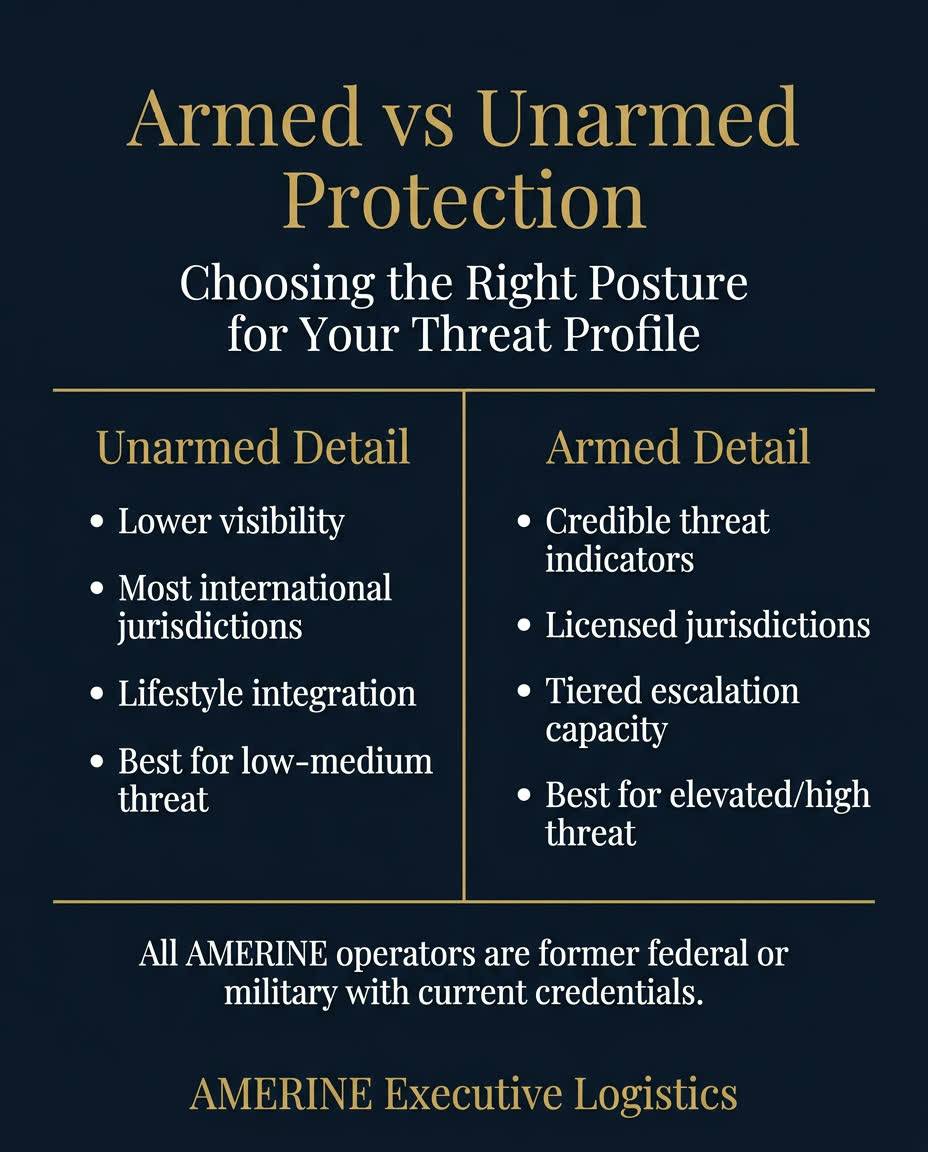
Are close protection officers armed?
It depends on jurisdiction, licensing, threat level, and client preference. AMERINE deploys both armed and unarmed protective details. Armed status is matched to the threat picture, the venue, the principal's preferences, and applicable state and venue rules.
How is close protection scoped?
Scope depends on threat level, duration, location, team size, vehicle requirements, and whether international travel or residential coverage is involved. Scope and terms are confirmed in writing. Contact us for a confidential conversation.
Can I hire a close protection officer for one day or one event?
Yes. AMERINE supports single-day movements, event-only coverage, short-term travel, and ongoing programs. The methodology — advance, intelligence, movement plan, contingency — is the same regardless of duration.
What backgrounds do AMERINE's close protection officers come from?
AMERINE operators come from the U.S. Secret Service, federal law enforcement, military special operations, and senior private-sector EP roles. Every operator is vetted for credentials, character, and the discretion that UHNW and corporate environments require.
---
This article is general information about close protection roles and is not legal, licensing, or operational advice. Licensing requirements vary by state and country. Contact AMERINE for guidance specific to your situation.