When a Normal Company Becomes a High-Risk Environment
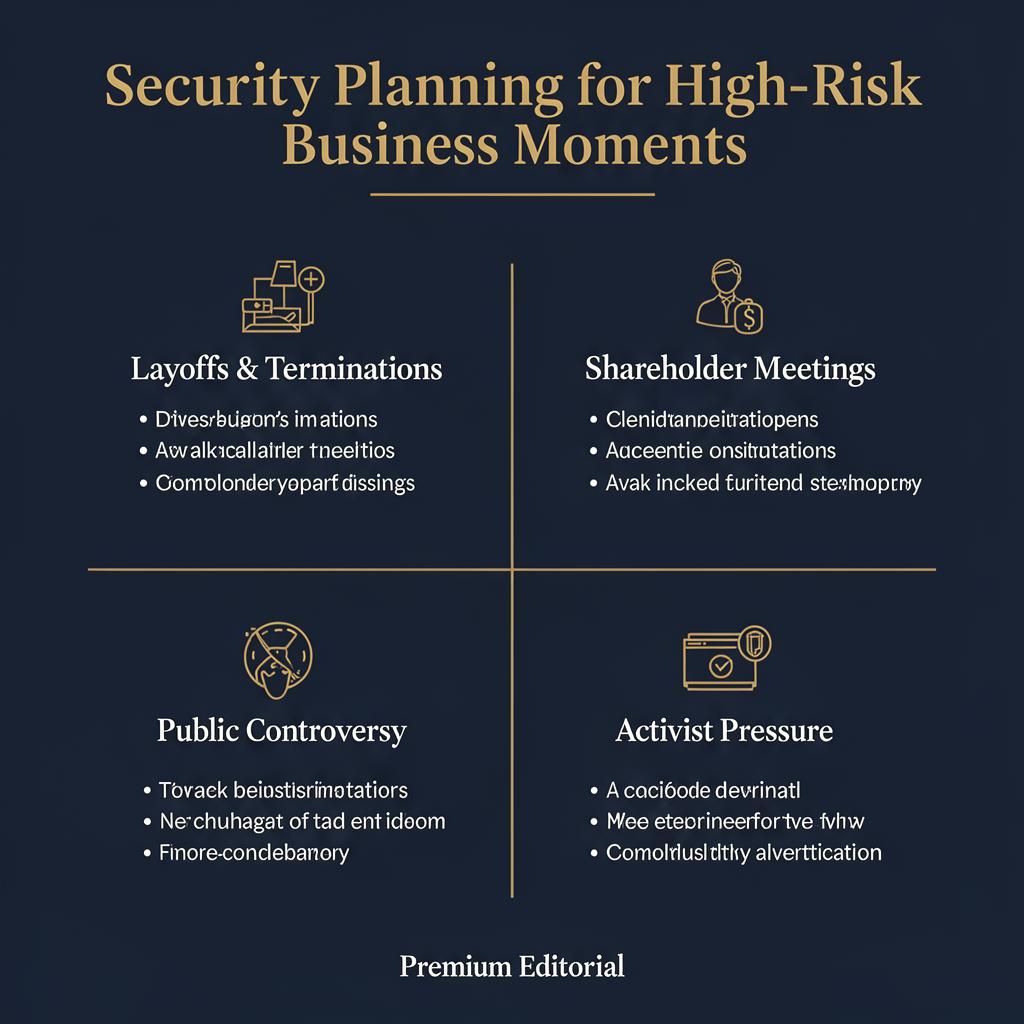
Corporate environments are usually low-risk, but the moments that change that are predictable: a layoff announcement, a high-profile termination, a contested shareholder meeting, a regulatory or media controversy, or an activist campaign. During those moments, otherwise-stable companies temporarily become high-risk environments for executives, HR staff, and the broader workforce.
This is the planning framework we walk corporate security leaders, general counsel, and CHROs through ahead of those moments.
1. Layoffs and Workforce Reductions
The risk picture around a workforce reduction extends well past the exit interview. Planning should account for:
- The HR staff and managers delivering the news.
- Named executives tied to the decision in internal or public messaging.
- The specific buildings, floors, and rooms where notifications take place.
- Digital channels where hostile reactions emerge: internal Slack channels, public review sites, and social media.
- The post-event window, which historically carries the highest risk of retaliation.
Standard planning components:
- Pre-event [protective intelligence](/protective-intelligence): Open-source monitoring focused on named executives for the 30 days leading up to the announcement.
- On-site posture: Visible, proportional security at notification sites. Plainclothes teams are preferable whenever a uniformed presence might agitate the room.
- HR support protocol: A clear escalation path for contentious meetings, backed by a designated decision-maker authorized to expand protective coverage immediately.
- Executive posture step-up: Temporary protective details for executives tied to the layoffs, scaled to specific threat indicators.
- Post-event watch period: Continued monitoring for 30 to 90 days, governed by clear, documented criteria for stepping down coverage.
2. High-Profile Terminations
When you terminate a senior or visible employee, the operational challenge differs from managing a broad workforce reduction. It's personal, the grounds are often documented, and the reaction can range from immediate withdrawal to sustained hostility.
Planning considerations:
- Pre-termination threat assessment on the individual, drawing on HR records, prior incidents, and OSINT.
- Meeting logistics: room location, attendees, exit protocol, return of property, and access termination.
- Digital access lockout timed directly to the conversation, not after.
- Documented contact protocol if the individual reaches out post-termination.
- Posture review for the executive conducting the termination, as well as the HR or legal staff involved.
When a very high-risk termination involves documented prior threats, weapons history, or severe mental-health indicators, it's appropriate to have a covered protective presence during the conversation itself.
3. Shareholder Meetings, Annual Meetings, and Investor Days
A public-company shareholder meeting brings executives, board members, activist investors, journalists, and members of the public together in a single location at a published time, especially when the meeting is contested. The combined risks include:
- Named executives publicly present and accessible.
- Activist or dissident-investor presence with media amplification.
- General public access where required by bylaws or local law.
- Predictable arrival and departure flow.
Planning components:
- Pre-event venue and route assessment.
- Coordinated security with venue, hotel, and (where appropriate) local law enforcement.
- Executive arrivals and departures handled discreetly with vetted transportation.
- Visible-but-proportional credentialing and access control.
- Real-time monitoring of social and adjacent channels during the event window.
- Post-event protective intelligence watch for follow-on activity.
If the meeting is virtual or hybrid, planning turns to digital posture. That means protecting the principal's home environment during the live broadcast, ensuring the infrastructure is secure, and watching for impersonation or disruption.
4. Public Controversy and Activist Pressure
Regulatory action, product controversy, executive misconduct allegations, ESG activism, and geopolitical positioning are reputational events with a distinct risk profile. Rather than a single threatening individual, the issue is usually a sustained period of elevated online hostility and doxxing risk that occasionally translates into physical exposure.
Planning components:
- Surge protective-intelligence coverage scaled to the controversy.
- Accelerated doxxing removal for named executives and family members.
- Family-side briefings: schools, spouses, adult children, and household staff.
- Residential posture reviews and temporary step-ups.
- Travel-window discipline, deferring or rerouting visible travel.
- Communications coordination so security and corporate comms are not working in opposite directions.
Treating a reputational event as only a communications problem is a mistake. Protective planning belongs in that same meeting.
5. Cross-Cutting Principles
A few principles apply across all four scenarios:
- Plan early, scale down later. The cost of an unprepared response to a serious incident is not recoverable.
- Documented decision authority. Who can authorize a posture step-up, who can authorize spend, who can extend coverage. Decided in writing before the event, not during it.
- Coordinate with legal, HR, comms, and IR. Security working in isolation either over- or under-reacts.
- Brief the principal. The most effective protective posture requires the principal's cooperation; that requires the principal understanding what is happening and why.
How AMERINE Engages
We engage on high-risk-moment planning in three patterns:
- Event-specific surge: Standalone planning and coverage for a single layoff round, contested meeting, or controversy window.
- Standing program component: For corporate EP clients, this planning is built into the program with named pre-event and post-event protocols.
- Crisis activation: Rapid engagement when an event has already begun and posture needs to be stood up quickly.
To discuss a specific event or build this capability into an existing program, Contact us or call (281) 799-1877.
---
This article is general guidance on protective planning for sensitive corporate moments and is not legal, HR, or labor-relations advice. Companies should coordinate with qualified counsel on circumstances specific to their situation.