Threat Investigations: How They Work and What Follows

A threat investigation is a fact-based inquiry into whether a person of concern is moving toward harming you, your family, your home, your event or your trip. It is not a hunt for suspects. It is the start of a management process. At AMERINE, we pair that process with assessment-led protection, so the findings turn into practical steps for the people who carry them out: executives, family offices, assistants and travel teams.
This guide explains the method in plain terms. It covers what triggers an inquiry, how professionals judge a threat, the steps, when to call emergency services, and how protection should match the risk.
TL;DR
-
A threat investigation looks at behavior and patterns, not just stated threats. Most attackers never threaten the target directly.
-
Three screening questions come first: is it an emergency, is it credible, and is it actionable.
-
Imminent danger goes to emergency responders first. The investigation comes second.
-
Findings should lead to a proportionate plan: digital monitoring, travel advance work, residential changes or close protection as needed.
Table of Contents
What a threat investigation actually is
People use “threat investigation” for several different things. Cyber teams use it for malware and network intrusions. This article covers the other kind: investigating a threat to a person.
The FBI describes threat assessment as a systematic, fact-based method of investigation and examination. It blends several information sources and focuses on a person’s patterns of thinking and behavior. The goal is to learn whether, and how far, that person is moving toward an attack. The FBI also stresses that it is the beginning of the management process, not a final product.
The U.S. Secret Service frames the primary goal of a protective intelligence investigation the same way. According to its protective intelligence guide, the goal is to prevent an attack. Investigators use skill, corroboration and common sense to decide whether someone poses a threat. Then they build a plan to monitor and intervene.
Three terms help:
-
Threat detection spots a signal, such as a post, a letter or a report.
-
Threat intelligence is the broader collection and analysis of information about risks.
-
Threat investigation takes one signal and works out what it means for one person or place, then what to do.
We explain the intelligence side in more depth in our piece on how the protective intelligence cycle works.
What can trigger an investigation
A criminal act is not required. The Secret Service’s 2024 guide for behavioral threat assessment units says inquiries should begin for concerning behaviors along a continuum. The list includes escalating disputes, grievances, concerning social media content, stalking and harassment, obsession with violence, idolizing past attackers, fixating on people or locations, and unusual aggression.
The FBI adds more signs on its Prevent Mass Violence page. They include threats or fantasies about violence, increasing isolation, and asking questions about or testing security at a possible target. The FBI notes that people who plan violence often show indicators first.
For your household, that translates into everyday observations:
-
A stranger who keeps turning up near the residence or the office.
-
Repeated messages from someone who feels wronged, including after a layoff or dispute.
-
Someone asking staff about your schedule, your car or your travel.
-
Online posts that name you, your family or your home.
-
Signs of tampering with a vehicle, gate or mailbox.
One item alone rarely settles anything. A pattern does.
Family members count too
The FBI’s guide warns that family, loved ones and caregivers of a person of concern can be targets even when there is no obvious grievance toward them. For a principal, the same logic runs in reverse. Spouses, children, household staff and assistants are part of the picture, which is why a good investigation looks beyond the executive.
How professionals judge whether a threat is real
Not every report deserves the same response. The Secret Service’s 2026 guide on preventing targeted workplace violence describes an initial screening with three determinations.
-
Is it an emergency? Imminent threats go to emergency responders, not to a threat assessment process.
-
Is it credible? Is the report accurate, made in good faith, and specific about the person and the threat?
-
Is it actionable? Is there enough detail to investigate, and is it within the scope of the program?
If a report passes, the deeper question is whether the person has the interest, motive, intention and capability to cause harm. The CISA Insider Threat Mitigation Guide says key facts should be corroborated, with healthy skepticism about each witness’s accuracy and credibility.
Behavior over statements
The Secret Service’s school threat assessment research found that most attackers did not threaten their targets directly. They did engage in pre-attack behaviors that could have signaled risk if someone had noticed. That is why investigators weigh what a person does over what a person says. A quiet person who is researching your schedule matters more than a loud one who vents online and goes nowhere.
Stay with the facts
The FBI warns that assessments must rest on fact. Otherwise they get distorted by assumption, speculation and guesswork. Where information is missing, investigators should say so and keep working rather than fill the gap with a guess. That discipline protects you from overreaction as much as from underreaction.
The steps of a threat investigation
The Secret Service describes the flow in its 2024 guide. Here it is, adapted for a private principal.
-
Receive and triage the report. A report can come from you, an assistant, household staff, a security desk or a family member. Anything that points to an imminent threat is handled first. The Secret Service calls bystander reporting a cornerstone of prevention and says every report should get a response. At our end, we confirm scope in writing before work starts, so everyone knows who is doing what.
-
Run a preliminary inquiry. Check the basic facts. Who is the person? What was said or done? Is there a link to your home, office, event or travel plans?
-
Move to a full assessment when concern is elevated. The government guide lists interviews with the individual, corroborating interviews with people who know them, records checks, online activity review and physical searches where protocol allows. A private firm works within what the law permits and coordinates with legal counsel.
-
Judge the pathway. Is there a grievance? Planning? Preparation? The FBI notes that target selection is a key waypoint, and that family, friends, coworkers or neighbors may see signs along the way.
-
Build a management plan. The Secret Service says a plan can range from periodic whereabouts checks to a pattern of specified contacts with the subject and the people around them. It should include informing targets or their designated protectors.
-
Monitor, then close. The plan continues until the risk is judged to have faded. Closed-case information is kept for at least several years, per the 1998 guide.
Where do investigations go wrong? Usually at steps one and five. Reports sit with an assistant who is not sure who to tell. Or a plan is made and never shared with the people who drive, staff the door and book the flights. We work with executive assistants, household staff, corporate security teams and legal counsel so the plan lands with the people who need it.
Emergencies and law enforcement come first
If someone is in danger right now, call 911. The Secret Service states that when an imminent threat to life exists, stopping the threat takes precedence over starting an assessment. Its example: an armed employee at a termination meeting should trigger an immediate law enforcement response.
The 2026 guide adds that coordination with law enforcement is critical in highly concerning cases, especially when the person is outside the organization. Police have the legal authority, training and protocols to engage such individuals safely. A private investigation does not replace that step. It runs alongside it, and we treat contacting the authorities as part of the process.
After a credible threat, the next question is what changes for the principal. Our article on executive protection after a credible threat covers that stage.
Privacy, documentation and discretion
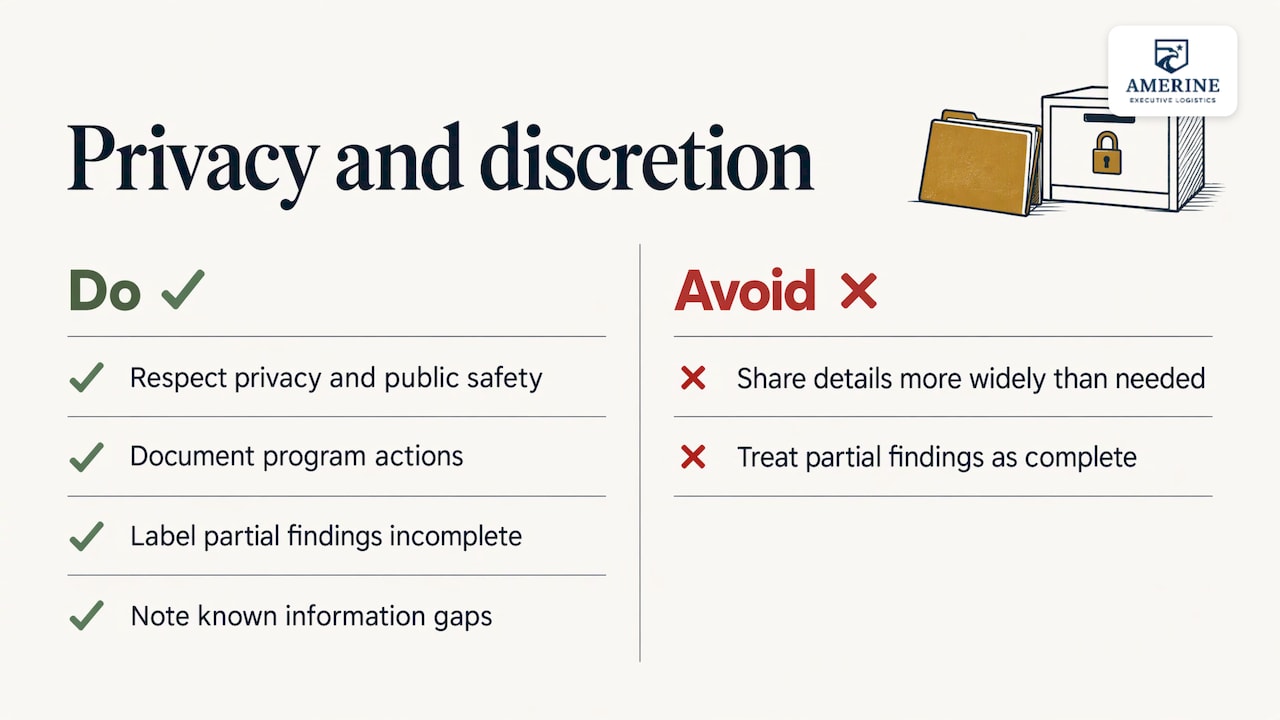
Investigating a person can be intrusive. The FBI says a respectful approach is a must and that the balance between privacy and public safety is essential. Privacy laws such as HIPAA and FERPA limit but do not ban disclosure to threat assessment teams and law enforcement. Exceptions often apply when disclosure is needed to prevent a serious and imminent threat.
CISA lists the legal foundations a program should weigh: privacy and confidentiality laws, due process, protective orders, and the duties to warn and to protect. It also expects programs to follow policy and document their actions.
The FBI also flags the “silo effect.” That is when the household, the company, the police and other parties each hold a piece and nobody shares. Its advice: label partial findings as incomplete and note the known gaps, so the next step can fill them.
For a family or an executive, discretion adds one more layer. The fewer people who know the details, the lower the chance the matter leaks or the person of concern learns too much. Our operators work low-visibility, and we coordinate with the people already in your circle rather than adding noise.
The digital side of a threat investigation
For most principals, the first sign of a threat is online. A hostile post, a flurry of phishing messages, a strange login alert, or a home address that suddenly appears on a data-broker site. The Secret Service’s 2026 guide notes that executives’ public visibility makes them vulnerable to stalking, harassment and targeted attacks when someone with a grievance fixates on leadership.
An investigation into a person of concern should include a digital review: what they post, who they talk to, and whether they are probing you or your family online. It should also check your own exposure.
-
Account takeover. Someone with your assistant’s or spouse’s credentials sees your calendar, your flights and your location.
-
Doxxing. Home addresses, children’s schools and property records gathered into one place.
-
Phishing. Messages built from real details about your schedule, aimed at staff as well as you.
-
Travel devices. Hotel and airport networks, shared chargers, and phones carrying more data than the trip needs.
-
Executive targeting. Public events, interviews and press coverage create a trail a fixated person can follow.
The Tufts threat-recognition guidance names predictable travel patterns as a risk factor for a target. Your digital footprint is often where that pattern is visible. Our cyber monitoring and digital protection service covers digital risk for executives and families, and it works alongside physical protection so both sides of the investigation share what they find.
Matching the response to the risk
Findings should drive action in proportion. The Secret Service’s school threat guide asks managers to look for the most effective and least damaging course of action, because the most familiar response may not prevent anything. An overreaction can make a situation worse.
For executives, the 2026 guide lists protective layers: digital monitoring of social media, close protection at home, office and during travel, travel advances with pre-trip intelligence, and residential security upgrades such as surveillance, alarms and access control. Here is how those line up with what we do.
| Assessed situation | Typical response |
|---|---|
| Concerning online content, no contact | Digital monitoring, account and device review, documentation |
| Repeated contact or fixation on a person or place | Residential review, camera and alarm integration, schedule changes |
| Credible threat with capability | Close protection, protective transportation, travel advance work, law enforcement coordination |
| Upcoming trip or event with elevated risk | Travel security planning and event security |
Two pieces of practical advice help in any case. Keep a record of every incident with dates and details. And vary routines where you can, since predictable patterns let someone plan. The PSNI’s personal safety booklet recommends both.
The Secret Service also notes that people of concern can often be steered away from violence. Clear, professional and consistent messages that the behavior must stop can raise the chance they abandon the idea. That work belongs with law enforcement and trained professionals, not with the principal.
If you want the program view, see our guides to building an executive protection program and to workplace violence and executive targeting.
Our view: investigate first, then protect
Most security failures we hear about start the same way. Someone saw something, nobody knew who owned it, and by the time it reached the right desk the window had closed.
Our approach is planning first. We assess before we recommend, and we confirm scope and responsibilities in writing. That means an assistant, a household manager, a corporate security lead and legal counsel all know what they are handling. Our team brings Secret Service experience to that work, and we run it with discreet, low-visibility operators.
We also treat physical and digital risk as one problem. A person fixated on a principal does not care which side of the line the evidence sits on. So protection, residential security, travel planning and cyber monitoring need to share one picture.
Outside Texas, we coordinate through vetted, licensed local providers. For multi-country travel, inbound and outbound movement, or large events, that single point of coordination is the value. AMERINE is Texas-licensed (Private Security License No. C31012001); operating nationally and internationally through vetted, licensed local partners where required.
When a concern appears, you want a team that already knows your household, your assistants and your routines.
AMERINE Team
How AMERINE supports you
We offer assessment-led executive protection, security assessments, residential security, protective transportation, travel security, event security, cyber monitoring and investigations. They suit families, family offices, executives, and the assistants who coordinate on their behalf.

If a concern is already on your desk, start with our security assessment and executive protection services. For recurring travel or events, our corporate security services cover travel and event security. You can compare the tiers on our memberships page. We do not promise deployment in any location. We coordinate each engagement through vetted local providers and confirm scope in writing.
FAQ
What does an insider threat investigator do?
An insider threat investigator looks at whether someone inside an organization may intend or be able to cause harm. CISA says a deeper look is warranted when a person may have the interest, motive, intention and capability. The investigator corroborates facts, documents actions and works within privacy and legal limits.
Do I need a threat investigation if no one has threatened me directly?
Not necessarily, but pay attention to patterns. Research from the Secret Service found that most attackers did not threaten their targets directly, but did show concerning behaviors first. Repeated unwelcome contact, fixation on you or your home, or probing of your staff can justify an inquiry.
When should I call the police instead of a security firm?
Call 911 whenever you believe harm is imminent. Federal guidance puts stopping an imminent threat ahead of any assessment. For serious but non-imminent concerns, law enforcement should still be involved, and a security firm can work alongside it.
Can an investigation cover my family and my travel?
Yes. Family members and caregivers can be targets, and predictable travel patterns raise risk. A good investigation looks at the household, the residence, upcoming trips and your digital exposure together. We coordinate that work across countries through vetted licensed local providers.
Sources
-
U.S. Secret Service, Protective Intelligence and Threat Assessment Investigations
-
U.S. Secret Service, Protective Intelligence and Threat Assessment Investigations, Part 2
-
U.S. Secret Service, Behavioral Threat Assessment Units guide (2024)
-
U.S. Secret Service, Preventing Targeted Workplace Violence (2026)