The Word Most People Get Wrong
Preparedness is one of the most misunderstood words in personal security. Say it out loud and most people picture bunkers, generators, gear closets, and a slightly anxious person scanning the news for the next thing to worry about.
That is not preparedness. That is anxiety with a hobby.
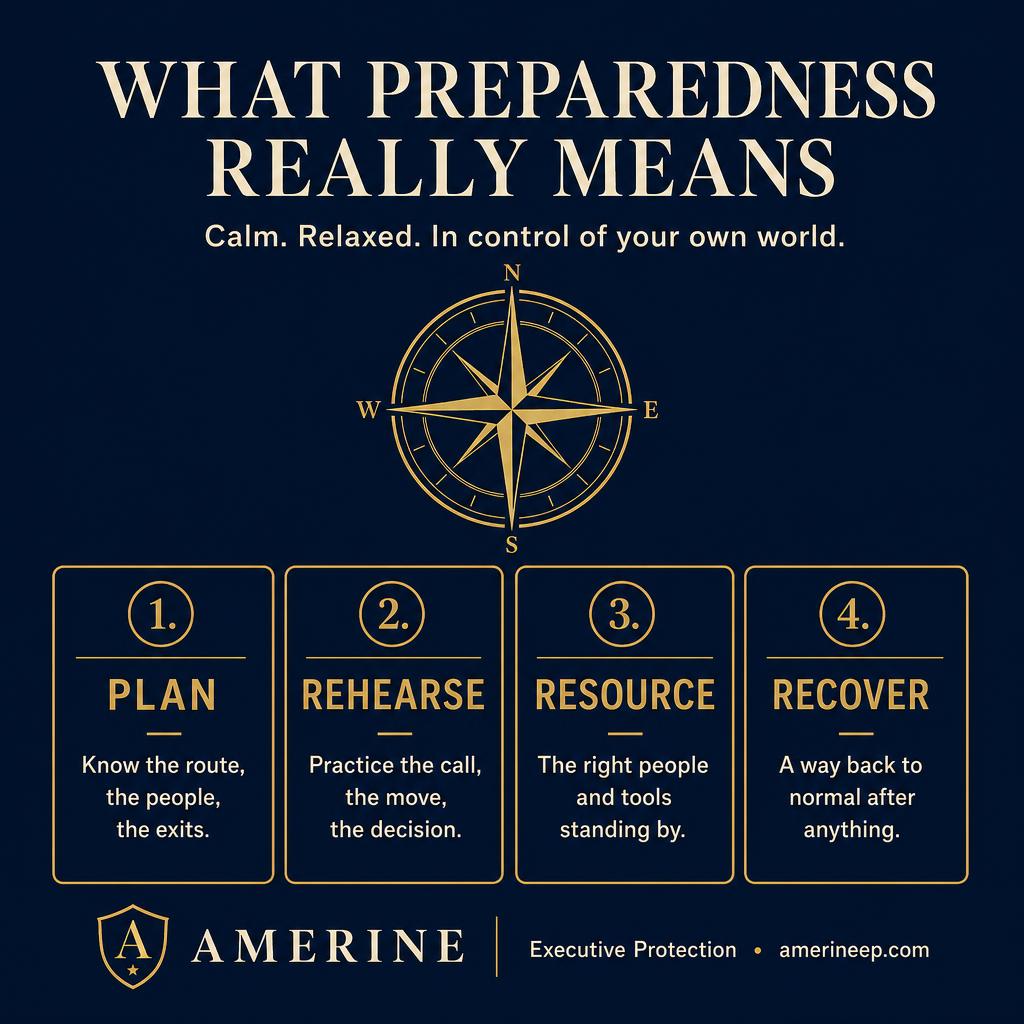
Real preparedness produces the opposite feeling. It produces calm. It produces the quiet confidence of someone who has thought ahead, made the calls, and arranged the small number of things that matter — and is therefore free to enjoy the day in front of them.
> Preparedness is not the feeling of being ready for the worst. It is the feeling of being in control of your own world.
Calm Is the Output, Not the Input
People who appear unflappable in difficult moments are rarely born that way. They are the product of preparation that happened weeks, months, or years earlier. The calm is downstream.
You see it in pilots, surgeons, and elite operators. None of them are calm because nothing can go wrong. They are calm because they have rehearsed what to do if it does, and they trust the system around them. The calm is earned and engineered.
The same is available to a family, a CEO, or a household. The path is unglamorous and entirely doable.
The Four Pillars of Real Preparedness
We frame preparedness around four words. They are deliberately simple, because the families and executives we work with do not have time for a 40-page binder. They need a mental model that fits in their head.
1. Plan
The plan answers a small number of important questions before they are urgent.
- Where do we go if we cannot stay here tonight?
- Who do we call if something happens to one of us?
- Where are the documents, the medications, the cash, the keys?
- Who picks up the kids if neither of us can?
- What is the rally point if phones are down?
A plan does not need to be elaborate. It needs to exist, be written down, and be known by the people who would need it.
2. Rehearse
A plan that has never been spoken out loud is a wish. A plan that has been rehearsed is a capability.
Rehearsal does not mean drills with smoke and timers. For most families it means:
- A 10-minute conversation at dinner about what we'd do if X happened.
- One dry run of the call tree so phones, numbers, and names are confirmed.
- One walk-through of the house with the kids: exits, meeting spot, fire extinguisher, safe room.
- One travel pre-brief before each major trip.
That is enough to convert paper into instinct.
3. Resource
Resources are the people and tools standing by so that you do not have to improvise in a hard moment. For a family this might be:
- A primary care physician who answers texts.
- A trusted driver, not just a rideshare app.
- An attorney on speed dial, not in a search bar.
- A protection partner who knows your family before something happens, not after.
- The right insurance, the right backup power, the right communications.
The point is not to stockpile. The point is to know exactly who you are calling, in what order, and to have already had that conversation with them.
4. Recover
Most planning stops at the incident. Preparedness includes the day after.
- How do you get the family back to a normal routine?
- How do you handle media or curiosity if there is a story?
- How do you take care of the people who helped you?
- How do you debrief, learn, and adjust the plan?
Recovery is the part that turns an event into a memory instead of a chapter that defines the next decade.
What Preparedness Is Not
It is worth saying clearly what preparedness is not, because the cultural stereotype gets it wrong.
- It is not paranoia. Paranoia scans for threats that aren't there. Preparedness handles real ones efficiently.
- It is not gear. Gear without a plan is decoration.
- It is not secrecy. The people in your life should know enough to act if you can't.
- It is not pessimism. The most prepared people we work with are the most optimistic, because they are not carrying low-grade dread about every "what if."
- It is not a one-time event. It is a small habit, reviewed quarterly.
The Surprising Side Effect: Freedom
The clients who go through this exercise universally report the same thing. They feel lighter. They sleep better. They travel with less low-grade tension. They stop checking the door three times.
That is the real product of preparedness. Not a hardened life. A freer one.
When the plan exists, the rehearsal has happened, the resources are in place, and the recovery is mapped, your nervous system can finally relax. You are not bracing anymore. You are living.
> The most prepared families we serve are also the calmest, the most generous with their time, and the most present with the people they love. That is not a coincidence. It is the whole point.
A Practical Starting Point
If you want to feel more in control this week, do not buy anything. Do this instead:
- Write down the five phone numbers you would need in a true emergency.
- Pick a rally point your family can get to without their phones.
- Identify the nearest hospital with the right capabilities, and the route to it.
- Have one 20-minute conversation with your spouse about what we'd do if X.
- Schedule a quarterly review of the same five questions.
That alone will move most households from "vaguely worried" to "quietly confident."
How AMERINE Helps
Our role is to be the partner that makes this real. We sit with the family, build the plan, rehearse it with the household, put the resources in place, and stay on call. Most of what we do is invisible by design. The visible part is how the family feels: calm, relaxed, in control of their own world.
Contact AMERINE for a confidential conversation. Scott personally takes every first call.