The Quietest Security Tool You Own
Awareness is the most powerful personal security tool you have. It does not require gear. It does not require permits. It does not require a team. It costs nothing and travels with you everywhere.
Most people, however, have never been taught what it actually is. They confuse it with paranoia or with always being "on." Real situational awareness is the opposite. It is a calm, relaxed alertness — the same posture a good driver, a good parent, or a good leader uses without thinking.
The Cooper Color Code
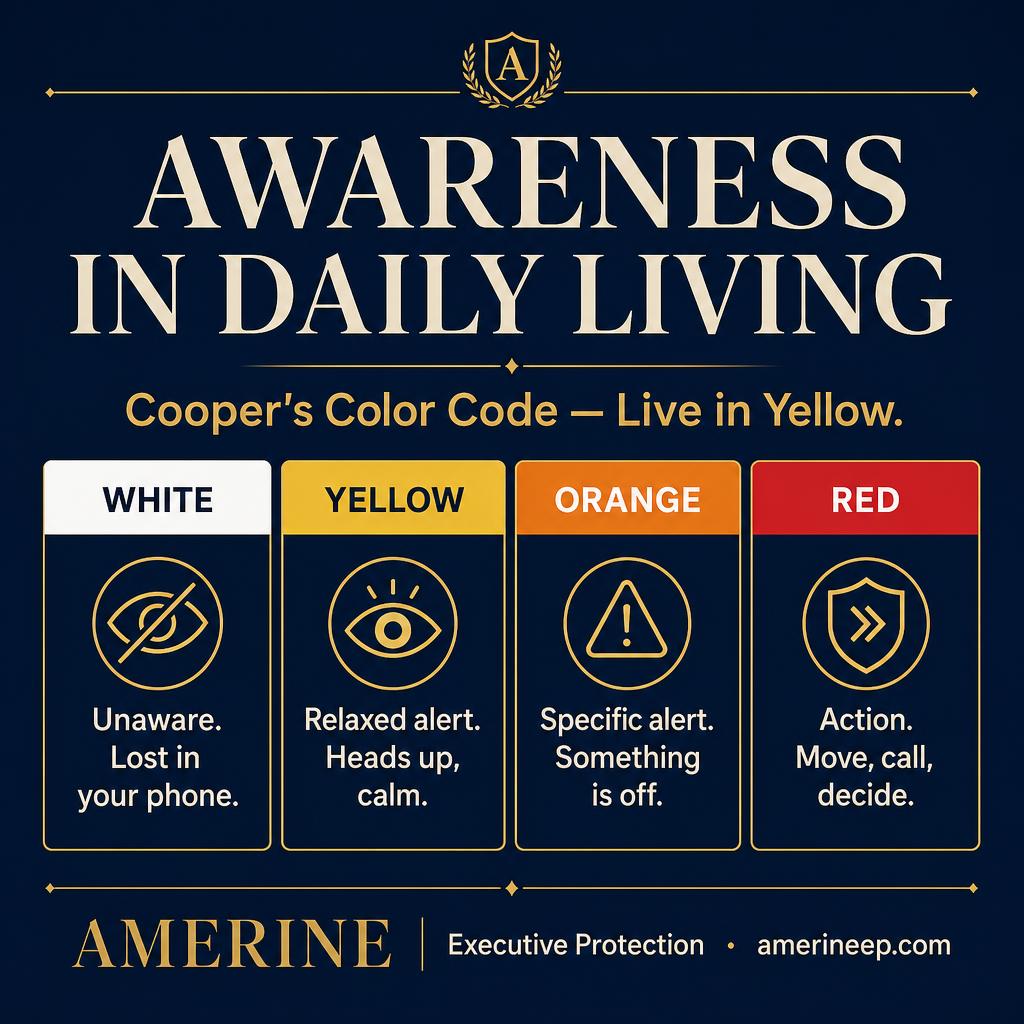
A simple framework, taught for decades to military, law enforcement, and protective professionals, breaks awareness into four states. It originated with Jeff Cooper and has stuck around because it is useful in real life — not just in tactical settings.
White — Unaware
Eyes on your phone. AirPods in. Lost in thought. Not registering who is around you, what the room looks like, or where the exits are. White is the default state of modern life and it is the state in which almost every preventable bad outcome happens.
Yellow — Relaxed Alert
Calm, comfortable, but plugged into your environment. You notice the people around you. You clock the exits when you walk into a restaurant. You know whether the car behind you has been there for three turns. You are not tense. You are not scanning for threats. You are simply present.
This is the state we recommend for daily life. Living in Yellow is sustainable, peaceful, and dramatically safer than White.
Orange — Specific Alert
Something is off. A specific person, vehicle, sound, or pattern has caught your attention. You shift focus. You start asking quiet questions. Why is he watching the entrance? Why has that car circled twice? Why did the room go quiet? You begin pre-positioning — closer to the exit, farther from the window, hand free, phone unlocked.
Orange is brief. It either resolves back to Yellow or escalates to Red.
Red — Action
The decision is made. Move, call, intervene, evacuate, comply, fight, drive away. The work you did in Yellow and Orange is what makes Red survivable. People who skip straight from White to Red almost always pay for it.
Why "Live in Yellow" Is the Goal
Most people oscillate between White (most of the day) and Red (the rare crisis), with no time spent in Yellow or Orange. That is the worst possible distribution. It means every emergency arrives as a complete surprise and you are reacting from zero.
Living in Yellow flattens that curve. You spend almost the entire day in a calm, low-effort state of awareness. When something develops, you slide gracefully into Orange and have the time and space to make a good decision. Most situations resolve there. The few that escalate to Red find you already moving.
> Yellow is not stressful. It is less stressful than White, because nothing surprises you.
What Awareness Looks Like in Daily Life
Awareness is not a posture. It is a set of small, almost invisible habits.
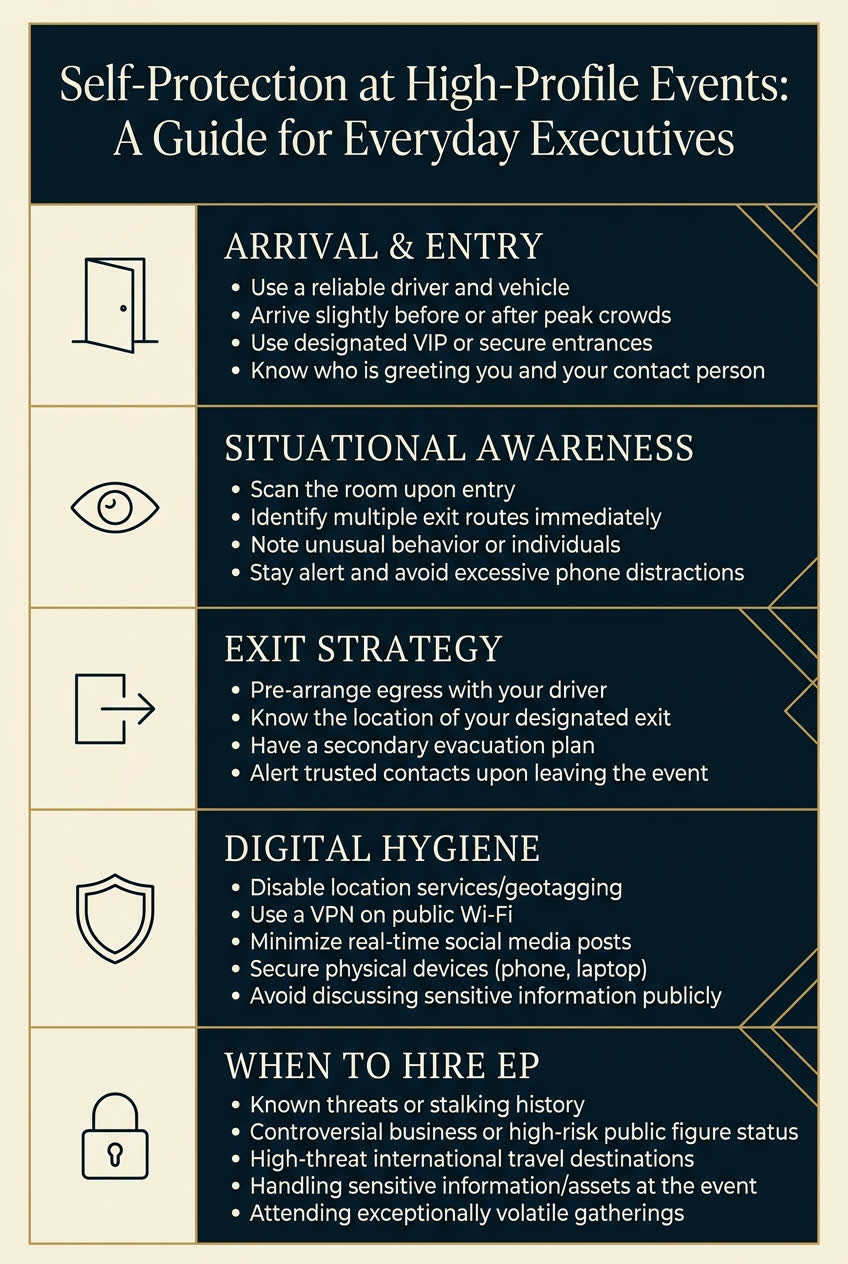
Walking into a Room
- Note the exits. Not just the door you came through.
- Scan faces once, casually. Who looks comfortable? Who looks out of place?
- Pick a seat that lets you see the entrance.
- Note the staff. They are your fastest source of help.
Walking to Your Car
- Phone goes in your pocket before you leave the building.
- Keys in hand.
- Quick scan of the lot, especially the cars next to yours.
- If something feels wrong, walk back inside. The cost is two minutes.
In a Hotel
- Read the evacuation map on the back of the door once.
- Count doors to the stairwell so you can find it in the dark.
- Note the floor and room number. People forget under stress.
- Lock, latch, and shoes by the bed.
Driving
- Eyes up. Mirrors on a rhythm.
- Leave space at every red light to pull out.
- Notice the same car twice. Notice it three times and act.
- Do not pull into your driveway with someone behind you. Drive past once.
In Public with Family
- Agree on a meeting spot before you split up.
- Kids know one parent's phone number by heart.
- A code word that means come now, no questions.
- A second code word that means I'm safe, ignore the previous message.
None of this is dramatic. None of it is visible to the people around you. All of it is Yellow.
Awareness Is Not Paranoia
Paranoia is exhausting because it scans for threats that aren't there. Awareness is restful because it accurately reads the environment and lets your nervous system relax when there is nothing to react to.
A useful test: if your "awareness" is making you tense, anxious, or unable to enjoy your meal, you are not in Yellow. You are in a low-grade Orange that has nowhere to resolve to. That is not awareness — that is anxiety wearing awareness as a costume.
Real Yellow feels like being awake. That's it.
Teaching the People Around You
Awareness is contagious in both directions. Households where one person lives in White tend to drag the whole family there. Households where one person lives in Yellow tend to lift everyone up.
Teach it gently. Make it normal.
- "Hey, where's the exit in this place?" — at dinner, casually.
- "What's our meet-up spot if we get separated?" — before a crowded event.
- "What would you do if a stranger asked you to help find their dog?" — to your kids, on a normal Tuesday.
- "Notice how the staff seems off today?" — to your spouse, quietly.
Repetition turns it into reflex. Reflex turns it into culture.
What Awareness Does Not Replace
Awareness is the foundation. It is not the whole house.
It does not replace:
- A real plan for emergencies.
- Trained professionals when your exposure warrants it.
- Physical security at your home.
- A relationship with local law enforcement when appropriate.
- Insurance, medical readiness, communications backup.
What awareness does is buy you the seconds and minutes that make all of those other things actually work. Without awareness, the best protection program in the world is reacting to incidents that better awareness would have caught earlier.
The AMERINE View
Almost every successful protective outcome we have been part of started with someone in Yellow noticing something a beat earlier than normal. Not a heroic catch. A small, calm observation that gave the team room to move.
That is the standard we want for our principals and their families. Not hyper-vigilance. Not paranoia. Just awake.
If you want help building awareness habits into your household — quietly, professionally, and without turning your home into a fortress — Contact AMERINE for a confidential conversation. Scott personally takes every first call.