Why This Conversation Matters Right Now
The 2026 White House Correspondents' Dinner reminded the country of something security professionals already know: high-profile events concentrate risk in a single room. Cameras, public figures, alcohol, predictable schedules, published guest lists, and dense crowds combine to create an environment where a single bad actor — or a single moment of poor planning — can change lives.
Most of the executives, journalists, donors, and guests in that ballroom did not have a Secret Service detail standing behind them. The same is true at industry conferences, award galas, charity events, political fundraisers, board offsites, and tech summits across the country every week. If you are a senior executive, board member, founder, or public-facing professional, you are likely a softer target than you realize — and you are responsible for your own protective posture until you are not.
This article is a practical guide for the everyday executive: what you can do personally to stay safer at events, what warning signs to watch for, and when it is time to stop improvising and bring a professional executive protection (EP) detail with you.
The Threat Profile of a "Normal" Business Event
When we conduct advance work for clients attending a major event, we map the same risk categories every time:
- Targeted threats: Stalkers, disgruntled former employees, activists with a specific grievance against you or your company, or individuals with a fixation on a public figure who will also be in the room.
- Opportunistic threats: Pickpockets, social engineers, hotel-room thieves, and individuals looking to compromise devices or credentials.
- Crowd and venue risk: Crush injuries, fire and evacuation hazards, medical emergencies, and the chaos that follows any incident in a packed ballroom.
- Reputational and digital exposure: Photos, recordings, overheard conversations, and information leaked through social media before, during, and after the event.
- Spillover risk: You are not the target — but you are sitting next to one.
That last category is what changed in many people's minds this week. You do not have to be the headline name to be in the danger zone. Proximity is exposure.
What Every Executive Should Do Personally — Before the Event
Most of the protective value at any event is created before you arrive. Use this checklist whether you are flying to a conference in Las Vegas, attending a gala in Manhattan, or sitting at a head table in Washington.
1. Review the Guest List and Speaker Lineup
Before you commit to attending, look at who else will be there. If the event includes politically polarizing figures, controversial executives, or anyone with an active threat profile, understand that the venue's security posture will be calibrated to them, not to you. That can cut both ways: more law enforcement presence, but also a more attractive target environment.
2. Audit Your Own Digital Footprint
Search yourself the way an adversary would. Common exposures we find for executives include:
- Home address visible through real estate records, voter rolls, or data brokers
- Family members and children identified on social media
- Travel patterns telegraphed by frequent check-ins or LinkedIn posts ("Excited to keynote at…")
- Vehicle photos with visible license plates
Lock down what you can. Set social profiles to private for the days surrounding the event. Avoid posting your itinerary in advance.
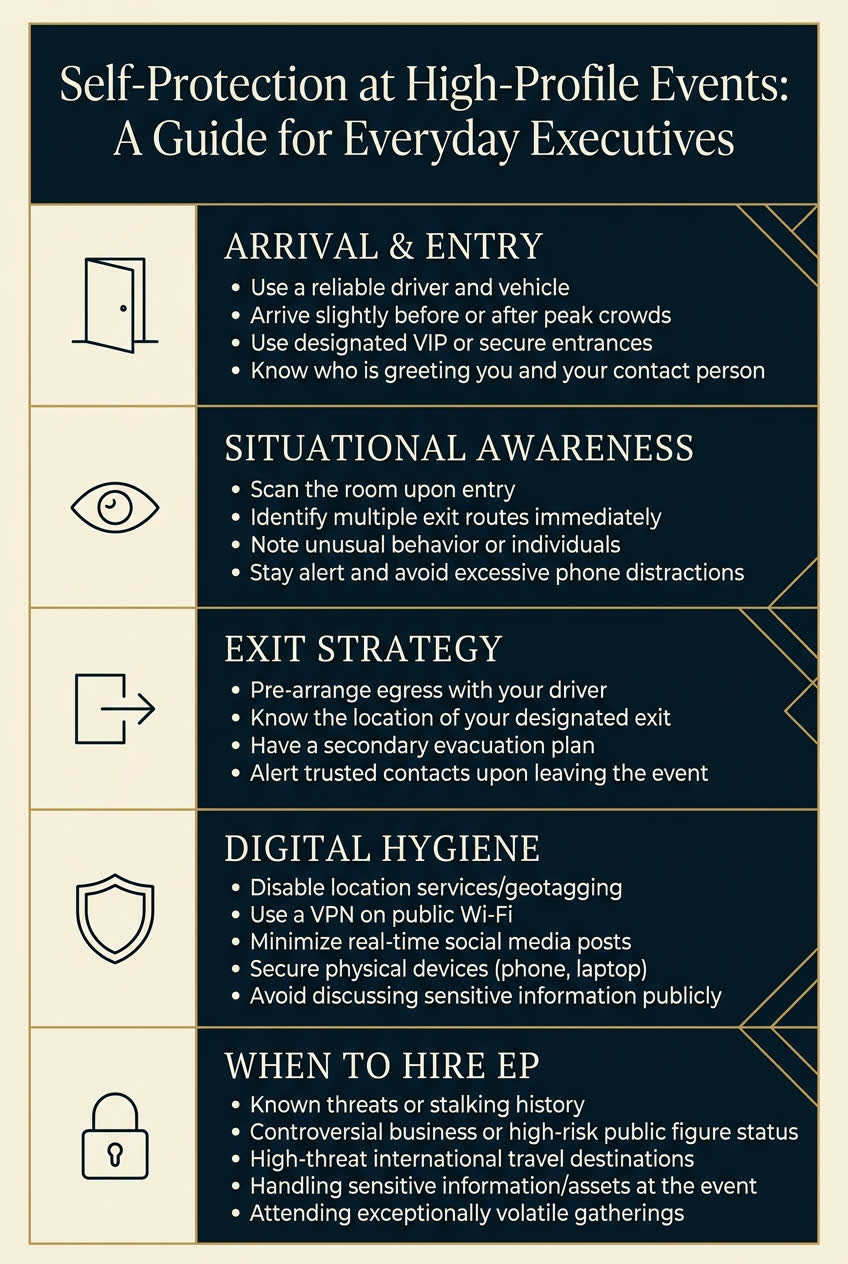
3. Pre-Plan Arrival, Egress, and a Backup Route
Know exactly:
- Which entrance you will use (and the secondary one if it closes)
- Where your car or rideshare will stage for pickup
- The closest hospital and trauma center to the venue
- Two ways out of the ballroom that are not the front doors everyone else will use
If you are using a car service, brief the driver on a primary and secondary pickup point and a code word that means "leave now."
4. Brief One Trusted Contact
Tell a spouse, assistant, or colleague where you are, when you expect to leave, and when they should escalate if they have not heard from you. This is the single highest-leverage habit most executives ignore.
What to Do During the Event
Use the First Five Minutes Strategically
When you walk into a ballroom, most people scan for who they know. Trained protection professionals scan for:
- Exits: All of them, not just the one you came in through
- Anomalies: Anyone whose dress, behavior, or focus does not match the room's baseline
- Choke points: Stairwells, narrow hallways, and bottlenecks you would want to avoid in an evacuation
- Friendly resources: Uniformed law enforcement, venue security, medical staff, and event staff with radios
Spend ninety seconds doing this before you start working the room. It will pay for itself.
Manage Your Position
You do not need to act like a protection agent. You do need to make small, deliberate choices:
- Sit or stand where you can see the room, not with your back to the largest crowd
- Keep an aisle seat at dinner if you can; it cuts your evacuation time in half
- Avoid being trapped against a wall, in a tight booth, or behind a stage
- Do not stand in the immediate orbit of the most controversial person in the room unless you have a reason to
Protect Your Devices and Conversations
Hotel and conference settings are notorious for digital exposure:
- Assume hotel Wi-Fi and conference Wi-Fi are hostile networks; use a VPN or your phone's hotspot
- Disable AirDrop, Bluetooth discovery, and auto-connect features
- Never leave a laptop in a hotel room; the in-room safe is not actually a safe
- Treat every conversation in a public space as on the record — directional microphones and phone recordings are common
Watch the Alcohol
This is the unglamorous part of every event security briefing. Impaired judgment is the single most common contributor to the bad nights we get called about — assaults, lost devices, compromised credentials, vehicle incidents, embarrassing recordings. If your role is to represent the company, treat the event like the work environment it is.
Recognize Pre-Incident Indicators
Most violent acts at public events are preceded by observable behavior:
- A person whose attention does not match the program (fixated on one individual, ignoring the speakers)
- Inappropriate clothing for the venue or weather (a heavy coat indoors, oversized bag in a black-tie room)
- Repeated visits to the same area, particularly near a target's seat or path
- Unusual sweating, agitation, or repeated checking of an item on their person
- Attempts to access restricted areas or "test" security responses
If something feels wrong, it usually is. Notify event security or law enforcement immediately and move yourself out of the area. You do not owe an explanation. You will not look paranoid — you will look prepared.
When You Should Bring Executive Protection With You
Self-protection habits are necessary, but they are not sufficient for every executive or every event. There are specific situations where attending a high-profile event without a professional EP detail is no longer a reasonable choice.
Bring EP When Any of These Are True
- You have a known or active threat: Stalking history, recent terminations, litigation, or specific online threats directed at you or your family.
- You are publicly controversial: You have taken visible positions on polarizing issues, or your company has been the target of organized activism.
- You will be on a stage or named in the program: Speakers, honorees, panelists, and award recipients are pre-identified targets with published schedules.
- You will be carrying sensitive material: Confidential deal documents, prototypes, or devices with privileged information.
- The event environment is volatile: Political fundraisers, contested industry conferences, events with planned protests, or international venues with elevated risk.
- You are traveling internationally: Destination risk, language barriers, and limited host-nation support change the calculus immediately.
- Your principal or family is attending with you: Spouses and children are often the first targets of grievance-driven actors.
What Professional EP Actually Provides at an Event
A properly run event detail is not a person standing next to you in a suit. It is a coordinated capability:
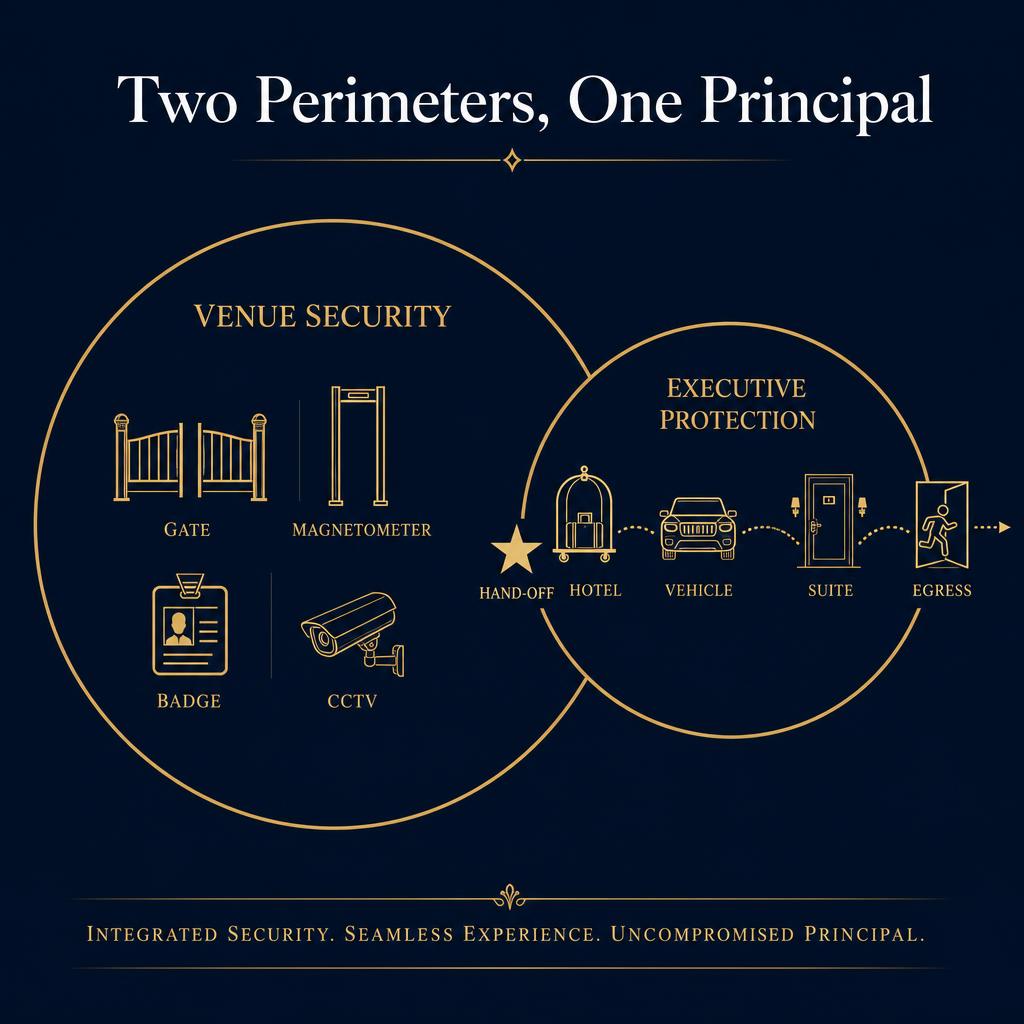
- Advance work at the venue 24–72 hours before arrival, including walk-throughs, route mapping, and liaison with venue security and local law enforcement
- [Secure transportation](/services/executive-transportation) with a vetted, trained driver and a primary plus backup vehicle
- A [close protection officer](/close-protection-services) moving with you, trained in unarmed and (where lawful) armed response, tactical medicine, and protective formations
- A counter-surveillance element watching the perimeter for individuals watching you
- A Global Security Operations Center (GSOC) monitoring open-source intelligence, social media, and threat feeds in real time
- A medical and evacuation plan with the nearest trauma center, helicopter resources, and pre-coordinated emergency contacts identified before you arrive
Most executives are surprised at how invisible a well-run detail is. Done correctly, your colleagues should not be able to tell which person in the room is with you.
A Quick Self-Assessment
Ask yourself, honestly:
- Do I know the names and contact numbers of the venue's head of security and my hotel's duty manager?
- If something happened in the next thirty seconds, do I know two ways out of the room?
- If I lost my phone right now, could anyone get into my email, drive, or company VPN?
- Have I told one person where I am and when I expect to be back?
- If someone wanted to harm me specifically, is there anything online that would help them find me, my home, or my family?
If you answered "no" to two or more of these questions before your next event, you are operating below the protective baseline we recommend for any senior executive — and you should either tighten your personal habits or bring a professional with you.
The Bottom Line
The Secret Service exists to protect a very small number of people. Everyone else in the ballroom — including the executives, donors, journalists, and guests sitting at the next table — is responsible for their own security posture, or the posture they have hired. Recent events are a reminder that the difference between an uneventful evening and a defining moment is often a few minutes of advance planning, a few habits practiced consistently, and the judgment to bring real protection when the situation calls for it.
If you are attending a high-profile event in the coming weeks and you are not sure whether your protective posture is appropriate for the environment, that is exactly the conversation we have every day.
---
AMERINE Executive Logistics provides discreet executive protection for high-profile events, conferences, galas, and political functions across the United States and internationally. Our agents come from the U.S. Secret Service, federal law enforcement, and military special operations. Every engagement is confidential. [Contact us](/contact) for a no-obligation event security consultation or call (281) 799-1877.