The DHS Warning, In Plain Language
In the run-up to and now through the FIFA World Cup 2026, the Department of Homeland Security has been unusually direct about one thing: the highest-probability threat vector around the tournament is not the stadium bowl. It is the soft targets around it — Fan Festivals, hotel lobbies, transit hubs, parking structures, hospitality districts, sponsor activations, and the corporate offices hosting visiting delegations.
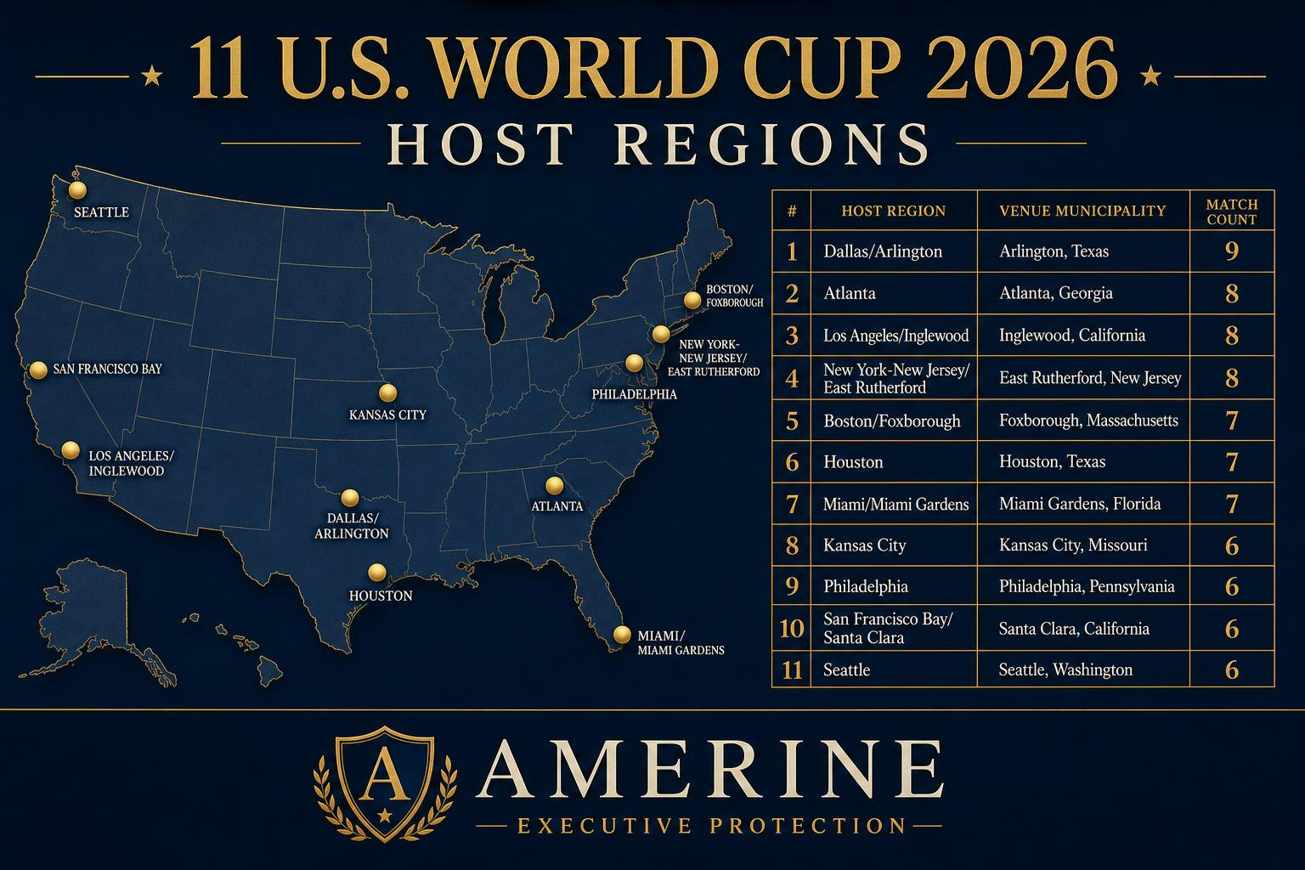
For the Philadelphia metro, that warning is not abstract. Philadelphia is hosting 6 matches including a Round of 16 fixture at Lincoln Financial Field, a Fan Festival footprint that will run for weeks, and sponsor, broadcast, and corporate hospitality operations spread across the metro. Executive and asset protection planning here looks different than it does in most other host cities.
This is the pre-event checklist AMERINE walks Philadelphia-based principals, family offices, and corporate security teams through.
Why Philadelphia Carries Distinct Soft-Target Exposure
A few facts shape the Philadelphia threat picture:
- The match footprint at Lincoln Financial Field — 6 matches including a Round of 16 fixture.
- A Fan Festival presence that will draw very large daily crowds into a defined district across the tournament window.
- Hospitality density concentrated in Rittenhouse Square, Old City, and the University City corridor, which is where sponsor delegations, visiting executives, and family travel actually overlap.
- Private aviation surge across PNE (Northeast Philadelphia), TTN (Trenton-Mercer), and WWD (Wildwood) as a Jersey-shore relief option, all running hot during match windows.
- A UHNW residential corridor — the Main Line (Bryn Mawr, Villanova, Gladwyne), Chestnut Hill, and the Princeton corridor in NJ — inside the realistic threat geometry of every match-day flashpoint.
Layer in the dual NYC / Philadelphia match-day overlap on the I-95 corridor, foreign delegation density around Independence Mall, and the South Philadelphia sports-complex compression that funnels every egress through three corridors, and you have the geometry DHS soft-target guidance is written for.
The Two Threats Executives Actually Need To Plan Around
Strip away the headline-grade scenarios and the day-to-day exposure for a Philadelphia executive during the tournament falls into two categories:
- Pattern-of-life exploitation. Tail-number tracking, social-media geotagging by family members, predictable routes between residence, office, and venue, and standing reservations at the same handful of restaurants. None of it is exotic — it is what every targeting cycle, criminal or otherwise, actually uses.
- Soft-target proximity. Hotel lobbies during sponsor check-in windows, parking structures around the stadium, Fan Festival edges, post-match nightlife in Rittenhouse Square, Old City, and the University City corridor, and the curbside chaos at Lincoln Financial Field in the 90 minutes after final whistle.
A serious pre-event plan addresses both. Most informal plans address neither.
Pre-Event Executive Protection Checklist for Philadelphia
A practical, sequenced version of what we run with clients in the weeks before any match window:
60–90 days out
- Lock hotel suites with side-entrance, porte-cochère, or motor-court access. Avoid main-curb properties on match weekends.
- Confirm FBO assignment (PNE (Northeast Philadelphia), TTN (Trenton-Mercer), and WWD (Wildwood) as a Jersey-shore relief option) and decide tail-number visibility. Blocking the flight plan from public trackers is a one-line request.
- Map the principal's calendar against match days. Identify the trips, dinners, and offsites that overlap I-95, I-76 (the Schuylkill), and Broad Street south of Center City during stadium ingress or egress windows.
- Inventory family travel. Spouses, adult children, and college-age children are inside the threat picture whether the principal travels or not.
30 days out
- Vetted drivers locked by name for every leg: airport, hotel, sponsor suite, dinner, departure. Not rideshare.
- Two routes per movement — primary and contingency — with a defined call-in point if the primary closes.
- Protective intelligence sweep on the principal, spouse, and adult children: surface area online, recent doxxing chatter, any targeted-harassment baseline.
- Brief residential staff across the Main Line (Bryn Mawr, Villanova, Gladwyne), Chestnut Hill, and the Princeton corridor in NJ. Estate managers, household security, and nannies should know which weeks are elevated and what the reporting standard is.
14 days out
- Route rehearsal between residence or hotel and Lincoln Financial Field for each match the principal will attend, with I-95, I-76 (the Schuylkill), and Broad Street south of Center City timed in real conditions.
- Family brief: meet-here-if-separated point at every venue and hotel, medical contingency (nearest Level I trauma center to each location), and a clean communications plan.
- Test cellular signal in hotel suite, FBO, and stadium seating section before you need it.
- Confirm credentialing with sponsor hosts in writing, not in the parking lot.
72 hours out
- Final confirmations on drivers, suite credentials, and FBO slot.
- Two-channel verification standard for any itinerary change. If a call says "we changed the pickup," the assistant confirms via a second channel before anyone moves.
- Curbside rehearsal at the hotel motor court. The arrival and departure handoffs are where most exposure happens.
Match day
- Decide your arrival window before kickoff. Late drop-offs are the most chaotic moment of the day.
- Lock the post-match egress decision before the second half — not at the final whistle.
- Cash in local currency for a 24-hour disruption. Card readers and ATMs fail around stadium districts during peak windows.
Asset Protection: The Philadelphia-Specific Layer
Executive protection is about the person. Asset protection is about what the targeting cycle can reach when the person is not there. In Philadelphia during the tournament, the assets actually exposed are:
- Residences across the Main Line (Bryn Mawr, Villanova, Gladwyne), Chestnut Hill, and the Princeton corridor in NJ when the family is at a match, sponsor event, or out of town. Pattern-of-life exposure spikes when public social posts confirm absence.
- Corporate campuses hosting visiting executives, board members, or sponsor delegations — particularly campuses with public-facing lobbies, shared parking, or open-perimeter design.
- FBOs and based aircraft (PNE (Northeast Philadelphia), TTN (Trenton-Mercer), and WWD (Wildwood) as a Jersey-shore relief option) during the windows where tail-number visibility, crew movement, and ground handling become predictable.
- Vehicles and garaged collections at residences and offices where access control is informal.
A serviceable asset-protection plan for the tournament window includes a residential security review (cameras, alarm zoning, after-hours staffing standards), a corporate-campus walk-through for any office hosting visiting principals, a quiet conversation with the FBO about who has ramp access during your slot, and a written standing order for household staff on what gets reported and to whom.
What "Soft Target" Means For Corporate Security Teams
If you run corporate security for a Philadelphia-headquartered or Philadelphia-operating company, the soft-target framing changes a few things in the next several weeks:
- Lobby flow during sponsor and partner visits. Visiting delegations move principal, spouse, and staff through the same lobby at the same time. That is the moment to separate flows, not standardize them.
- Garages and shuttle pickup points. Most campus garages were designed for convenience, not segregation. A temporary closure of one level or one entrance during high-visit weeks is effective.
- Town halls, customer events, and broadcast appearances held off-campus during the tournament window. Treat them as event-security engagements, not internal meetings.
- The week after the principal's match attendance. Targeting cycles often run on a delay. The soft moment is frequently the Monday return-to-office, not the match itself.
A Reasonable Standard, Not An Overbuilt One
The point of this work is not to lock the principal inside a hardened envelope for the tournament window. It is to make the trips feel uneventful — for the principal, the family, the visiting delegation, the sponsor's clients, and everyone whose name ends up on an itinerary.
The DHS soft-target framing is correct, and Philadelphia carries a meaningful share of that exposure. The good news is that the planning to address it is not exotic. It is sequenced, written down, rehearsed, and quiet.
AMERINE supports Philadelphia principals, family offices, and corporate security teams with executive protection, secure transportation, protective intelligence, and pre-event planning across Lincoln Financial Field, the Fan Festival footprint, Rittenhouse Square, Old City, and the University City corridor, and the broader metro. We are still accepting a limited number of July engagements.
Request a confidential Philadelphia pre-event protective briefing →
Related: World Cup 2026 hub, Philadelphia host-city guide, Match-day secure transportation, Crowd crush & stadium egress safety, Hotel security during the World Cup, Soft targets at mega-events.
---
General planning guidance, not legal, immigration, ticketing, or aviation advice. Verify current requirements through official FIFA, U.S. government, airline, venue, and host-city sources before departure.