Athlete Security Services: What They Cover and How to Choose
Athlete security services protect a public person in four places at once: the home, the road, the venue and the phone. The best programs start with an assessment, confirm scope in writing, and use low-visibility operators who blend in. AMERINE is Texas-licensed (Private Security License No. C31012001); operating nationally and internationally through vetted, licensed local partners where required.
TL;DR
-
Athletes are targeted where they are predictable: at home on game days, in transit, and online. Public schedules and social posts do most of the work for the bad actor.
-
Good protection starts with an assessment of threats and vulnerabilities, then a plan built around the athlete’s calendar.
-
Digital risk is physical risk. Doxxing, account takeover, phishing and fitness-app data all lead back to a front door.
-
Domestic and international trips need advance work, vetted local partners and a written scope.
Table of Contents
What athlete security services actually include
The phrase covers a lot of ground. For an athlete, a family office or a public figure with a busy calendar, it usually breaks into these parts:
-
Close protection. Low-profile operators who travel with the athlete, dressed for the setting. See our page on close protection services.
-
Protective transportation. Planned movement between home, training, venues and airports, including executive transportation and black car service.
-
Residential security. Property assessment, camera and alarm integration, and access control for staff and vendors. More on residential security.
-
Protective intelligence. Tracking messages, approaches and fixated individuals so a pattern shows up early. Our protective intelligence work covers this.
-
Cyber and digital risk monitoring. Watching for doxxing, impersonation, deepfakes and account takeover. See cyber monitoring and digital protection.
-
Event and travel security. Advance planning for appearances, camps, tours and multi-country trips through our corporate, travel and event security services.
The point is coordination. An athlete with a great driver, a weak home alarm and a public running route is still exposed. Our page for athletes and celebrities lays out how these pieces fit together.
The threats worth planning for
Not every athlete faces the same risk. Most face some mix of these.
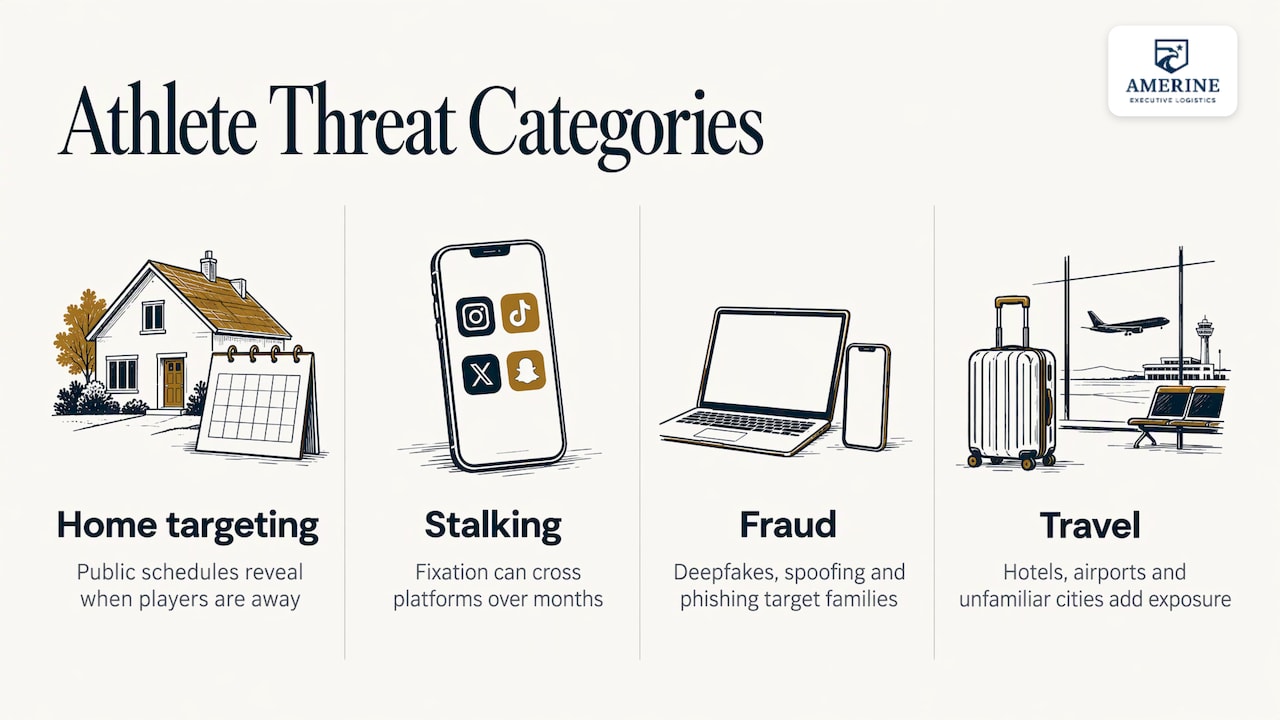
Home targeting. An NFL security bulletin reported by CNN in November 2024 warned that organized groups were targeting players’ homes on game days, using public records, social media, media reports and surveillance. The groups know when the player is on the field and away from the house. Team schedules are public, so timing is easy.
Stalkers and fixated individuals. Fixation builds over months. It often crosses platforms before anyone shows up in person. Our guide to stalker threat management explains how to document and respond.
Impersonation and fraud. Deepfake ads, spoofed accounts and phishing aimed at the athlete, family or business manager. Our article on doxxing, deepfakes and AI-driven digital threats covers how they work.
Travel exposure. Hotels, airports, fan crowds and unfamiliar cities. Risk changes with the country, the event and the profile of the person.
All of these share one root: reconnaissance. Someone learns where the athlete lives, who is in the family and where they will be. Cut that supply of information and most of the risk drops with it.
How a provider assesses threats and builds the plan
Assessment comes before coverage. Guessing at the right level of protection wastes money in one direction and leaves gaps in the other.
A useful model comes from a paper on sports team travel security from the ASIS Foundation, the security profession’s professional body. It describes this sequence:
-
Gather protective intelligence early. Start in the planning cycle, not the week of the trip.
-
Score the risk. The paper uses the U.S. Department of Homeland Security formula, risk equals threat times vulnerability times consequence, simplified to threat times vulnerability for team travel.
-
List threats. Stalkers, protestors, gangs, terrorism, natural disasters and health hazards all appear.
-
List vulnerabilities. Screening, access controls, entry and exit routes, emergency plans, medical response and media relations.
-
Match the response to the score. The response can run from added screening all the way to canceling the appearance.
That last point matters. A good provider will say “no-go” when the threat outweighs the benefit of the event. The paper says as much about the planning cycle.
At AMERINE, we assess before we recommend. We confirm scope and responsibilities in writing, so everyone knows who handles what. Our Secret Service background shapes this planning-first approach. The plan then follows the athlete’s real calendar: training, travel, appearances, family time. Operators dress for the environment and stay low-visibility, because a protective detail that draws a crowd defeats its purpose.
Protecting the home, the family and the household staff
For many athletes, the house is the biggest exposure. It is also where the family lives, so the plan has to cover children, guests and staff.
The CNN-reported NFL bulletin recommends a short list of basics:
-
Cameras, sensors and exterior lighting.
-
Solid exterior doors with deadbolts and reinforced frames.
-
Valuables stored out of sight.
-
A trusted house sitter when the family travels.
-
No real-time activity posts and no photos of high-value items online.
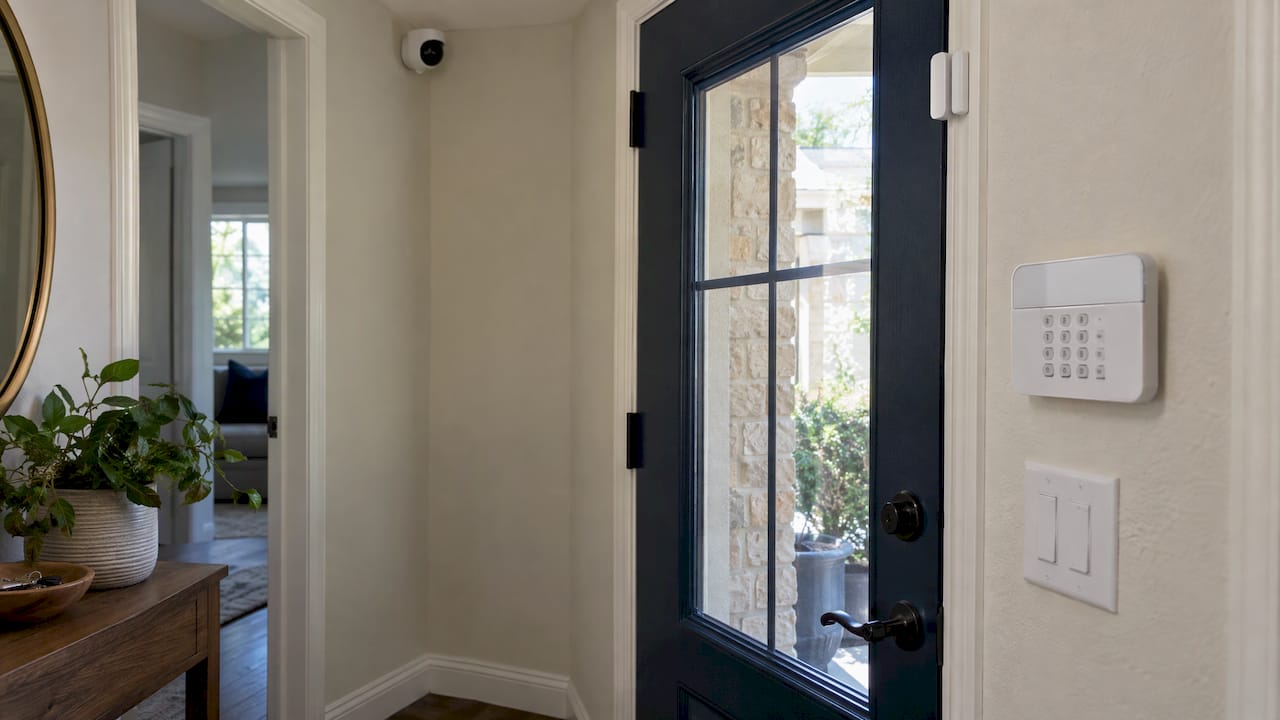
A professional assessment goes further. It looks at access points, parking, lighting, alarm monitoring, deliveries and service entrances. It also looks at who has keys, codes and app access. Cleaners, contractors, nannies and assistants each need individual, temporary access that can be pulled the moment the relationship ends. Smart-home systems deserve the same discipline as physical keys: unique passwords, multi-factor authentication and vendor permissions that expire.
Our residential security work includes camera and alarm integration, so the hardware, the monitoring and the household routines work as one system. We coordinate with household staff and executive assistants so the plan survives real life.
A tested emergency contact chain belongs in every plan. Everyone in the house should know who to call first, who calls the athlete, and who talks to law enforcement. Run it once. Fix what breaks.
Digital risk is physical risk
A burglar does not need to watch the house if the athlete posts the schedule. A stalker does not need to follow a car if a fitness app maps the route.
Citi Private Bank’s personal safety guidance points out that aggregated location data supports pattern-of-life analysis, which can facilitate targeted robberies, harassment and kidnappings. It recommends limiting public sharing of real-time locations, travel dates and home addresses. It also suggests turning off automatic geotagging, removing hidden metadata from photos, and keeping family members’ school names and team schedules off social media.
Fitness apps deserve their own look. A 2026 Springer chapter on surveillance in sport reports on research of 1.4 million Strava activity records. Privacy zones that hide the start and end of a run offered only limited protection. At the smallest 200-meter setting, location prediction reached up to 85% accuracy because of metadata leakage. The chapter recommends privacy-by-default GPS settings, no public runs near home, two-factor authentication and a travel kit with a loaner phone.
A practical digital checklist for an athlete and family:
-
Audit every fitness, location-sharing and social app. Set each to private by default.
-
Delay posts until after the athlete has left the location.
-
Turn on multi-factor authentication for email, banking, social and cloud accounts. Email is the master key, so protect it first.
-
Search for the home address on people-search sites and request removal.
-
Brief the whole family, children included. One teenager’s public account can undo everything else.
-
Agree on a verification step for any unusual request for money or access, since deepfake voice and video scams are now convincing.
-
Use a clean travel device with limited data on it when crossing borders.
For reducing the exposure that public location data and personal information create, online safety solutions can help organizations understand where their digital footprint leaks. For athletes and families, our cyber and digital risk monitoring watches for doxxing, phishing, impersonation and account takeover, and ties what it finds back to the physical plan. Digital and physical protection should share one picture.
Keeping an athlete safe on domestic and international trips
Travel is where routines break. Hotels are unfamiliar. Fans know the team’s arrival times. Local law and local emergency services differ from city to city.
Good travel protection is mostly advance work:
-
Threat picture for the destination. Crime patterns, civil unrest, health hazards, and anything tied to the athlete’s profile or the event.
-
Lodging. Room placement, floor access, a plan for arrivals and departures, and a plan for the lobby.
-
Movement. Planned transportation with backup options, timed to avoid predictable patterns.
-
Medical and emergency. Where the nearest capable hospital is, and who makes the call.
-
Communications. One point of contact for the athlete’s assistant, agent and family.
-
Digital hygiene. Travel devices, roaming settings and public Wi-Fi rules.
Outside the United States the details matter even more. Licensing for private security, rules on carrying equipment and local police expectations all vary by country. We do not claim local offices or in-country staff. We coordinate those providers, confirm scope in writing, and keep one plan across every stop.
We serve clients worldwide, not one region. That includes domestic and international trips, inbound visits, outbound tours, multi-country movement and large events. Our travel security and event security services are built for that kind of movement. For appearances, our checklist on executive protection versus event security shows where venue security ends and personal protection begins. Venue security protects the crowd. It does not protect one person.
For entertainers who tour, the same principles apply. See our notes on touring artist security and entertainment industry security.
Coordinating with agents, assistants, family offices and team security
Most security failures are handoff failures. The agent knows the schedule. The assistant books the hotel. The family office manages the house. The team handles the arena. Nobody has the whole picture.
A protection provider should sit in the middle of that web. At AMERINE we coordinate with executive assistants, household staff, corporate security teams and legal counsel. For larger events, the ASIS paper notes that private security can embed a representative in law enforcement’s command and control structure to improve communication and intelligence sharing.
Set these rules at the start:
-
One lead contact for each side, with a named backup.
-
A written scope that says what the provider does, what the team or venue does, and what the family handles.
-
A need-to-know list for schedules, addresses and flight details. Fewer people holding the itinerary means fewer leaks.
-
An escalation path for threats, with clear triggers for calling law enforcement.
The assistant or chief of staff often carries the heaviest load here. A good provider takes the coordination burden off that desk instead of adding to it.
What to check before you hire a provider
This is the question the executive assistant, family office or agent has to answer. Use these checks:
-
Licensing. Is the firm licensed where it is based? Ask what it holds and where.
-
How it works abroad. Ask plainly whether it has its own staff in the country or uses local partners, and how those partners are vetted and licensed. A straight answer is a good sign.
-
Assessment first. Does the firm assess before it proposes coverage? A quote before an assessment is a guess.
-
Written scope. Responsibilities, hours, escalation and reporting should be on paper.
-
Discretion. Operators should be low-visibility and the firm should handle your information with care.
-
Emergency procedures. Ask how it responds when a threat appears at 2 a.m., or when a trip changes in the air.
-
Integration. Can it cover home, travel, events and digital risk under one plan?
-
Background. Ask about the team’s experience in protective work.
An emergency plan is also worth testing at the destination. Hospitals, backup lodging and data recovery for lost devices all belong in it. For the data side, a clear data backup and disaster recovery plan means a lost or seized phone does not take contacts and records with it.
On background, our Secret Service background informs how we plan. We treat that as a starting point, and the written scope is what you hold us to.
Membership: protection that is already in place
The worst time to find a protection provider is the day you need one. A threat arrives, a trip is added, a stalker appears at a training facility. Procurement, vetting and scope discussions take time you do not have.
That is the case for a subscription. The assessment is done, the scope is written, and the relationship exists before anything goes wrong.
For an athlete, a family office or an agent’s office, this means a known team, a standing plan and a single point of contact. Overseas, we coordinate through vetted licensed local providers, and we do not promise deployment anywhere. We confirm what is possible and put it in writing.

If you manage protection for an athlete, a family or a corporate roster, start with the membership page and tell us what you need covered.
Our perspective
We see athlete security as an information problem first and a manpower problem second. The people who cause harm need to know where the athlete will be. Take that away and you remove most of the threat before an operator ever steps out of a car.
That is why we pair physical protection with digital risk work. A hardened home means little if a family member’s public account shows the floor plan and the school pickup time. A good driver means little if the itinerary sits in six inboxes.
We also believe in planning over reaction. We assess first, write down who is responsible for what, and keep operators low-visibility. The best protection is the kind nobody notices.
A membership makes that practical. We coordinate worldwide through vetted licensed local providers, and we say clearly what we can and cannot do in each place.
AMERINE Team
FAQ
How is athlete security scoped?
Scope depends on the threat level, the number of people covered, travel and the hours of coverage. We scope the work after an assessment and confirm it in writing. You can ask about membership options through our website.
Do athletes need security at home or only when traveling?
Both. Home targeting is a real pattern, and the NFL bulletin reported by CNN warned players about break-ins timed to game days. A home assessment, camera and alarm integration and controlled access for staff cover that gap. Travel and events add their own risks, so a full plan covers every setting.
Can you protect an athlete outside the United States?
Yes. We do not have local offices or in-country staff. We coordinate those providers under one written plan and one point of contact.
What is the difference between event security and executive protection?
Event security protects a venue and its crowd. Executive protection focuses on one person or family wherever they go. An athlete at a large event usually needs both, working together. Our event security checklist shows where each one starts and stops.
How does digital security fit into athlete protection?
Most physical threats begin with information: addresses, schedules, routes and family details found online. Monitoring for doxxing, phishing, impersonation and account takeover shortens the time between a leak and a response. It also feeds the physical plan.
Sources
-
Pro sports leagues warn players after home break-ins (CNN, 2024)
-
Surveillance in Sport: Monitoring, Privacy and the Athlete (Springer, 2026)
Ready to put protection in place before you need it? Request a conversation about a subscription through the AMERINE website.