First article in the AMERINE LA28 Pre-Game Series. See also our [World Cup 2026 After-Action Report](/major-event-security) and the evergreen [Mega-Event Security Playbook](/resources/mega-event-security-playbook).
The Los Angeles 2028 Olympic and Paralympic Games open in 24 months. For most corporate security teams and family offices with principal-facing exposure in Southern California, that is not a long runway — it is a short one. The programs that will perform well at LA28 are the ones that begin doctrine work in the second half of 2026, not the ones that stand up a task force in early 2028.
This is the pre-game playbook we are running now, informed directly by the World Cup 2026 after-action review we just published. The physics are the same. The geometry — venue clustering, hospitality-district exposure, private-aviation surge, hardened rings and soft outer perimeters — is the same. What changes for LA28 is the timeline, the metro-density, and the concentration of principal-facing risk inside a single MSA over 17 competition days.
Why the runway is shorter than it looks
Three constraints compress the calendar:
- Housing and hospitality inventory locks close early. The Olympics displace normal hotel booking behavior 18–24 months out. Executive housing options (residential rentals, private-club accommodations, off-strip hotels with defensible geography) get taken by sponsors and delegations long before the Games.
- Private-aviation slots at VNY, LAX, ONT, BUR, and LGB compete with an unprecedented volume of official delegation traffic. The FBO surge lesson from the World Cup — that primary FBOs run near ceiling and secondary-FBO handoff friction is where programs actually get caught out — applies with more force at LA28 because the LA basin has fewer secondary options than the Northeast corridor did.
- Protective-driver, agent, and vetted-vendor capacity in Southern California is finite. Every mega-event contractor operating in the LA basin during Games-time is already spoken for by June 2027 at the latest. Programs that do not lock capacity by mid-2027 will pay a premium — or accept a downgrade — in Q1 2028.
The programs that build their doctrine now, and let it drive the housing, aviation, and vendor decisions through 2027, are the ones that arrive at Opening Ceremony with an operational posture rather than a scramble.
The five phases
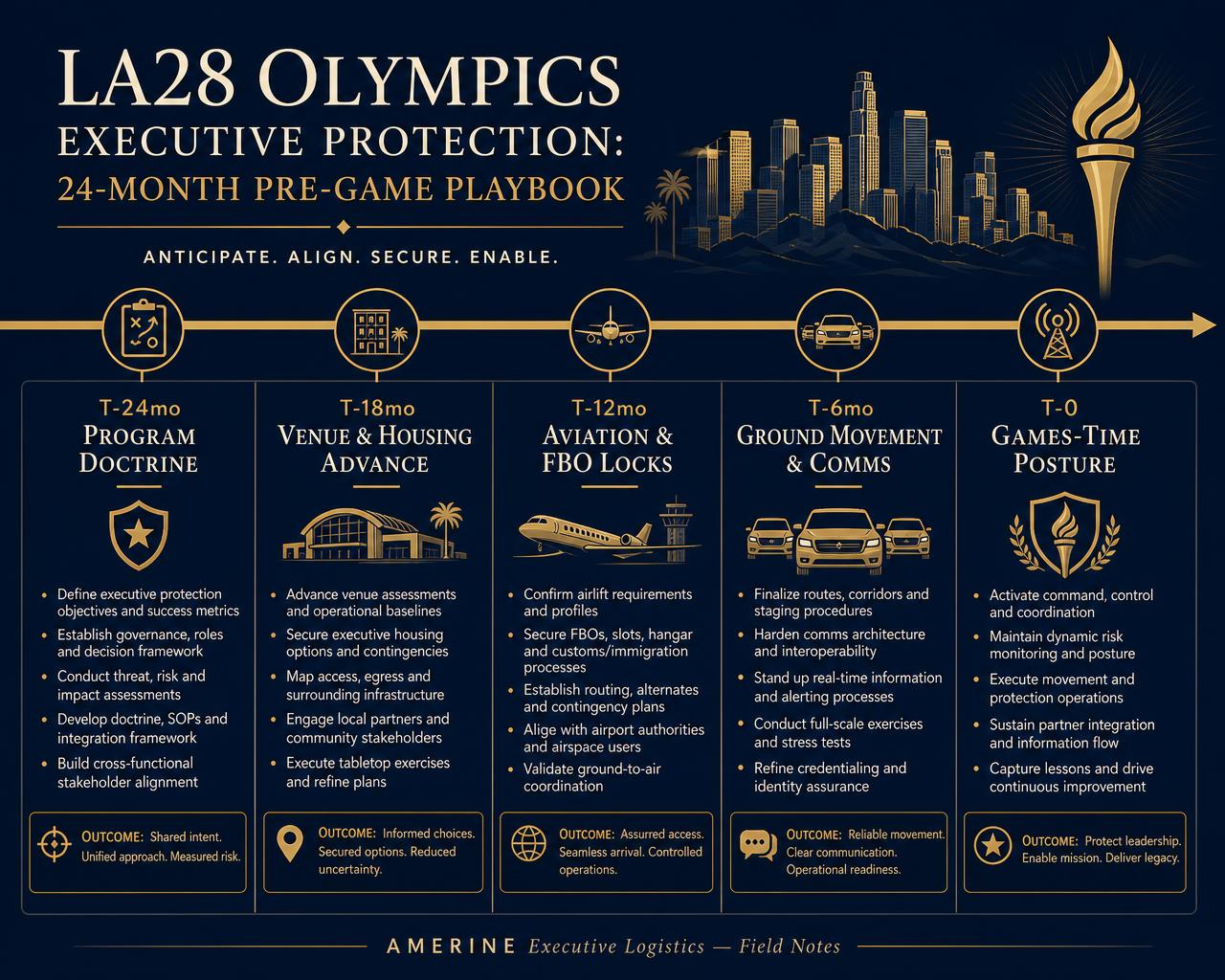
The playbook we are running with clients breaks into five phases anchored to the Opening Ceremony date. Each phase has a deliverable, an owner, and a decision that cannot slip.
Phase 1 — T-24 months (now through mid-2027): Program Doctrine
Deliverable: A written LA28 program doctrine covering objectives, principals, risk tolerance, governance, and decision authority.
Why it matters: Every downstream decision — housing, aviation, movement, credentialing, family policy, hospitality attendance — flows from doctrine. Programs that skip this and start with tactical choices spend 2027 relitigating basic questions.
What good looks like:
- A named executive sponsor at board or C-suite level
- A written principal list with attendance intent (which sessions, which hospitality events, family travel, ceremonies)
- A stated risk tolerance for public exposure, social-post latency, and hospitality-district movement
- An escalation and decision-authority chart that covers game-time
- A retained protective-intelligence function starting no later than Q1 2027
Phase 2 — T-18 months (mid-2027): Venue and Housing Advance
Deliverable: Locked housing, mapped venue access, and a completed physical advance for every planned attendance day.
Why it matters: Housing inventory is the first thing to disappear. Venue advance is what turns a general plan into an executable one. The advance-work discipline that separated winning programs at the World Cup is going to matter more, not less, at LA28.
What good looks like:
- Housing secured with defensible geography, not just proximity
- Physical advance completed at every venue on the attendance list — including egress points, medical routing, and secondary meeting locations
- Sponsor-lounge and hospitality-district geography documented — this is where the World Cup hospitality-district retrospective showed programs consistently get caught out
- A written residential-security posture for every principal residence and rental
Phase 3 — T-12 months (mid-2028): Aviation and FBO Locks
Deliverable: Confirmed slots, handling, and ground-side handoffs at primary and secondary FBOs.
Why it matters: See the World Cup FBO retrospective linked above. The lesson from Teterboro, Van Nuys, and Opa-locka during the World Cup is that the plan has to survive same-day slot changes and duty-time collisions. In the LA basin, with fewer secondary options, the pre-brief on alternates has to be more thorough, not less.
What good looks like:
- Slots and handling confirmed at both primary (VNY, LAX) and at least one secondary (BUR, ONT, LGB)
- Line-service walk-through completed at every FBO on the plan
- Ground-transport secure-lot arrangements confirmed at every FBO — not assumed
- Crew duty-time contingency built into every match-day and ceremony-day itinerary
Phase 4 — T-6 months (early 2028): Ground Movement and Comms
Deliverable: Locked ground-transport routes, communications architecture, credentialing, and tabletop exercises complete.
Why it matters: LA's traffic is the tournament's single most predictable operational stressor. Ground movement during the World Cup was, as we noted in the host-city debrief, the leading source of schedule friction — and Los Angeles compresses that geometry harder than any other U.S. host metro.
What good looks like:
- Primary and alternate routes documented for every venue-to-housing pairing
- A comms plan that survives cell congestion, including a fallback bearer (satellite, LMR, or push-to-talk over private LTE)
- Credentialing and identity assurance rehearsed — including the family-office scenario where a principal's spouse or adult child arrives independently
- Two full tabletop exercises complete, minimum, before T-90 days
Phase 5 — T-0 (Games-Time): Posture
Deliverable: Command, control, coordination, and dynamic risk monitoring active from arrival through departure.
Why it matters: By Games-time, the doctrine and the plan have to be executable by the team on the ground under real-time conditions. This is not the moment to build. It is the moment to run.
What good looks like:
- Active command post with real-time intelligence feed
- Dynamic risk monitoring on principal movements
- Continuous partner integration with local LE, venue security, and (where applicable) delegation security
- A daily after-action cadence — not a post-Games one — feeding into next-day operations
What carries forward from the World Cup
Three findings from the AMERINE World Cup after-action review carry directly into LA28 planning:
- Doctrine beats vendor selection. This is the single most portable lesson from the tournament, and it is the one that requires the most runway.
- The hospitality district is where exposure lives. Inside the hardened ring, the operation is disciplined. Two blocks out — hotel bars, restaurant rows, sponsor lounges — is where the majority of client-facing exposure actually happens. LA's hospitality geography (Beverly Hills, West Hollywood, Downtown LA, Santa Monica) will re-run the same pattern.
- The exit is the event. Egress from every session, every hospitality event, every ceremony is where the majority of avoidable incidents cluster. Advance work on egress is the single highest-leverage tactical investment.
For the fuller version of these findings, see the World Cup 2026 After-Action Report and the Mega-Event Security Playbook.
What a family office should be doing this quarter
If you are a family office with principals who will attend any part of LA28 — sponsor hospitality, competition sessions, ceremonies, related philanthropic events — the actions for Q3 and Q4 2026 are:
- Commit to a doctrine. Even a first draft is better than none. See the Family Office Security Strategy pillar for the framework.
- Inventory attendance intent. Which principals, which family members, which events, which nights.
- Begin housing conversations. Not decisions — conversations. Understanding the inventory landscape now positions you to lock the right option in 2027.
- Retain a protective-intelligence function. This does not require standing up a large team; it requires a written intelligence brief on a defined cadence starting no later than early 2027.
What a corporate security team should be doing this quarter
If you are running corporate security and your executives will attend LA28 — corporate hospitality, sponsor obligations, delegation-adjacent programming — the actions for Q3 and Q4 2026 are:
- Brief the board or audit committee on LA28 as a governance item, using the framing from Executive Protection as a Board-Level Governance Issue.
- Plan on a two-year runway. Programs built in the last six months deliver less than programs built over 24 months.
- Coordinate early with the aviation function. Slots, alternates, and duty-time contingency require flight-department involvement now.
- Formalize the [engagement process](/how-an-engagement-works) with your chosen provider — including scope, decision authority, and after-action cadence.
How AMERINE runs this with clients
Our LA28 client engagement runs on the five-phase timeline above, with quarterly formal reviews, monthly working sessions during Phase 1 and 2, and weekly cadence from T-12 months forward. Scott takes every first call personally.
The pre-game work is the work. Games-time is where the plan performs.
If you are building or auditing a protective program for LA28 — for a family office, a corporate C-suite, or a sponsor delegation — contact us to start with a confidential first conversation. Our executive protection services and protective intelligence work is built around exactly this doctrine.
Frequently Asked Questions
When should executive protection planning for the LA28 Olympics begin?
Doctrine and vendor selection should be locked no later than 24 months before the Opening Ceremony — meaning the second half of 2026 for principal-facing programs. Housing inventory, venue advances, and licensed in-basin operator capacity begin to compress inside 18 months, and by 12 months out the programs that have not committed to a partner are competing for what is left rather than choosing what fits.
Which Los Angeles venues and neighborhoods carry the highest principal-facing exposure during LA28?
The concentrated risk is in the hospitality and entertainment districts that sit two blocks off the hardened venue perimeters — Downtown LA around Crypto.com Arena and the Convention Center, Century City and Beverly Hills for sponsor hospitality, Santa Monica and Venice for after-hours movement, and the beach-cluster venues (Long Beach, Carson). Historically the hardened rings perform; the client-facing exposure lives in the soft outer ring, which is the doctrine we carried out of the World Cup 2026 hospitality-district retrospective.
How does private aviation planning change for LA28 compared to a normal Los Angeles trip?
The LA basin has fewer credible secondary FBO options than the Northeast corridor did during the World Cup, so primary FBOs at VNY, LAX, ONT, BUR, and LGB will run at or above ceiling during the 17 competition days. Slot reservations, ground-side hardstand access, and secondary-FBO handoff plans need to be locked before Q1 2028; treating LA28 as a normal LA trip is the single most common planning error we see. See the FBO surge retrospective for the underlying pattern.
Do family offices with no California presence need an LA28 protective program?
Yes, if any principal, adult child, or portfolio-company executive plans to attend even a single competition day, a sponsor event, or a Southern California hospitality week during the Games window. Ticketed access, hotel bookings, and social-media posts all create attributable presence; the exposure attaches to the principal, not to the office's zip code. A right-sized program can be as light as a single advance week plus games-time close protection, but it should be governed by written doctrine rather than assembled ad-hoc.
Is it better to hire a Los Angeles-based executive protection firm or a national firm for LA28?
The right answer is a firm that runs a national doctrine with vetted in-basin operator depth. Pure-local firms often lack the program governance that boards and family offices need; pure-national firms without licensed Southern California operators end up subcontracting the actual close-protection work at the worst possible moment. AMERINE's model is a national planning and program layer coupled with a vetted Los Angeles operator bench, which is the posture we ran successfully across the 11 World Cup 2026 host cities.
Related reading
- World Cup 2026 After-Action Report — the operational record we are carrying into LA28
- Mega-Event Security Playbook — the evergreen framework
- World Cup 2026 Host-City Debrief
- World Cup 2026 Hospitality-District Retrospective
- World Cup 2026 FBO Surge Retrospective
- Family Office Security Strategy
- How an Engagement Works
AMERINE Executive Logistics is licensed by the Texas Department of Public Safety, License No. C31012001.
