A Federal Task Force Says the Quiet Part Out Loud
On the eve of kickoff, ESPN published an interview with Andrew Giuliani, executive director of the White House FIFA World Cup 2026 Task Force, in which he described the tournament's security demands in a single word: unprecedented.
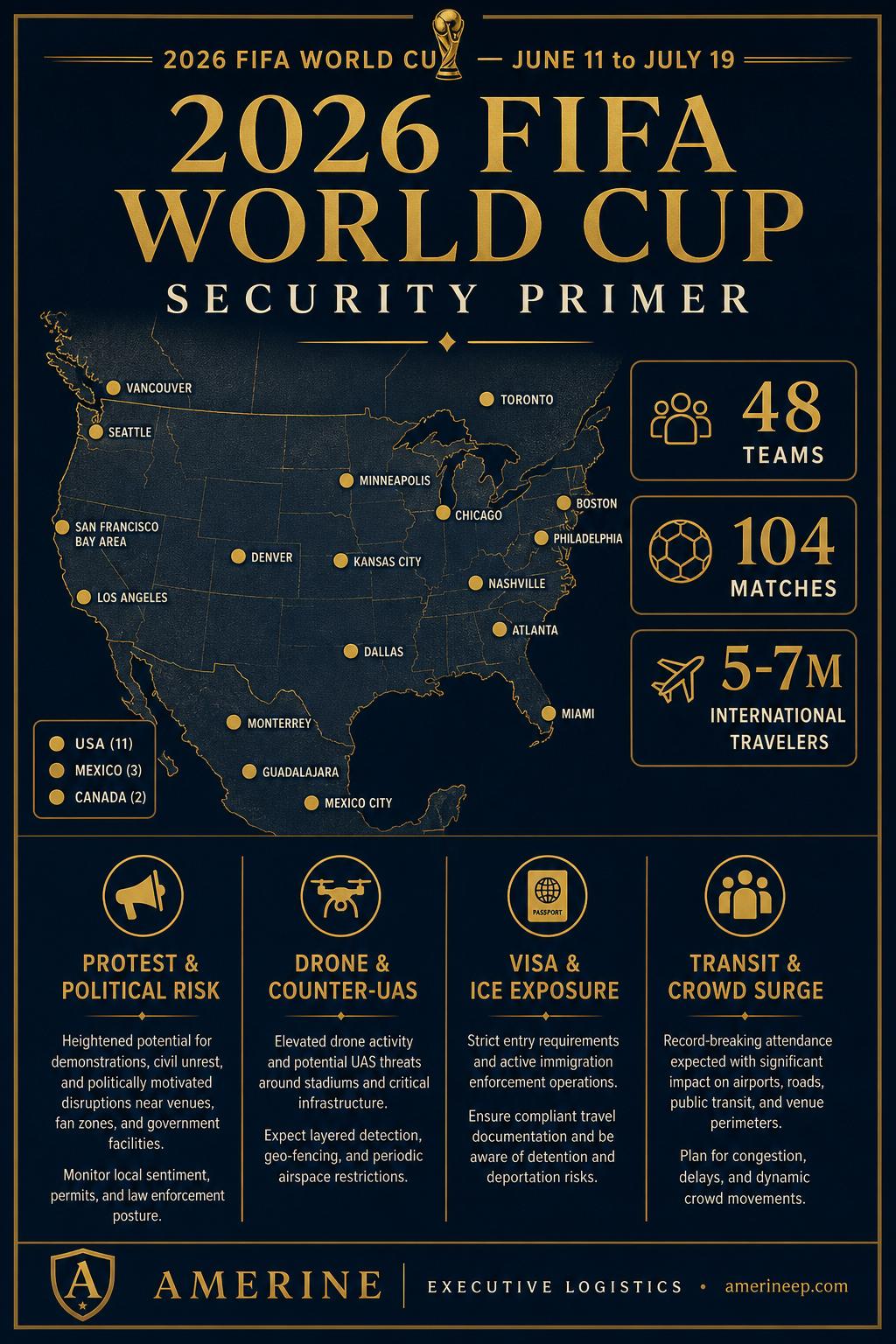
The numbers explain why. More than 400 law enforcement agencies are coordinating with federal authorities and private security firms to protect 48 teams, 78 U.S. matches, 11 U.S. host cities, and 39 days of competition — with another 26 matches across Canada and Mexico. Qatar 2022 hosted 32 teams in a country smaller than Connecticut. The 2026 tournament is an order of magnitude larger and geographically dispersed across an entire continent.
For executives, UHNW families, and corporate delegations traveling to matches, that scale changes the planning calculus. Below is how AMERINE reads the ESPN reporting and the operational adjustments we are making with clients in the final weeks before the opener.
What ESPN Confirmed That Changes Planning
Four points from the reporting deserve the closest attention from anyone traveling to a host city.
1. The federal government cannot blanket the event. Giuliani told ESPN that, unlike a presidential inauguration or even the Olympics, the federal government does not have the resources to take over. Coordination is being shared with state and local agencies. Translation for travelers: the protective umbrella is real, but it is woven, not solid. Gaps exist between jurisdictions, and the burden of executive-level protection falls on private planning.
2. Soft targets are the primary concern. FBI deputy director Christopher Raia told ESPN he is most worried about homegrown extremists striking soft targets — hotels, team base camps, restaurants, fan festivals, block parties. He specifically referenced the 2025 Bourbon Street truck attack. Stadiums will likely be the safest places on match day. The risk concentrates in the hours before and after the whistle.
3. Drone threats are the operational nightmare. DHS has awarded host cities more than $250 million for counter-drone technology, and the FBI has trained officers from 30 jurisdictions on drone mitigation at Redstone Arsenal. French officials logged more than 400 unauthorized drone incursions during the 2024 Paris Olympics. "The thing that keeps us all up at night," the FBI's Devin Kowalski told ESPN, "is an unauthorized drone with a payload that could hurt people."
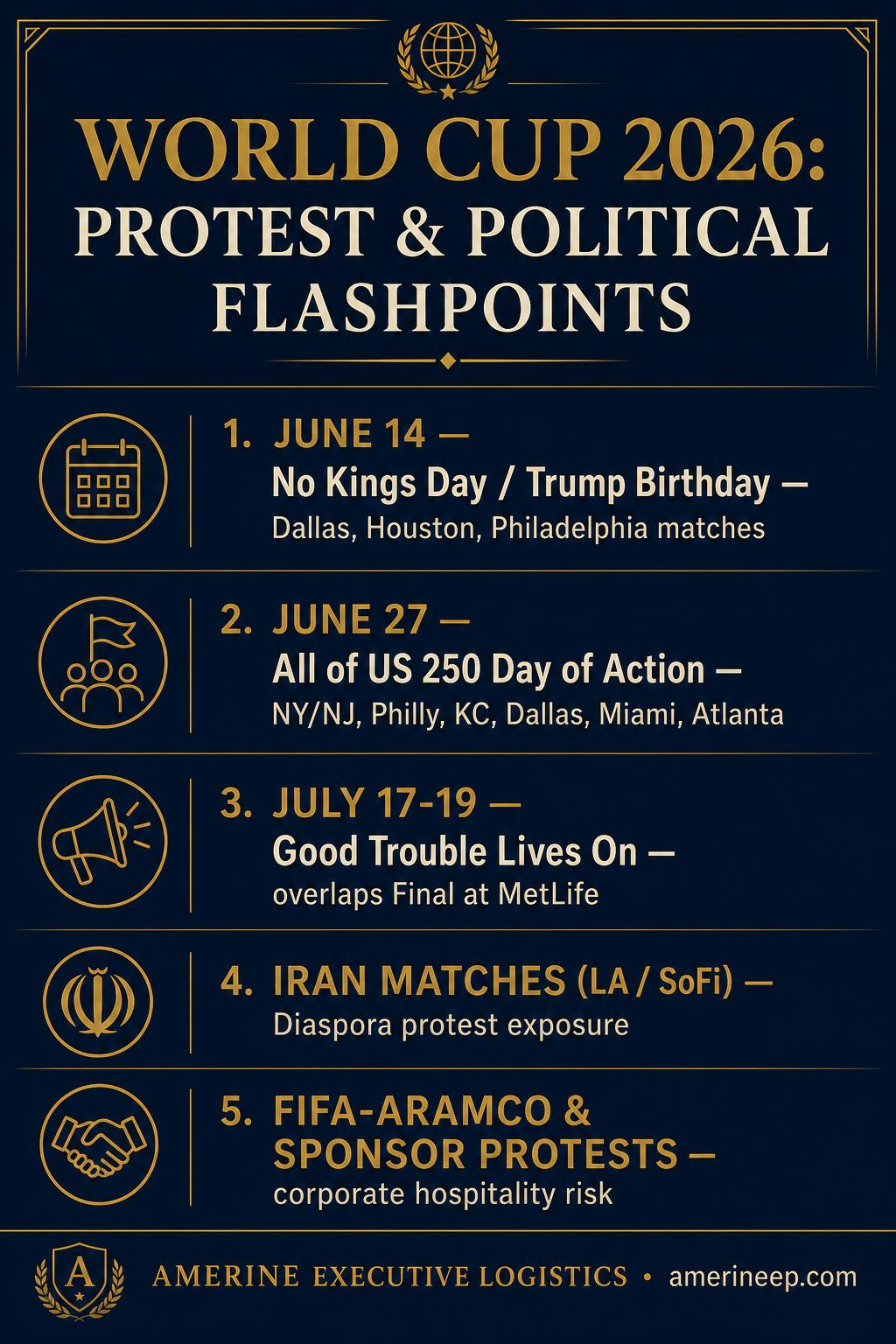
4. Cyber and disruption attacks are expected. Giuliani told ESPN to expect ticket hacks, malicious QR codes, attacks on stadium Jumbotrons, and pressure on transportation systems. A joint federal advisory in April flagged an ongoing Iranian-affiliated cyber threat to critical infrastructure. For traveling executives, this means assume your phone, your tickets, and the public Wi-Fi around any venue are contested terrain.
The "Secondary City" Problem
The most important line in the ESPN piece, for our client base, came from John Cohen of the Center for Internet Security: he is more concerned about secondary locations — the smaller and midsized jurisdictions where teams and fans will base camp, train, and stay — than about the 11 host cities themselves.
This matches what AMERINE has been telling corporate clients for months. The Dallas-Fort Worth metroplex is hardened. So are MetLife, SoFi, and the other primary venues. But the boutique hotel in a suburb forty minutes from the stadium, the steakhouse the sponsor delegation booked for a Wednesday dinner, the watch party in a private residence — these are softer environments, with thinner local resources, and that is where private protective planning earns its keep.
What This Changes for Executive Travelers
Reading the ESPN reporting through the lens of an active protective program, four planning shifts are warranted.
Treat the hotel as a public space, not a refuge. With 400+ agencies focused on stadium perimeters, hotels become the path of least resistance. Pre-arrange lobby bypass, confirm elevator-bank discipline with the security director on property, and never rely on the front desk for room confirmation. Our team's full hotel doctrine is laid out in Hotel Security During the 2026 World Cup.
Compress the match-day footprint. Pre-match dinners three hours before kickoff in unrelated neighborhoods are an unforced exposure. Co-locate the meal, the pre-brief, and the transit window. The fewer distinct soft targets in a day, the fewer planning failures can compound.
Plan for the egress, not the entrance. FIFA's new "last mile" stadium perimeter — fenced parking lots, ticket-required entry zones — will make ingress orderly. Egress is where the 2024 Copa America final in Miami broke down, and where crowd-crush risk concentrates. Our crowd crush and stadium egress safety playbook walks through the specific decisions that matter in the first ninety seconds after final whistle.
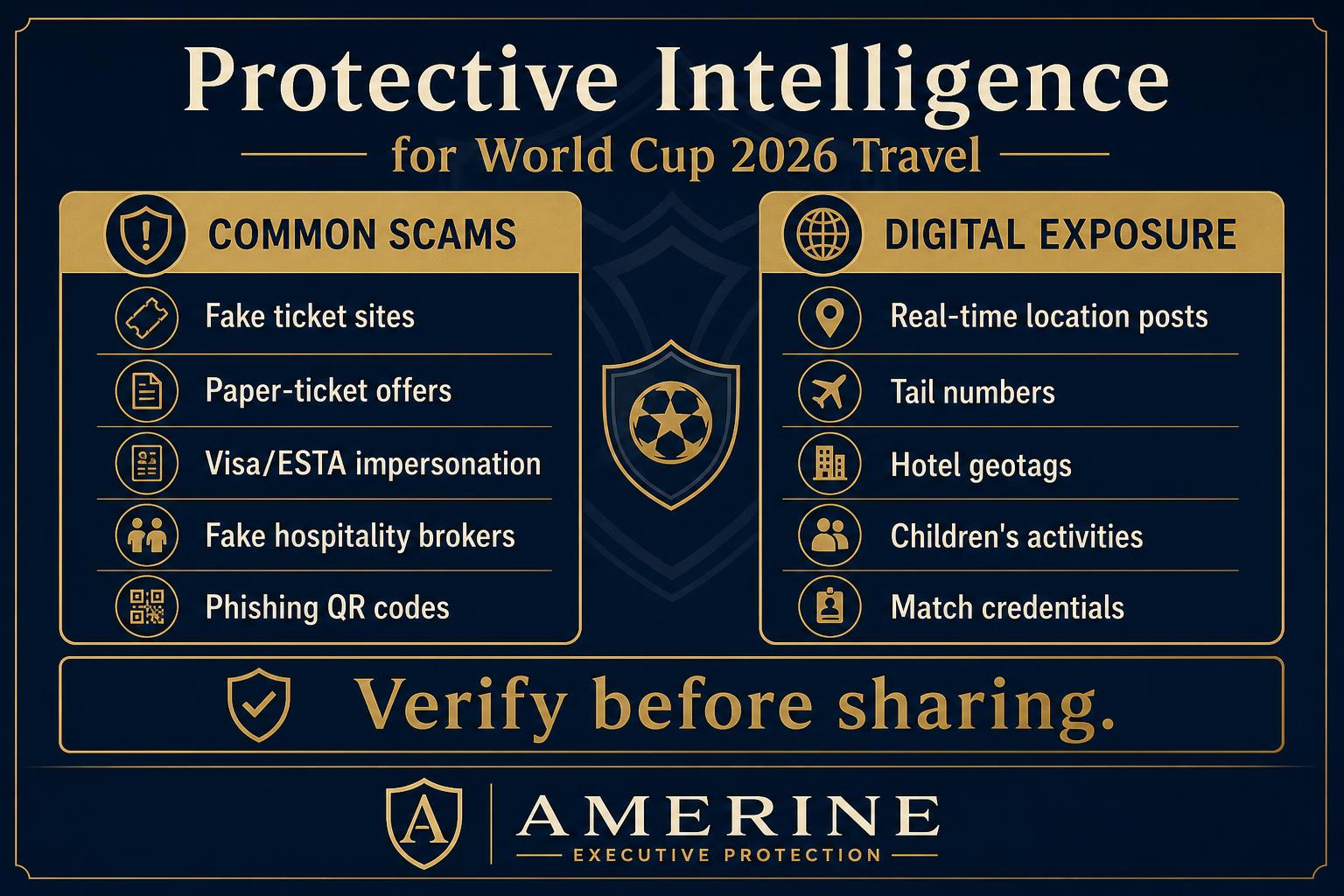
Harden digital travel hygiene before wheels-up. Assume the ticket-app phishing wave is already underway. Travelers should verify every transfer through the official FIFA app, treat any QR code presented outside the venue as hostile until proven otherwise, and use a clean travel device for tournament-related accounts. The fuller protocol is in cyber & digital hygiene for travelers.
Where Private Protection Fits Inside a "Whole-of-Government" Posture
It is tempting, reading the ESPN reporting, to conclude that with 400+ agencies and $625 million in federal grants the private sector has been displaced. The opposite is true.
The federal-state-local coordination is built around public safety at scale — keeping the tournament running, preventing mass-casualty events, responding to incidents. That is necessary work, and the people doing it are world-class. But it is not the same as protecting a named principal at a named hotel, riding in a named vehicle, sitting in a named suite, with a named accountable protector who has rehearsed the route.
Private executive protection fills the space between a city-wide security posture and a single family's calendar. It is the layer that knows which side of the venue your driver should stage on, which back-of-house corridor the property manager will allow you to use, and which alternate hospital is closest to the suite on the night of the match.
The ESPN piece is, in our reading, the clearest public articulation yet that the public-safety apparatus is leaning forward — and also that it cannot be everywhere. That is the gap private protection has always filled. This tournament makes the case unusually clear.
AMERINE's Role
AMERINE is supporting executives, UHNW families, family offices, and corporate delegations across all eleven U.S. host regions for the 2026 World Cup. Our services span executive protection, secure transportation, event and hospitality security, and protective intelligence. We continue to take a limited number of June and July engagements.
If you are still finalizing protective coverage for a match window, a delegation visit, or a family trip, contact us. Scott takes every first call personally.
---
This article summarizes and analyzes reporting by Tisha Thompson published by ESPN. It is general security-planning commentary, not legal, law-enforcement, or operational advice for any specific event. Travelers should verify all current security guidance through official FIFA, U.S. government, and host-city sources.